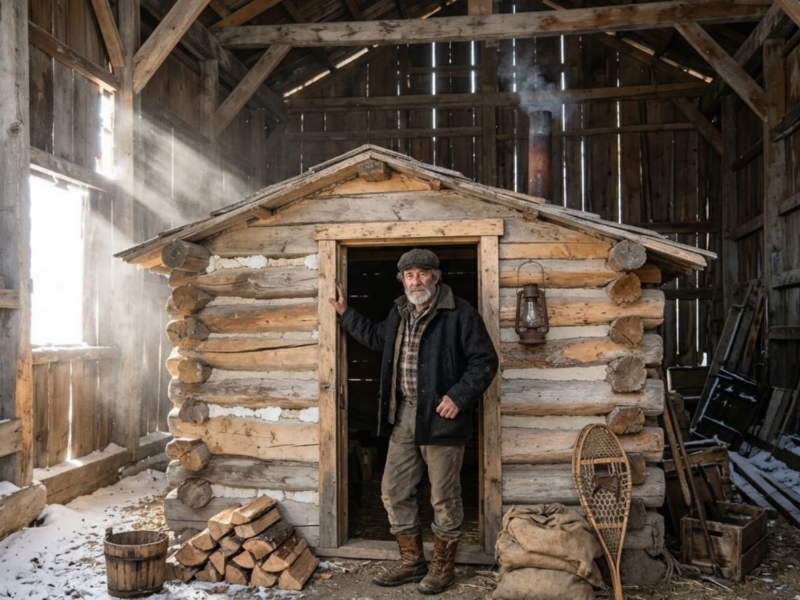
Neighbors Laughed When He Built A Cabin Inside An Old Barn—Until It Kept His Home 35 Degrees Warmer
The Lessons of the Steppe
Carl Peterson had arrived in North Central Montana three months earlier with a wagon full of well-oiled hand tools, a head full of ancestral memories, and enough cash to last exactly one winter if every penny was rationed like flour during a siege.
The glowing advertisements published by the Great Northern Railway had promised mild Chinook winds, fertile soil, and effortless farming—a pastoral paradise waiting for the plucky settler. But Carl was a German-Russian whose family had spent generations learning to read the deceit of politicians and salesmen. You did not trust a climate that offered something for nothing.
He had grown up in a hausbarn on the Russian steppe near the Black Sea—a massive, combined dwelling where human quarters, storage lofts, and animal stalls shared a single, fortress-like roof. His grandmother, Anna Schmidt, had been the matriarch of that wind-lashed compound. When Carl was twelve years old, a six-day blizzard had buried their settlement so completely that the family had to tunnel out through the kitchen window.
During that confinement, Anna had walked him through the drafty corridors of the housebarn, pointing out the mechanics of their survival. She showed him the double-layered walls packed tight with chopped straw and sun-dried clay; she made him feel how the heat from the livestock stalls rose through the timber framework to temper the air in the family loft above.
“You never fight the wind head-on, Carl,” she had told him in German, her hands rough and warm as they gripped his small shoulders. “You make the wind fight something else first. You build your warm place behind a shield.”
Now, two thousand miles west of the Black Sea, Carl recognized the exact same topographical violence in the Montana prairie. The rolling, treeless expanse offered no natural breaks, no wind-breaks, no forgiveness.
When he filed his homestead claim in May 1917, he hadn’t just looked at the patch of dirt; he had looked at the unexpected windfall left behind by a bankrupt cattle syndicate: a forty-by-seventy-foot timber frame barn.
Most homesteaders would have seen an old shed to store a plow or stable a mule. Carl saw an outer hull. The building was battered, its vertical pine boards warped by five years of prairie sun and snow, and its peg joints groaned in the autumn gales. But the bones—hand-hewn pine posts and massive tie beams—were as solid as a cathedral.
In August, while his neighbors raced against the calendar to throw up flimsy board-and-batten shacks, Carl hauled his lumber and measured his sanctuary.









