Neighbors Laughed When He Built A Cabin Inside An Old Barn—Until It Kept His Home 35 Degrees Warmer
The Blue Barometer
December 1917 settled over the Highline like a sheet of lead.
Old-timers in town began speaking in hushed tones about barometric readings that hadn’t been seen since the legendary “die-up” winter twenty years prior. Livestock grew restless, bunching tightly in the lee of cut banks and refusing to graze even when hay was scattered. The quality of the light on the northern horizon changed from a clear, cold blue to an ominous, bruise-purple haze.
Inside the McKay household, the war against the cold was becoming desperate. Eliza McKay spent her days huddled near their glowing iron stove, wrapped in three wool blankets, while her fingers cracked and bled from the dry, sub-zero air. Their water bucket, placed three feet from the stove, formed a thick crust of ice every single night.
To keep the shack habitable, Thomas McKay was forced to forage further and further afield, tearing down old fence lines and burning green willow branches that hissed, smoked, and coated the interior walls in a greasy layer of black creosote.
Across the county, standard claim shacks were revealing their fatal structural flaw. They presented their thin, single-wall surfaces directly to the prairie’s wrath. Convective heat loss—the relentless stripping of warmth by moving air passing over exterior walls—drained heat faster than any stove could generate it.
Carl’s setup, however, operated on an entirely different plane of physics.
His morning ledger entries showed a remarkable thermal stability:
Dec 22: Outside -32°F. Barn interior -10°F. Cabin interior 50°F. Wood burned: 2 armloads.
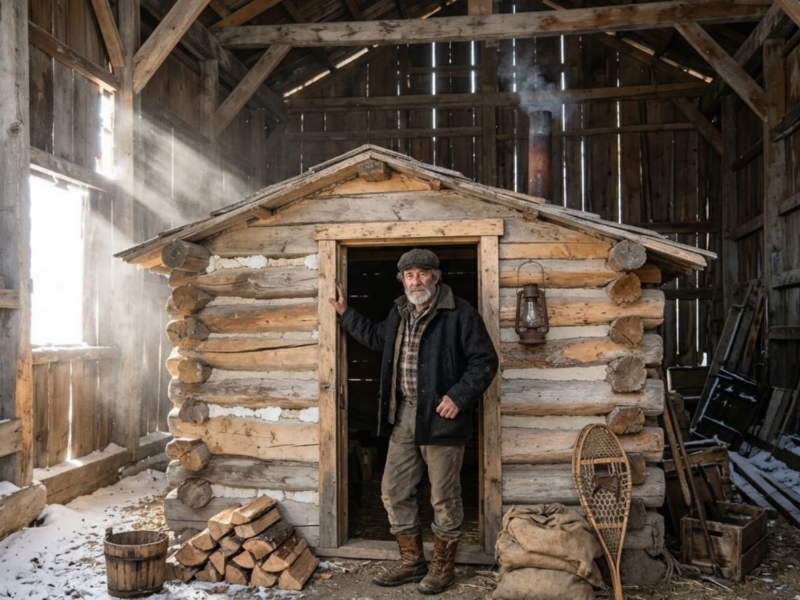
The barn shell was doing exactly what Anna Schmidt’s housebarn had done decades ago: it was taking the punch. The prairie winds slammed against the massive forty-foot-by-seventy-foot timber frame, losing their momentum against the thick, weathered siding. By the time the air reached the inner cabin walls, its freezing edge had been blunted.
James Halverson made one final inspection visit just before Christmas, bringing two other ranchers who wanted to see the contraption before the deep freeze set in for good. They stepped through the heavy barn doors into a dim, quiet interior where the wind was nothing more than a faint, whistling sigh overhead. Then Carl opened the cabin door, and a wave of welcoming, wood-scented warmth washed over them.
Halverson stood in the center of the cabin, removing his heavy mittens. He looked around at the dry, frost-free walls, the clean floor, and the sleeping children tucked safely into a bunk built against the inner partition. He was a proud man, slow to admit error, but the evidence was irrefutable.
“It’s warm,” Halverson admitted, his voice dropping an octave. “I’ll be damned if it ain’t warmer in here than it is in my ranch house kitchen.”
“It’s not magic, Mr. Halverson,” Carl said, offering him a tin cup of hot chicory coffee. “It’s just arithmetic. You don’t heat the prairie. You build a coat for your house, and then you put a house inside the coat.”