Neighbors Laughed When He Built A Cabin Inside An Old Barn—Until It Kept His Home 35 Degrees Warmer
The Skeptics of Montana
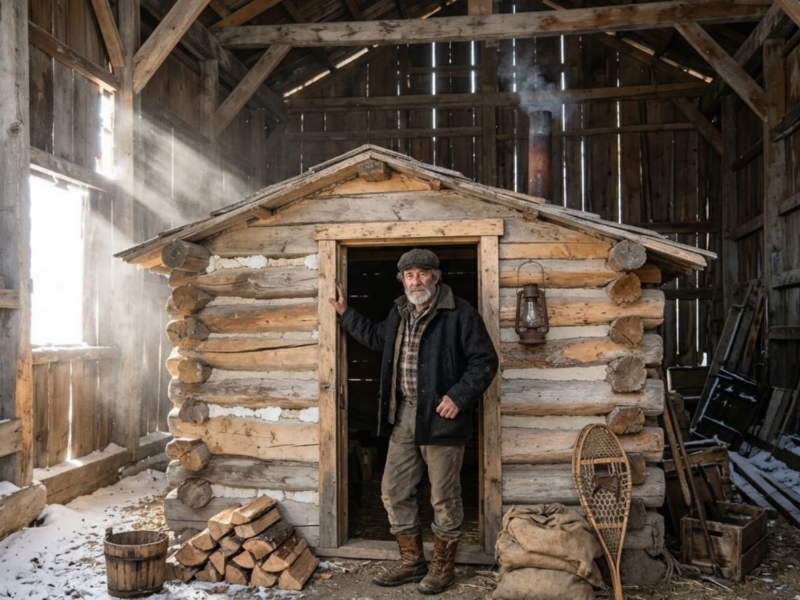
The construction of the interior cabin was a masterclass in deliberate, old-world stubbornness.
First came the foundation: short stone piers rising eighteen inches off the barn’s packed dirt floor, supporting a heavy framework of salvaged floor joists. Beneath this wooden platform, Carl stuffed every available cubic inch with loose straw and dry sawdust—primitive insulation materials that cost nothing but sweat. He remembered how his grandmother had packed similar organic stuffing between the double skins of their steppe dwelling, creating a dead-air floor that kept the frost from creeping up through the soles of their boots.
By September, the log work was underway. Each pine log, measuring six to eight inches in diameter, was sourced from a stand of lodgepole pine he had purchased from a down-on-his-luck homesteader twenty miles south. Carl notched each piece with the patient precision of a cabinetmaker, fitting them so tightly that daylight could not find a seam.
The chinking was a complex ritual: thin wood splinters driven into every gap, followed by a heavy packing of dry moss, chopped straw, and a lime-sand mortar recipe he had memorized from watching German-Russian masons build church foundations in Kansas.
The roof was engineered to defy geometry. Using salvaged two-by-six rafters, he framed a low, heavy gable that sat a full eight feet below the barn’s massive roof rafters. This created a cavernous attic airspace above his cabin—a thermal buffer that ensured heavy winter snow loads pressing down on the outer barn roof would never touch the living quarters below.
Local opinion hardened from amusement into active hostility as the weeks wore on.
James Halverson brought his ranch hands by twice a week just to shake their heads at the growing anomaly. “He’s wasting good timber on a nesting box,” Halverson told the men gathered around the general store porch in October. “A man’s got no business building a house inside a shed. It’s un-American. Looks like a squirrel hiding in a church.”
Thomas McKay was even more vocal. McKay’s own claim shack, completed in late September, represented standard American frontier pragmatism: single-wall pine boards, black tar paper tacked down with lath strips, and a cheap iron box stove that roared like a blast furnace whenever it was fed.
“Let the German tinker with his dollhouse,” McKay scoffed to his wife, Eliza, as they watched smoke curling lazily from a metal pipe protruding incongruously from the side of the massive barn. “When the first real freeze hits, that barn will act like a giant ice-chest. He’ll be burning his own bedposts by Christmas.”
Carl ignored them. He finished the chinking, hung a heavy, double-insulated wooden door he had crafted himself, and moved his family inside just as the first dusting of November snow whitened the highline.









