Neighbors Laughed When He Built A Cabin Inside An Old Barn—Until It Kept His Home 35 Degrees Warmer
The Physics of Still Air
Inside the completed cabin, Carl established a rigid domestic and atmospheric routine.
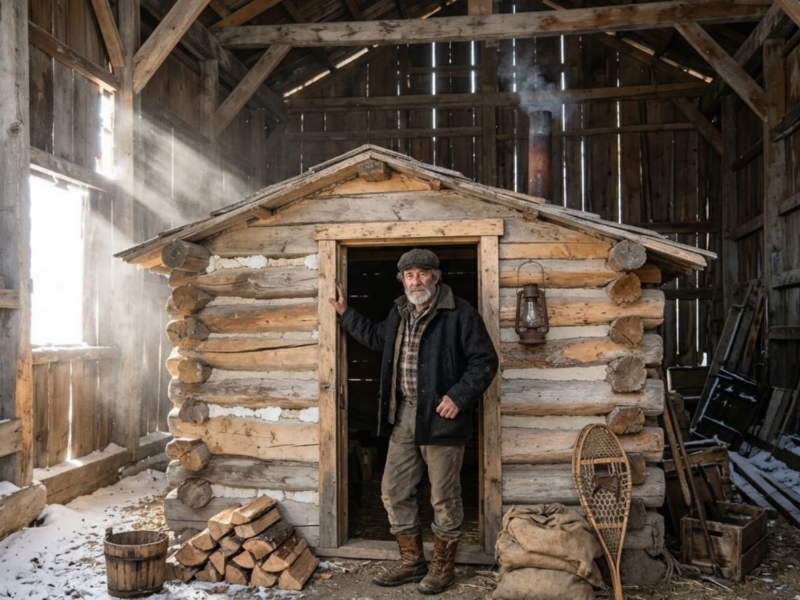
The heart of the dwelling was a medium-sized cast-iron box stove, placed strategically near the center of the twenty-five-by-fourteen-foot room. Its output was modest—roughly 30,000 BTUs per hour—but because the cabin’s interior envelope was nearly airtight, that modest heat had nowhere to escape.
The ventilation system was deceptively simple yet brilliantly counter-intuitive. High up in the barn’s gables, Carl had deliberately left wide gaps in the weathered siding. The neighbors thought he had simply been too lazy to finish the repairs, but Carl knew better. Those gaps allowed the outer barn shell to “breathe,” venting moisture and preventing the dangerous accumulation of condensation that would otherwise rot the timber frame.
However, in the eight-foot gap between the barn’s interior walls and the cabin’s exterior logs, the air remained entirely still.
This was the secret weapon. Trapped, motionless air is one of nature’s most effective thermal insulators. While the outer shell of the barn absorbed the kinetic energy of the prairie winds—breaking a forty-mile-per-hour gale down into gentle, harmless eddies—the dead air pocket surrounding the cabin created a thermal barrier. Heat trying to escape from the cabin’s log walls hit this blanket of stationary air and stalled, unable to conduct outward into the freezing void of the barn.
By late November, Carl began keeping a meticulous logbook, recording temperatures with a brass-rimmed thermometer he had brought from Russia.
Nov 24: Outside -20°F. Barn interior -2°F. Cabin interior 55°F. Wood burned: 2 armloads.
The contrast with his neighbors was already staggering. While Thomas McKay was burning three to four armloads of green cottonwood a day just to keep his claim shack at a miserable, frost-rimed forty degrees, Carl was achieving superior comfort with half the fuel expenditure.
Neils Anderson, a Norwegian carpenter with a grudging respect for good joinery, visited the site in early December to inspect the stove pipe arrangement. The pipe ran straight up through the cabin roof, transitioned into a larger-diameter metal sleeve where it crossed the cavernous barn attic, and finally exited through the barn’s apex with proper clearance from all combustible timbers.
“I’ll give you this, Peterson,” Anderson muttered, running a calloused hand along the clean flashing. “It’s not a fire trap. But you’re still heating two separate worlds. It defies common sense.”
“Common sense,” Carl replied quietly, stoking the stove with a single dry pine chunk, “is usually just what people do because they are too lazy to remember how their grandfathers survived.”