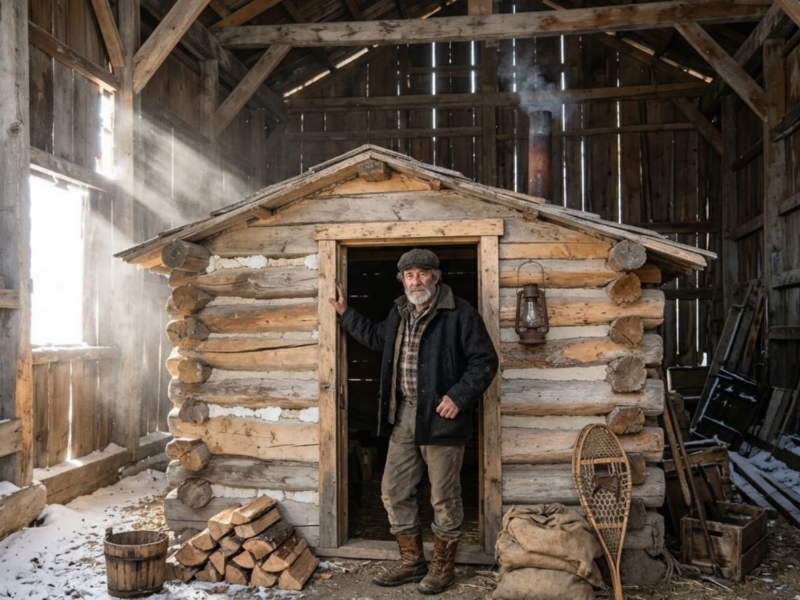
Neighbors Laughed When He Built A Cabin Inside An Old Barn—Until It Kept His Home 35 Degrees Warmer
The Ten-Day Siege
The storm that defined the winter of 1917 arrived on January 15th without the courtesy of a gradual descent.
The barometric pressure bottomed out overnight. By dawn, the wind was screaming across the frozen ground at fifty miles per hour, carrying a blinding sheet of dry, powdery snow that reduced visibility to zero. Within six hours, the temperature plummeted from a manageable ten below zero to an unbreathable thirty-five below.
Thomas McKay realized his family was in mortal peril by noon.
The wind had torn away a strip of tar paper from the north wall of his claim shack, opening a jagged seam where horizontal snow was jetting into the room like white shrapnel. Despite his stove glowing a terrifying, cherry-red, the interior thermometer had dropped to twenty-eight degrees. Water was freezing in the tea kettle while it sat on the iron top.
Eliza gathered their two young children, wrapped them in every blanket and quilt they possessed, and began to cry—not with anger, but with the quiet, terrifying acceptance of people who knew they were freezing to death.
Across the Highline, the story was repeated in variations of tragedy. The Anderson cabin developed a thick coat of interior frost that marched inward from the corners. The Halverson ranch bunkhouse grew so cold the hired men abandoned it to crowd into the main ranch kitchen, taking turns feeding the wood stove with furniture legs.
But inside Carl’s barn, the ten-day siege played out like a masterclass in ancient engineering.
The massive timber frame absorbed the initial kinetic fury of the storm. Snow drifted eight feet deep against the barn’s windward wall, creating an enormous, insulating snow-mantle that further stabilized the interior microclimate. In the eight-foot buffer zone, the air remained still and dead, holding back the arctic cold with invisible hands.
Inside the inner cabin, Carl maintained a steady forty-one degrees. It was cool by modern standards, but it was entirely survivable. No pipes burst; no frost formed on the interior logs; no one had to burn their own furniture to stay alive.
On the third day of the storm, a frantic pounding shook the heavy exterior doors of Carl’s barn.
Carl dropped his wood-carving knife, pulled on his heavy wool coat, and hurried out into the dim interior. He heaved open the heavy timber door just enough to clear the drift.
It was Thomas McKay. He was staggering through the snow, carrying his youngest child bundled in a horse blanket, while Eliza stumbled behind him, her face caked in ice, her lips blue and swollen. Their claim shack had given up the ghost during the night when the roof seams split under the wind load.
“Carl,” McKay gasped, his voice breaking as the freezing air rushed into the barn. “God help us… we can’t stay out there another hour.”
Carl didn’t lecture. He didn’t gloat over the man who had called his home a fool’s hotel three months earlier. He simply grabbed Eliza by the arm, hauled them through the barn’s airlock doors, and led them across the threshold into the brilliant, life-saving warmth of the inner cabin.









