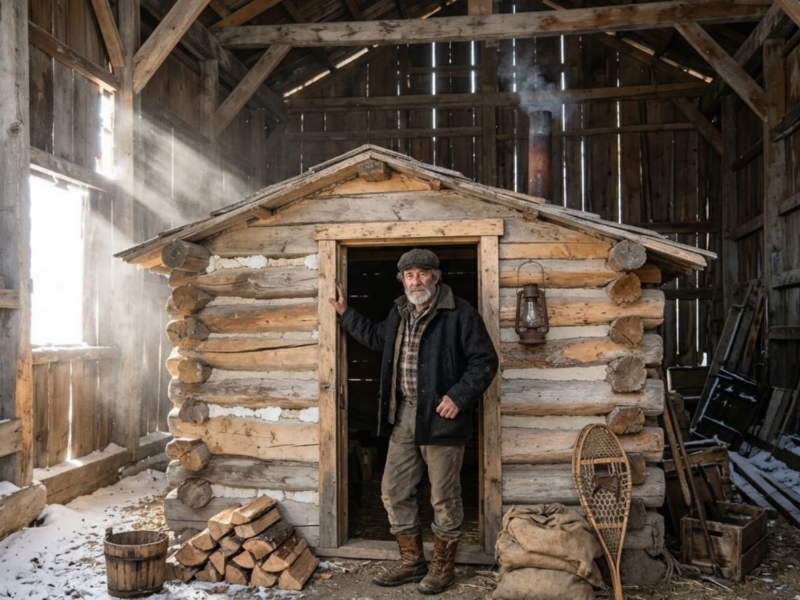
Neighbors Laughed When He Built A Cabin Inside An Old Barn—Until It Kept His Home 35 Degrees Warmer
The Evolution of the Frontier
By the spring of 1918, the landscape of Chouteau County was changing in ways the Great Northern Railway’s advertising agents had never anticipated.
Neils Anderson was the first to adapt the concept, constructing a tight, insulated frame cottage inside his failing granery, packing the cavity with clean wheat straw and adding controlled gable vents based on Carl’s design. Within a year, three other homesteaders had built variations of the “barn-within-a-house” architecture, utilizing abandoned storehouses, oversized machinery sheds, and makeshift lean-tos to create thermal buffer zones around their living quarters.
The Territorial Agricultural Extension Service, alerted by county school teacher Margaret Lewis—who had visited Carl’s property in April to document the structural dimensions for historical archives—sent an inspector out in the summer of 1918.
The inspector spent three hours crawling through Carl’s attic, measuring the ventilation gaps, checking the stove pipe clearances, and interviewing the families who had survived the ten-day siege. The resulting report was published in the Montana Farmer-Stockman under the title: The German-Russian Method: Thermal Efficiency in Highline Construction.
The article noted that while conventional building standards focused purely on minimum material costs, Carl Peterson’s hybrid architecture achieved a forty-percent reduction in fuel consumption and a completely failure-proof thermal envelope by applying ancient principles of wind-breaking and dead-air insulation.
Carl never became a wealthy man. He farmed his quarter section, raised three children who grew up knowing the precise value of a well-fitted dovetail joint, and lived to see the Highline settle into a more sustainable, cautious relationship with the Montana winters.
He rarely spoke about the days when the town laughed at his double roof. When new settlers arrived on the afternoon train, blinking in confusion at the strange, massive barn with a residential chimney sticking out of its spine, Carl would simply walk over, tip his hat, and offer them a cup of coffee by the stove.
And if anyone asked him the secret to surviving the Highline, he would take them outside, point to the vast, empty prairie where the wind never truly stopped hunting, and give them the only advice that mattered.
“Never fight the wind directly,” he would say, tapping the thick pine logs of his inner wall. “Make the wind fight something else first. Then build your home behind the silence.”









