Neighbors Laughed When He Built A Cabin Inside An Old Barn—Until It Kept His Home 35 Degrees Warmer
The Doorway in the Snow
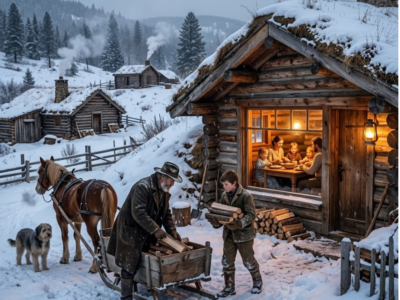
Over the next forty-eight hours, two more families found their way to the barn fortress, guided along the buried fence lines by sheer instinct and the faint, steady plume of smoke rising from the apex of the big timber barn.
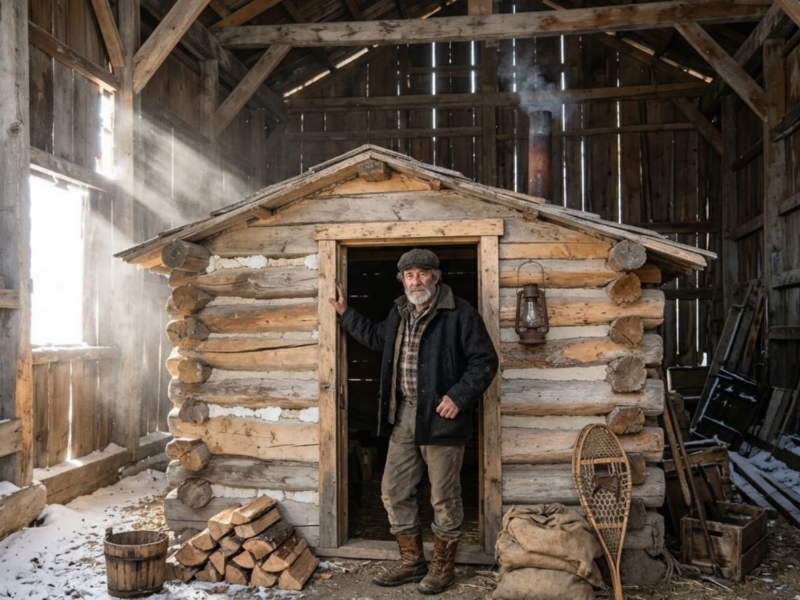
The inner cabin accommodated Carl’s family and the McKays, while the cavernous loft of the barn—hastily draped with spare canvas and lined with thick wool blankets—became a communal shelter for the overflow refugees. Twelve people lived within that double-walled sanctuary while the storm raged outside at forty-five below zero.
They shared salt pork, boiled potatoes, and dried apples by the light of a single kerosene lamp. The children played quiet games on the warm wooden floor, their breath no longer visible as a ghostly mist.
James Halverson arrived on the sixth day of the storm on horseback, wrapped in a buffalo robe, having ridden over from his ranch to check on the district. When he stepped through the inner cabin door and saw men, women, and children sitting comfortably without heavy coats, talking in normal tones, the last vestiges of his frontier skepticism evaporated completely.
“Carl,” Halverson said quietly, removing his frost-rimed cap. “You saved these people’s lives.”
“The barn saved them,” Carl corrected him, leaning against the warm whitewashed wood of his stove. “I just didn’t get in its way.”
When the storm finally broke on January 25th, the sun rose over a landscape utterly transformed. Drifts reached the eaves of the farmhouses; entire claim shacks lay partially crushed or hopelessly buried beneath hard-packed snow waves. McKay’s shack was a total loss, its roof caved in under the weight of the wind-driven drifts.
Yet Carl’s barn stood proud and unscathed, looking like a weather-beaten ship riding out a gale at anchor.
When the refugees emerged into the blinding glare of the January sun to assess the wreckage of their homesteads, the mood was entirely devoid of mockery. The conversation had shifted permanently from ridicule to desperate, respectful inquiry.
The local men gathered around Carl in the snow, notebooks in hand—or in McKay’s case, a charred piece of wood and a flat shingle.
“That airspace,” James Halverson asked, leaning heavily on his riding crop, his eyes scanning the gap between the barn siding and the cabin logs. “How did you know to make it eight feet instead of four? If it’s too narrow, it doesn’t insulate. If it’s too wide, the air circulates. How did you calculate it?”
Carl smiled faintly, remembering his grandmother standing in the dark, straw-stuffed corridors of the Russian housebarn while the snow hissed against the thatch.
“I didn’t calculate it with numbers, Mr. Halverson,” Carl said, looking out across the endless, glittering white expanse of the Montana prairie. “I calculated it with survival. You just have to listen to what the wind is trying to tell you before it breaks your door down.”