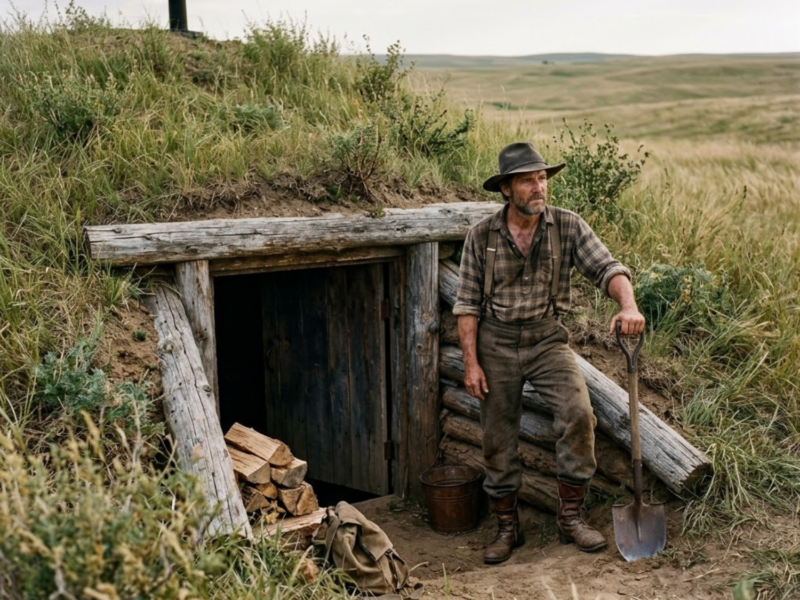
Neighbors Laughed When He Built an Underground “Grave” And Not a Cabin—Until It Kept Him 25°F Warmer
The Blueprint of the Earth
The pride of the township was shattered, replaced by a desperate, urgent need for knowledge.
John McCutchen was the first to return to the dugout. He did not come to mock. He came with a piece of charcoal and a roll of brown butcher paper.
He sat at Lars’s table, swallowing his immense pride. “Show me,” John said, his voice raw. “Show me how to build it so my family doesn’t die next year.”
Lars obliged. With the meticulous precision of a master craftsman, he began to sketch. He drew the twelve-by-sixteen excavation. He detailed the wall benching, the exact slope of the drainage swales, the depth of the French drain. He explained the critical importance of peeling the cottonwood to prevent rot, and the exact mixture of clay and straw needed for the airtight chinking.
He wrote down the load calculations for the roof, emphasizing that a dry sod roof weighed forty pounds, but a wet one could crush a house if the poles were not at least seven inches thick and spaced eighteen inches on center. He explained the overlapping geometry of the sod blocks, grass-side down, the roots serving as nature’s mortar.
Word spread. Jacob Kreger came next, realizing that earth-sheltered construction was the salvation of the poor. He didn’t need expensive dimension lumber, or nails, or tar paper. He only needed his own labor, local stone, creek-bottom poles, and the dirt beneath his feet. It was a home built of sweat, not cash.
Even Ezra Pike, the arrogant freight agent, was forced to adapt. His lumber sales plummeted as the township turned its eyes to the earth. A smart businessman, Pike pivoted. He began stocking specialized stovepipe hardware designed for sod roofs. He brought in heavy glass for the south-facing windows, and barrels of lime for the whitewash that brightened the subterranean walls. Pike learned the dugout specifications by heart, dispensing Lars’s advice over the counter to any man willing to listen.
White Willow watched the transformation from the edge of the settlement. She saw the white men finally stop trying to conquer the prairie with their fragile wooden boxes, and start listening to the wisdom of the earth—a wisdom her people had known since the first fires were lit on the plains.
Epilogue: Roots in the Prairie
By March, the snow began to melt, turning the wagon roads into rivers of thick, black mud.
But across the township, a new sound replaced the ringing of hammers. It was the sound of spades biting into the earth. Five new families were already digging their excavations, preparing for the next winter. The landscape was changing. The balloon-frame cabins still stood, but they were increasingly flanked by the gentle, grass-covered mounds of the dugouts—fortresses of earth, facing south to catch the sun.
Lars Nygard stood on the roof of his home. The spring sun warmed his face. Beneath his boots, the severed roots of the sod blocks had awakened. They had reached out in the dark, tangling together, drinking the snowmelt, fusing the roof into a single, living, breathing organism. Small shoots of green buffalo grass were already pushing their way toward the light.
He had not built a grave. He had planted a seed.
The pioneers had learned a brutal, unforgiving lesson, written in frostbite and shattered timber. They learned that to survive the vast, violent expanse of the frontier, one could not stand defiant against the sky. One had to seek sanctuary in the deep, warm memory of the earth.
Build with the ground, and you buy time. Because on the worst, darkest night of winter, when the wind howls like a demon and the fire dies to ash, time is the warmest thing a human being can ever own.









