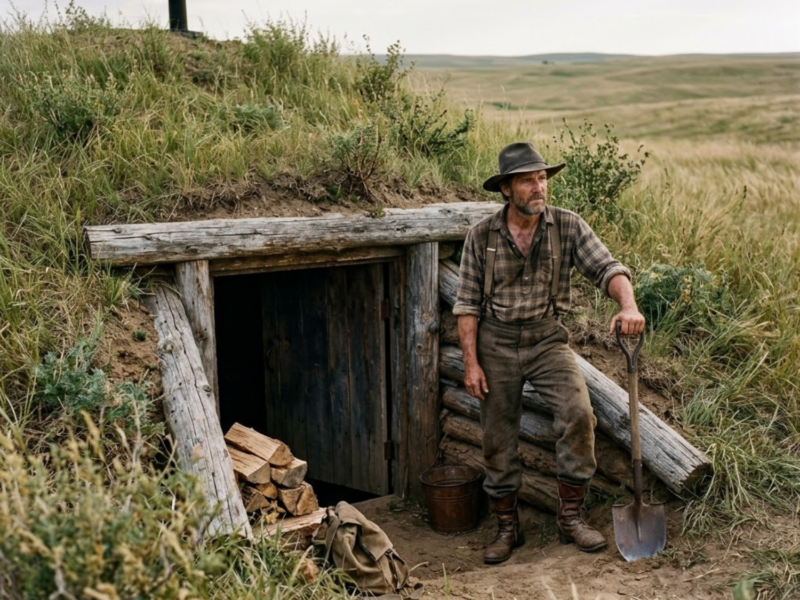
Neighbors Laughed When He Built an Underground “Grave” And Not a Cabin—Until It Kept Him 25°F Warmer
The Architecture of the Earth
Lars’s spade finally struck the clay subsoil at four feet. He knelt, taking a handful of the dense, gray earth, rubbing it between his thumb and forefinger. It was perfect. The frost line here, he calculated, would only penetrate thirty to forty inches in a normal winter. Below that invisible barrier, he was safe.
But a hole in the ground was not a home. The construction details separated Lars’s work from the crude, collapsing mud pits of desperate, bankrupt settlers.
He journeyed to the creek bottoms, selecting green cottonwood posts, six to seven inches in diameter. He peeled the bark smooth with a drawknife to prevent the rot that insects and trapped moisture would inevitably bring. He set these posts at precise twenty-four-inch centers along the excavated walls, stretching from the dirt floor to the planned roofline seven feet above.
Each post was painstakingly scribed—shaved and contoured with an adze—to fit the irregular, breathing earth wall behind it. Once set, Lars packed the negative space with a dense mortar of fieldstone and wet clay, pressing it deep until he had created an absolute, airtight seal.
He was working on the drainage trench when the old woman appeared.
White Willow was a Lakota elder who occasionally traded beaded moccasins for coffee and sugar at Riddle’s store. She moved with the slow, deliberate grace of a woman who had watched empires rise and fall across this very grass. The white settlers usually ignored her, treating her as a ghost of a conquered past.
She stood at the edge of the excavation, her dark, weathered face framed by a heavy wool blanket. She did not mock him. She studied the work with a clinician’s eye.
“You cut the water path,” she said in halting English, pointing a gnarled finger at the wide drainage swale Lars had trenched around the uphill perimeter of the dugout.
Lars wiped his brow and nodded. The swale was eighteen inches wide and twelve inches deep, falling exactly one inch for every eight feet of run. It was designed to catch the spring snowmelt and driving rain, shunting it harmlessly around the structure.
“Wet ground steals heat,” White Willow noted, her eyes glinting with approval.
Lars climbed out of the trench. For the first time since he had begun, he felt a kinship with another human being in this desolate territory. He showed her the French drain he was laying beneath the floor: a four-to-six-inch bed of smooth fieldstone that would intercept the invisible, rising groundwater before it could ever touch the living space, channeling it to daylight down the slope.
She touched the peeled cottonwood posts, tracing the clay chinking. Her people had built timber and earth lodges on these plains for centuries, utilizing the exact same thermodynamic principles Lars had learned in the fjords. The European settlers built boxes of air that the wind could crush; the Lakota and the Norwegians built with the mass of the earth.
White Willow looked at him, gave a single, firm nod, and walked away. It was the only blessing Lars needed.
The roof, however, drew the most intense skepticism from the passing wagons.
Lars did not use cedar shingles. Instead, he spanned the twelve-foot width with massive cottonwood poles, spaced sixteen inches apart. He knew the terrifying mathematics of a Dakota winter. The roof had to carry a dead load of forty pounds per square foot when dry, and a crushing eighty pounds per square foot when saturated with freezing rain and heavy snow. The heavy poles were graded for knots, calculated to deflect less than half an inch at mid-span under maximum distress.
Over these rafters, he laid a thick, springy mattress of willow brush and prairie grass thatch. Then, he took a specialized cutting spade to the virgin prairie.
He cut sod blocks, immense bricks of earth and buffalo grass, measuring six inches thick, twelve inches wide, and eighteen inches long. He cut them with the root systems completely intact. Hauling them up the slope, he laid them grass-side down in overlapping courses, exactly like enormous, muddy shingles.
The neighbors laughed, pointing at the dirt roof. But Lars knew that over the coming months, those severed root systems would blindly seek each other out in the dark, knitting together, fusing into a single, living, impenetrable membrane that would shed water like a duck’s back.
By the first week of November, he finished the interior. He sealed the wall joints with a dough of clay and straw, applying it an inch and a half thick. He painted the interior walls with two coats of brilliant white limewash. It hardened the clay to a ceramic shell and caught the light from the single, recessed, south-facing window, filling the underground room with a warm, diffuse glow. He crowned the dirt floor slightly in the center, ensuring any spilled water would run to the edges and into the stone drain.
On November 7th, the first hard freeze struck the territory.
From the wagon road, Lars’s home looked exactly as Ezra Pike had predicted: a grass-covered mound resembling a fresh burial site. Only the black iron stovepipe protruding from the sod, and the recessed wooden door cut into the southern slope, betrayed that a living man resided within.
It violated every rule of frontier housing. But inside, Lars lit a small fire. He sat at his handmade table, opened his own ledger, and noted the temperature.
Outside, the wind howled at fifteen degrees. Inside, the dugout held steady at sixty-two degrees. His small stove was consuming a mere two pounds of wood per hour.
The true test, however, was still sleeping in the deep Arctic north, waiting to be unleashed.









