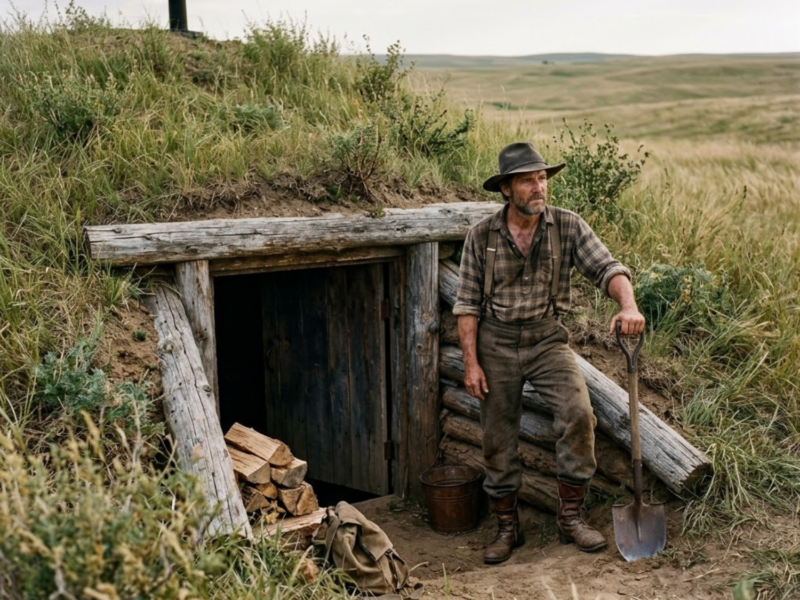
Neighbors Laughed When He Built an Underground “Grave” And Not a Cabin—Until It Kept Him 25°F Warmer
Boxes of Air
A mile to the east, John McCutchen was deeply proud of his balloon-frame cabin.
He had arrived in the spring of 1885 with his wife, Mary, and their teenage son, Thomas. John was a man who believed in the catalog. He had followed Ezra Pike’s specifications to the letter: a sixteen-by-twenty-foot footprint, eight-foot ceilings, one-inch pine boards nailed over studs, and taut black tar paper sealing the exterior.
In the center of the north wall sat the pride of their home: a large, cast-iron potbelly stove, its six-inch metal pipe punching straight up through a sheet-metal collar in the roof.
When the November freezes began, the McCutchen cabin functioned acceptably. John and Thomas would feed the stove six to eight heavy armloads of split oak and cottonwood a day. As long as the fire roared, the space immediately surrounding the iron beast stayed a comfortable sixty-five degrees.
But John tried not to think about the corners of the room. The green lumber he had purchased from Pike had begun to dry and shrink in the arid prairie air. Microscopic gaps opened between the floorboards and the wall studs. Even packed with oakum and clay, the house breathed. It was an involuntary respiration; the cabin exchanged its entire volume of heated interior air with freezing exterior air at least once an hour.
Further down the township road lived the Kregers.
Jacob and Anna Kreger were recent German immigrants, arriving late in September with three children under the age of ten and a terrifying lack of cash. They represented the grim economic reality of the homesteader rush. They could not afford Pike’s premium lumber.
Their cabin was a desperate compromise. They used thin, low-grade boards and tar paper, but could not afford cedar shingles, leaving their roof highly vulnerable to wind-driven moisture. Instead of proper oakum, Jacob chinked the walls with a slurry of mud and dead grass.
Their heating system was a small, tin box stove, entirely inadequate for the volume of the room. By early December, when the nighttime temperatures routinely dipped to ten degrees, the Kreger cabin became a place of localized suffering.
The family would drag their mattresses into the center of the room, crowding violently against the little tin stove. Just three feet away from the heat source, the interior walls grew a delicate, crystalline fur of white frost. Anna would wake in the morning to find the water buckets frozen solid, and the heavy wool quilts damp and stiff from the condensation of their own breath freezing upon the fabric.
Augusta Riddle tracked it all. She recorded the fuel purchases at her store. The McCutchens were buying cord after cord of wood, their cash reserves dwindling. The Kregers were burning whatever scrap they could find, scavenging the creek beds.
And then there was the Norwegian.
Lars Nygard came into the store once a week. He bought coffee, a little flour, and salt. He did not buy wood.
“How is the badger hole, Lars?” Augusta asked one afternoon in mid-December, leaning over the counter. Outside, the wind was whipping the snow into blinding white devils.
“It is quiet, Mrs. Riddle,” Lars replied, handing her a silver coin.
It was more than quiet. It was an engineering marvel that defied the local understanding of physics.
A conventional cabin presented four walls, a floor, and a roof to the atmosphere. It was a box of air constantly besieged by the weather. Lars’s dugout exposed only one thing: the small, recessed southern entrance. The remaining three walls and the roof were entirely enveloped by the earth.
He had reduced his exposed surface area by eighty percent. Furthermore, the wind could not bite what it could not touch. While the McCutchens burned three pounds of wood an hour simply to heat the freezing air infiltrating through their shrunken boards, Lars’s dugout experienced almost zero unwanted infiltration.
Instead, he controlled his air. He had installed a three-inch intake vent near the floor on the leeward side. As freezing fresh air was drawn in, it was forced to pass along the stable, fifty-degree earth wall before entering the room, pre-warming it. A five-inch outlet near the ceiling exhausted the stale, carbon-dioxide-heavy air. The system breathed at a measured, perfect pace.
By Christmas, Lars had consumed barely a cord of wood. The McCutchens had burned through four. At three dollars a cord, Lars was saving money that meant the difference between surviving the next year and starving.
But fuel efficiency was merely an economic luxury. The Earth’s thermal mass offered something far more vital: time.









