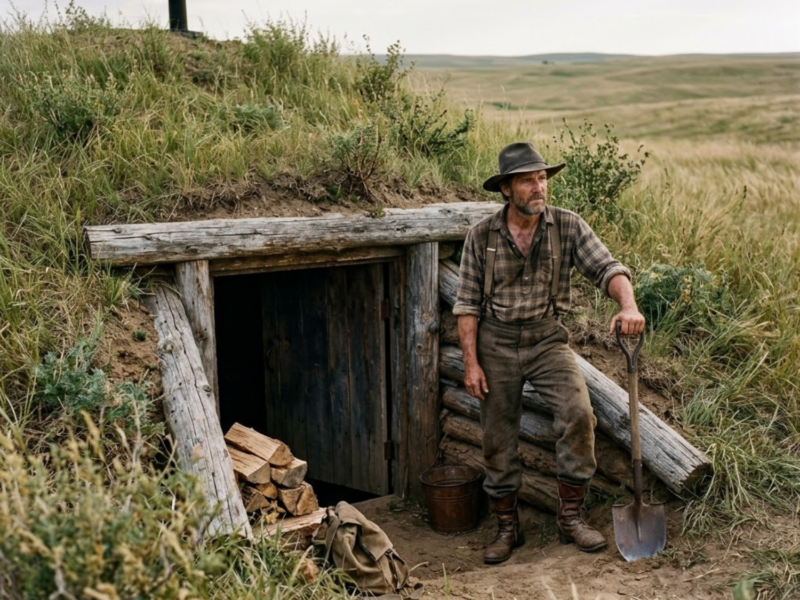
Neighbors Laughed When He Built an Underground “Grave” And Not a Cabin—Until It Kept Him 25°F Warmer
The Reckoning of the Thaw
The brutal grip of the Blue Norther did not break until January 22nd.
The temperature crept painfully up to fifteen degrees above zero. The wind shifted, blowing softly from the south, carrying the first, faint promise of survival. The sky cleared to a brilliant, blinding blue, revealing a landscape utterly transformed. The Dakota territory was a white desert, buried under drifts that reached the rooftops of the surviving cabins.
When the McCutchens and the Kregers finally emerged from the dugout, shielding their eyes from the glare, they walked back to a reality of devastation.
Augusta Riddle, venturing out to assess the township, recorded the catastrophic failures in her ledger.
The McCutchen cabin was a disaster zone. The extreme, rapid cycles of freezing and desperate thawing had warped the green lumber. The nail heads had popped. Inside, the destruction was absolute. Every ceramic pitcher and glass jar had shattered. Fifty pounds of premium flour had frozen into a solid, unusable block of ice. The oakum chinking had cracked and blown out, leaving gaping holes to the outside.
Worst of all, John stood before his woodshed and realized he had burned through nearly seventy percent of his winter fuel in ten days. He had two months of winter left, and nothing to burn.
The Kregers had it worse. Their single-wall cabin was barely standing. The ice formation on the interior walls had destroyed the clay chinking, turning it to mud that slumped to the floor. The temperature cycling had warped the walls so severely the front door would not close. They had burned every scrap of wood, a chair, and part of a table just to survive the night before they fled.
And then there was the dugout.
Lars returned to his quiet routine. He swept his dirt floor. The dugout showed absolutely zero structural damage. The thermal mass had completely prevented the violent temperature cycling that tore the surface cabins apart. The controlled humidity had prevented any condensation.
For the entire ten-day crisis, sheltering twelve people against the worst weather in territorial history, Lars had burned less than two hundred pounds of wood. It was the equivalent of what the McCutchens burned in two days of normal weather.
The mathematics of survival had been definitively solved.









