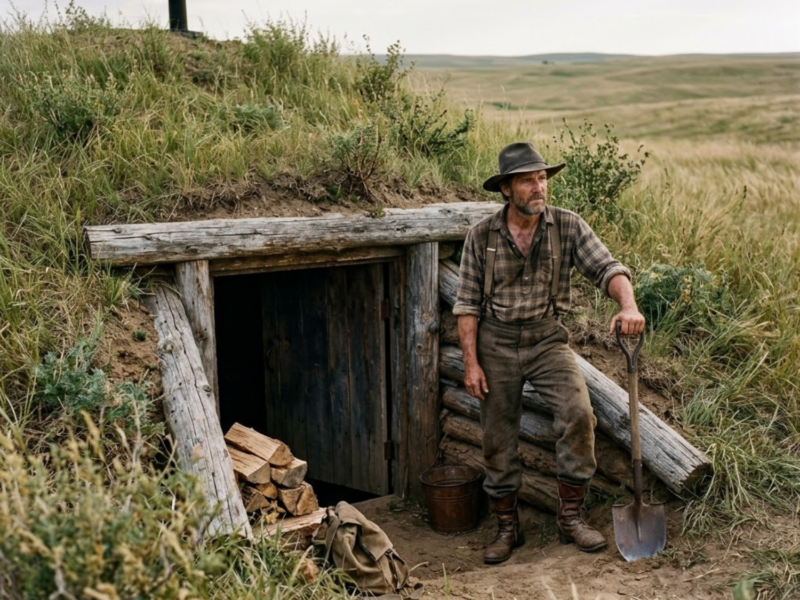
Neighbors Laughed When He Built an Underground “Grave” And Not a Cabin—Until It Kept Him 25°F Warmer
The Mathematics of Survival
Twelve occupants in a twelve-by-sixteen-foot dugout created a crisis of a different nature.
In a surface cabin, crowding twelve people would have resulted in rapid, uncontrollable temperature spikes, followed by suffocating humidity as their breath condensed on the freezing walls, soaking their clothes and inviting pneumonia.
But the earth shelter breathed differently.
Lars immediately moved to his ventilation controls. He opened the floor-level intake vent an additional quarter turn, allowing a steady stream of icy, fresh air to flow over the warm clay walls. He cracked the high outlet vent just enough to draw the heavy carbon dioxide and excess moisture out into the storm.
The true miracle, however, was the thermal mass.
Twelve human bodies act as twelve biological furnaces, radiating heat at roughly 350 BTUs per hour. In a normal cabin, this heat would vanish instantly through the drafty walls. But in the dugout, the massive earthen walls absorbed the ambient body heat, soaking it up like a sponge, and slowly radiating it back.
The room stabilized. The humans were helping to heat the earth, and the earth was heating the humans.
Lars watched his thermometer. It was forty-five degrees below zero outside. The wind was a continuous, demonic roar that shook the very roots of the prairie.
Inside, the temperature held flawlessly between fifty-eight and sixty degrees.
Lars only fed the stove roughly fifty pounds of mixed wood over the next eight hours. It was a fraction of what John McCutchen had burned to freeze in his own home. The fuel consumption bordered on the miraculous.
The twelve people sat on the floor, wrapped in blankets, leaning against the warm, solid walls of the badger hole. The children, exhausted and traumatized, finally fell into a deep, peaceful sleep, safe in the belly of the earth.
John McCutchen stared at the single, small stove, watching it sip at the wood. He looked up at the ceiling, where the massive cottonwood poles effortlessly held back the crushing weight of the snow and the sod.
He had spent weeks mocking the Norwegian. He had laughed at the grave. Now, he realized, he was sitting in the only lifeboat on the prairie.
“I was a fool,” John whispered to Lars in the quiet dark of the early morning. “We were all fools.”
Lars did not gloat. He simply stoked the fire, the orange light playing across his stoic face.
“The wind does not care about our pride, John,” Lars replied softly. “It only cares what you put in its way.”









