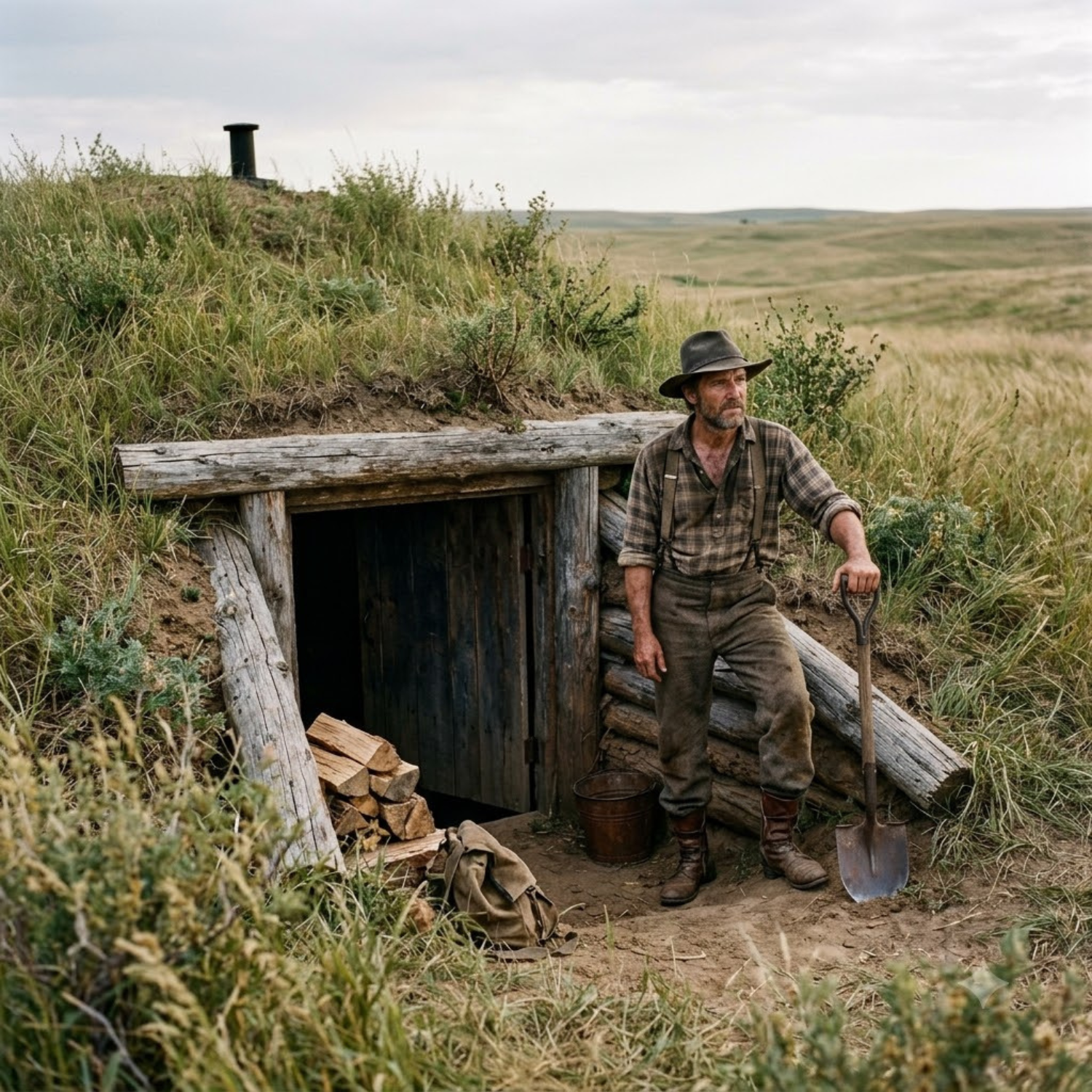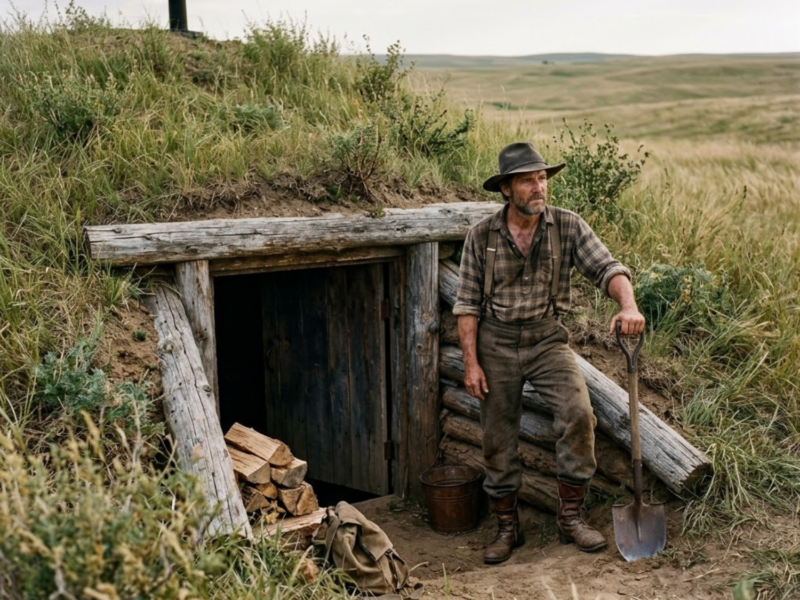
Neighbors Laughed When He Built an Underground “Grave” And Not a Cabin—Until It Kept Him 25°F Warmer
The Badger Hole
The morning of October 23rd found Lars Nygard knee-deep in the earth. The frost had already painted the buffalo grass a shimmering silver for three consecutive mornings, a crystalline warning that melted by noon but left a lingering chill in the bones.
All across the township, the staccato rhythm of hammers rang out like a desperate heartbeat. The homesteaders were throwing up balloon-frame cabins in a frenzy. The recipe was standard, shipped out from the lumber companies back east: one-inch pine boards nailed over two-by-four studs, a skin of black tar paper stretched tight against the howling wind, and cedar shingles if a man had the cash to spare. They were built in two or three weeks, standing proud and vertical, announcing civilization to the empty horizon.
Lars ignored the hammering. His excavation measured precisely twelve by sixteen feet, cut deliberately into a gentle, south-facing slope that would catch the low, anemic arc of the winter sun.
He was a Norwegian carpenter by trade, a man of few words and deliberate movements. He worked methodically, his broad shoulders shifting rhythmically as his spade bit into the Dakota clay. He benched the sides of the excavation in two-inch steps, a technique learned in the unforgiving fjords of his homeland to prevent the walls from caving in under their own weight. He checked his progress with a knotted hemp rope, marked at one-foot intervals, ensuring mathematical perfection in the dirt.
The back wall descended seven feet from grade level, while the front wall stood only three and a half feet below ground. It was a sloped floor plan designed by a mind that understood the flow of water and the weight of air.
A shadow fell over his trench. Ezra Pike, the local freight agent, sat perched on the driver’s bench of his heavy wagon, the horses snorting plumes of white vapor into the crisp air. Pike was a man who traded in progress; he supplied the lumber, the nails, and the dreams.
“You’re digging your own grave, Nygard!” Pike called out, his voice tinged with the weary condescension of a man who knew better. He gestured expansively toward the neat, mountainous piles of earth flanking Lars’s excavation. “The ground stays wet down there. Come spring thaw, you’ll drown in your own cellar. I’ve seen it happen to better men.”
Lars paused, resting his calloused hands on the handle of his spade. He looked up at Pike, his blue eyes unreadable beneath the brim of his wool cap.
“I can get you a standard cabin package,” Pike pressed, sensing an opening. He tapped a leather-bound catalog on his knee. “Boards, nails, paper, hardware. Delivered for forty-seven dollars. Three weeks’ work with some proper help, and you’ll have something that looks like civilization, instead of an Indian mound.”
“No thank you, Mr. Pike,” Lars said, his voice thick with the gravel of his native tongue.
Pike spat a stream of tobacco juice into the frozen grass. “Suit yourself, Norski. But when they find you frozen stiff or drowned like a rat, don’t say the territory didn’t offer you a proper roof.”
Pike drove on, and with him went the gossip.
Three miles away, in a balloon-frame cabin that doubled as the township’s general store and post office, Augusta Riddle kept a meticulously neat ledger. Beside the tallies of flour, salt, and ammunition, she recorded the life of the community.
On October 26th, her dip pen scratched across the parchment: The Norski is building himself a Badger Hole. Neighbors betting whether he freezes or drowns first.
The mockery carried a particular, venomous sting because dugouts represented the absolute antithesis of the settler’s dream. To live in the dirt was to admit defeat. It was the desperate, filthy expedience of failed men who lacked the cash for proper timber. It was a regression to the earth lodges of the indigenous tribes they were so eager to displace.
Lars absorbed the whispers the same way the earth absorbed the autumn rain: silently, and without leaving a trace. He knew what they did not. In the mountain valleys of western Norway, turf-roofed sheds and deep dugouts maintained steady, life-saving temperatures through winters that lasted seven months.
The principle was a secret kept by the planet itself. Soil below the frost line held steady at forty-eight to fifty-five degrees, year-round. It was a massive thermal battery, absorbing the heat of the summer sun and releasing it with agonizing slowness through the dark months. While the surface world froze and shattered, the deep earth remained a warm, steady heartbeat.
Lars was not digging a grave. He was building a fortress.