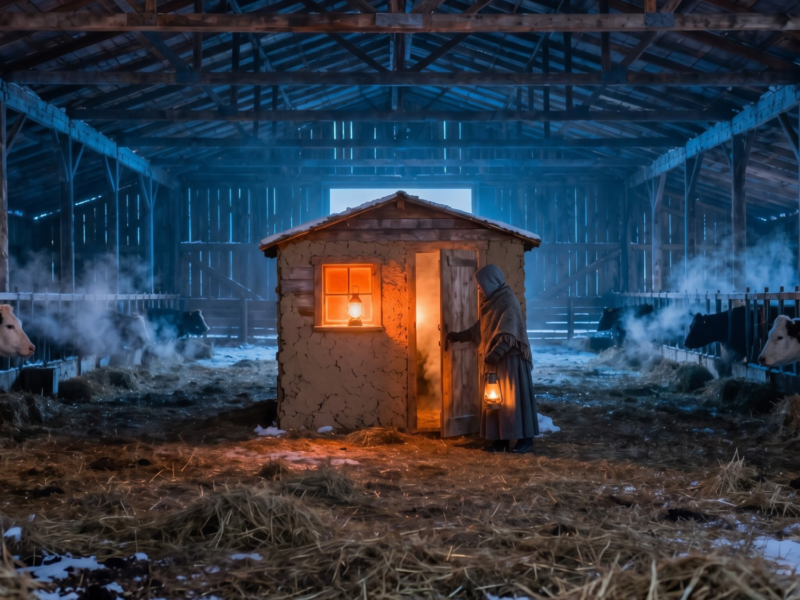
Nobody Believed Her When She Insulated the Cabin Inside Her Barn Until Temperatures Dropped 30°F
THE THAW AND THE VERDICT
On January 10th, the blizzard broke, leaving behind a blinding landscape of fifteen-foot drifts under a hard, merciless blue sky.
Ingred dug out of the barn to find her entire herd alive. The cattle were hungry and thirsty, but sound. Marta was sitting up, pale but breathing clearly.
She stood in the doorway of her barn and let the clean air fill her lungs. Her design had worked. When the killing cold came, when blizzards buried the territory and families burned their own furniture, Ingred Halverson had kept her children warm with nothing but animal heat, prairie hay, and a Norwegian grandmother’s memory.
By late February, word spread through Kingsbury County that the Norwegian widow had lost zero livestock in the January cataclysm, while neighboring herds had suffered twenty-five to fifty percent mortality.
Skeptics rode out to see for themselves. Ezra Woodworth, the land agent who had begged her to sell, arrived on the first passable day in late February. He walked into the barn, unbuttoned his heavy coat in the ambient warmth, and stared at the healthy livestock and the canvas cabin.
“Mrs. Halverson,” Woodworth removed his hat, his voice carrying a heavy weight of humility. “I told you in July that you could not survive. I offered to buy your claim because I believed you would die. I was wrong.”
“You were trying to help, Mr. Woodworth,” Ingred said quietly. “In your way.”
“I was trying to save you from what I thought was certain death. Instead, I nearly convinced you to give up something that could save lives.” He looked around the interior. “How did you think of this?”
“In Norway, we did not separate ourselves from our animals in winter. The heat from the cattle warmed the living space. My grandmother lived this way.” Ingred met his eyes. “The old ways. Sometimes they survive because they work.”
Silas Mertton visited soon after, walking through the barn in silence, examining every detail. When he left, he shook her hand—a rare gesture of frontier respect. “You proved me wrong, Mrs. Halverson. I do not often admit that, but I have never seen anyone survive a winter the way you did.”
Bertram Schuster did not come. He did not acknowledge her survival, nor did he withdraw his petition to the land office. But when spring arrived and travel opened, the land office reviewed his challenge.
When Ingred rode to De Smet in April to confirm her claim, the clerk informed her: “A petition was filed against your land for abandonment. It has been denied. You have met all residence requirements. The claim is secure.”
She encountered Schuster at the general store a week later. His face darkened when he saw her.
“I hear you survived the winter,” he muttered.
“I did. My children, my livestock—all of them living in that barn.”
Schuster’s jaw tightened. “It is still not proper. A civilized woman does not—”
“Mr. Schuster,” Ingred cut him off, her voice ringing across the store. “I have lived. My children have lived. My livestock have lived.” She paused, locking eyes with him. “How many cattle did you lose?”
Schuster did not answer. He threw coins on the counter and walked out without another word, his sons following silently behind him. His power to threaten her was broken.









