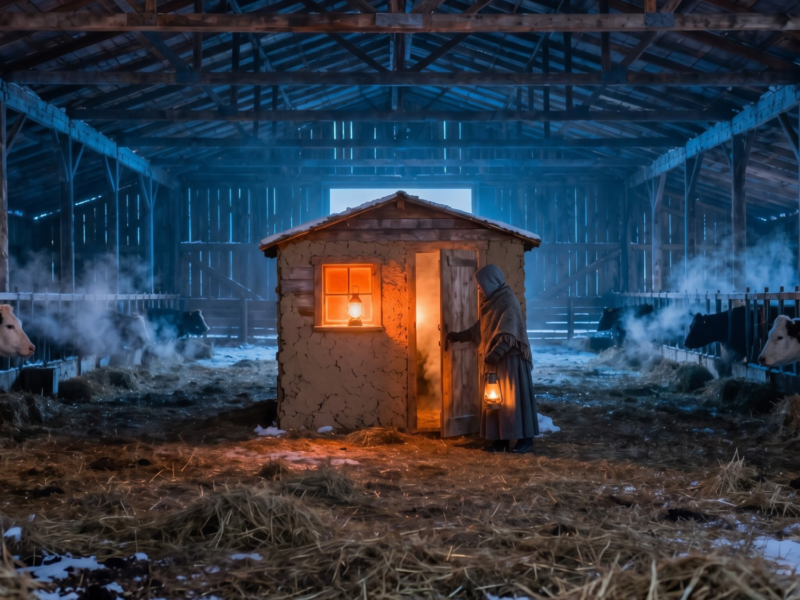
Nobody Believed Her When She Insulated the Cabin Inside Her Barn Until Temperatures Dropped 30°F
THE ANCIENT LESSON
The insight arrived on an evening in late July when the air was still warm and winter felt like someone else’s distant problem.
Ingred walked through the half-finished barn, running her calloused hands along the sturdy pine framing Lars had erected. The lumber was good—expensive, high-quality timber hauled sixty miles from the railhead. Her husband had built the skeleton of something that could last decades; he had simply run out of days to finish it.
She thought about the house she had grown up in back in Hedmark County, Norway—not a standalone house, but a collection of connected agricultural structures sharing common walls and mutual warmth. The family’s living quarters sat directly adjacent to the livestock barn, and in the coldest months, the profound body heat generated by the cattle seeped right through the wooden partition, taking the killing edge off the winter air.
She remembered lying in bed as a child, listening to the cows shift and breathe on the other side of the pine planks, and her grandmother explaining that the animals gave their warmth as a gift, and the family gave them shelter in return.
American settlers, she realized, did not build this way. They isolated their barns from their houses, separated by yards of open, windswept ground that howling gales tore through. They heated their homes with iron stoves that devoured cord after cord of wood, ton after ton of coal. And when the fuel inevitably ran out, they burned their own furniture. When the furniture was gone, they died.
What if she did it differently?
The barn frame was already here. If she finished the walls using sod—where lumber was too expensive—and salvaged boards for the framework, she would have robust shelter for the livestock. The animals would survive.
But animals produced massive amounts of heat. A dairy cow’s body ran hot, nearly 102 degrees Fahrenheit, and all that thermal energy had to go somewhere. It rose into the air, heating whatever space the animals occupied. A single cow produced as much heat as a small continuous stove running all night long. Four cows produced four times that.
Six large animals together—the cows and the oxen—would produce enough thermal energy to raise the temperature inside a closed, insulated barn by twenty, perhaps thirty degrees.
And if she built a smaller space inside that barn? A cabin within the barn, heavily sheltered from the outside wind by the outer barn walls, and warmed by the ambient air the livestock had already heated? That smaller enclosure would stay remarkably warm.
She wouldn’t need to heat her personal living space. The animals would do it for her.
The logic locked into place in her mind like the mortise and tenon of a timber frame. The barn became the first layer of insulation, blocking the wind and trapping livestock heat. The small inner cabin became the second layer, capturing the rising warmth and holding it close.
She would need almost no fuel—just a candle for illumination, perhaps a small oil lamp on the worst nights. No eight cords of firewood. No four tons of coal.
The idea solved the impossible mathematics. Build the barn. Build a small cabin inside it. Use the animals as a living furnace.
She could afford this. Just barely. If she spent nothing on anything else, she could stretch her forty-seven dollars to cover nails, canvas, and minimal provisions.
But if she was wrong—if the design failed, if the temperatures inside the cabin dropped below freezing—her children would freeze to death in their beds. There was no backup plan, no second chance, no stockpiled fuel for an emergency. She was gambling everything on a childhood memory from five thousand miles away.
Ingred stood in the skeleton of her dead husband’s barn and made her choice.









