Nobody Believed Her When She Insulated the Cabin Inside Her Barn Until Temperatures Dropped 30°F
RAISING THE SOD
September arrived with early frost on the grass and a frantic new urgency in the air. The growing season was dying, the window for construction was closing, and the barn was still incomplete.
Ingred established a punishing rhythm: awake before dawn, feed the children and livestock, work the sod walls until noon, pause for a cold bite, work until dark, feed the livestock again, collapse into sleep.
The sod walls rose course by course. Each block weighed fifty pounds. She cut sixty blocks per day during her best stretches, fewer when her physical strength failed.
The barn’s north wall—the one that would face the lethal winter wind—she built double-thickness: two layers of heavy sod with prairie grass packed tightly between them, creating a thermal barrier the cold would have to fight through twice. It consumed precious time and daylight, but the north wind killed, and she would not underestimate it.
Christopher helped where he could. At seven years old, he carried creek stones for the rough foundation, held tools, fetched water, and did not complain even when his small hands blistered. Marta, at five, gathered grass for stuffing, pulled weeds, and kept track of the chickens. She asked every single night when the house would be finished. Ingred never knew how to explain that there would be no house—only the barn, the small cabin within it, and a desperate gamble.
By October 10th, the barn roof was ninety-five percent complete. The inner cabin walls were framed, the studs stuffed with prairie hay, and the interior lined with canvas from the wagon cover that had carried them west.
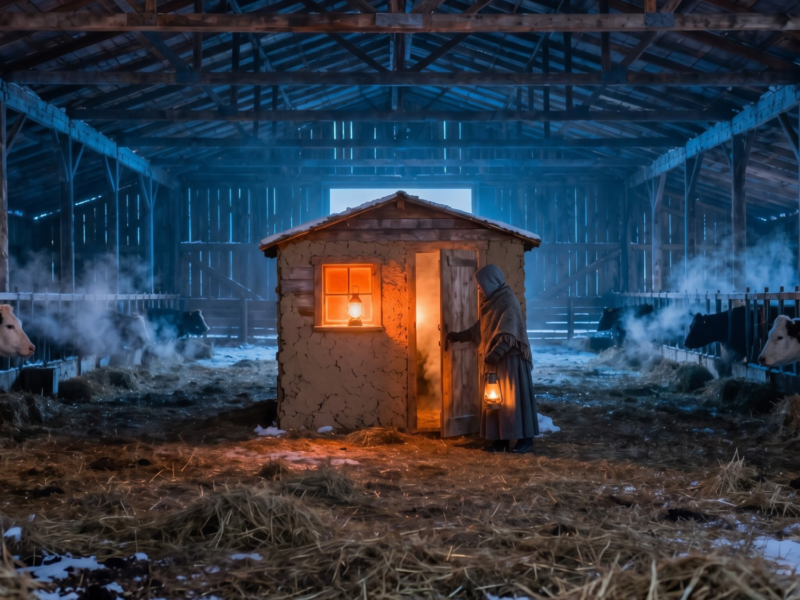
Ingred moved the livestock inside: four cows, two oxen, and eight chickens. The barn immediately filled with the warm musk of creatures who had evolved to survive the cold. She checked the inner cabin. The door was a heavy wool blanket weighted at the bottom to seal out drafts. The sleeping platform was raised eighteen inches off the floor to catch the rising heat.
It was cramped, dark, and primitive. But it was ready.
She had four dollars left to her name. Food stores for perhaps three months. Livestock that might survive or might freeze. An untested idea, and two children trusting her with their lives.









