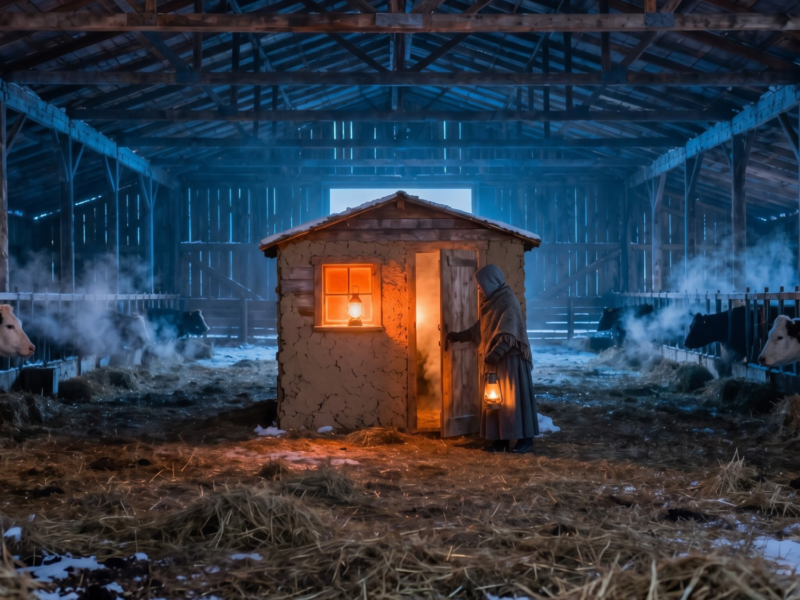
Nobody Believed Her When She Insulated the Cabin Inside Her Barn Until Temperatures Dropped 30°F
WHISPERS IN DE SMET
The general store in De Smet served as the town’s informal town hall, a space where news was exchanged, moral judgments were rendered, and reputations were made or destroyed.
Ingred tried to avoid it. She bought what she needed quickly, spoke to no one, and left before the whispers could reach her. But the gossip traveled anyway. By late August, word had spread through the German and Scandinavian settlements of Kingsbury County that the Norwegian widow was building something unnatural.
Some claimed she meant to live in a hole in the ground like a badger. Others insisted she had constructed a pen for herself alongside the pigs. The variations grew more outlandish with each retelling, but the core judgment remained consistent: The Halverson woman had lost her mind. Grief had cracked her judgment. She was going to get those children killed.
Bertram Schuster heard the stories and saw an opportunity. Schuster was a forty-four-year-old German-American farmer with a claim adjacent to Ingred’s, four grown sons, a substantial house, and the confident bearing of a man who believed the frontier rewarded the strong and punished the weak.
He wanted Ingred’s claim—not for the acreage, but for the seasonal creek that crossed her property, providing water his own claim lacked. He had already filed a petition with the land office requesting the right to purchase her land if she failed to prove up. All he needed was for her to fail.
He found her in the general store on a Thursday afternoon, counting out precious nails to see if she could afford enough to finish the cabin frame.
“Mrs. Halverson,” Schuster announced, pitching his voice so everyone could hear. “I hear you are building some kind of animal pen for yourself and your children to sleep in.”
Ingred did not turn around. “This is not how civilized people live,” Schuster continued smoothly. “This is how peasants live in the old country—dirt, manure, and the stink of cattle. You have already proven you cannot manage a claim. Now you endanger your children.”
Ingred turned slowly. Her face was entirely calm, but her eyes held something that made Schuster’s practiced confidence flicker. “I have a barn, Mr. Schuster. I have livestock. I have children who need to eat. What I do on my claim is my concern.”
“It is the county’s concern when children are endangered. The land office will hear of this.” Schuster smiled thinly. “They will understand that you cannot prove up. And when your claim reverts, I will be right here.”
Sunday brought further pressure. At the community gathering at the De Smet church, Mrs. Johanna Ellingsson, a fellow Norwegian immigrant, pulled Ingred aside. Her face was kind, but deeply worried.
“Ingred, you must understand how this appears,” she murmured. “In Norway, yes, the old ways had people and animals together. But this is America. We came here to live better. Some people are saying… they are saying that if you cannot provide a proper home, perhaps your children would be better placed with a family that can.”
The words struck like a physical blow. Her children—all she had left of Lars, all she had left of her past—threatened with removal because she was building wrong, because she was surviving wrong.
“My children will stay with their mother,” Ingred said, her voice steady while her hands trembled at her sides. “And their mother will keep them alive.”
She left the church before the service ended and did not return.









