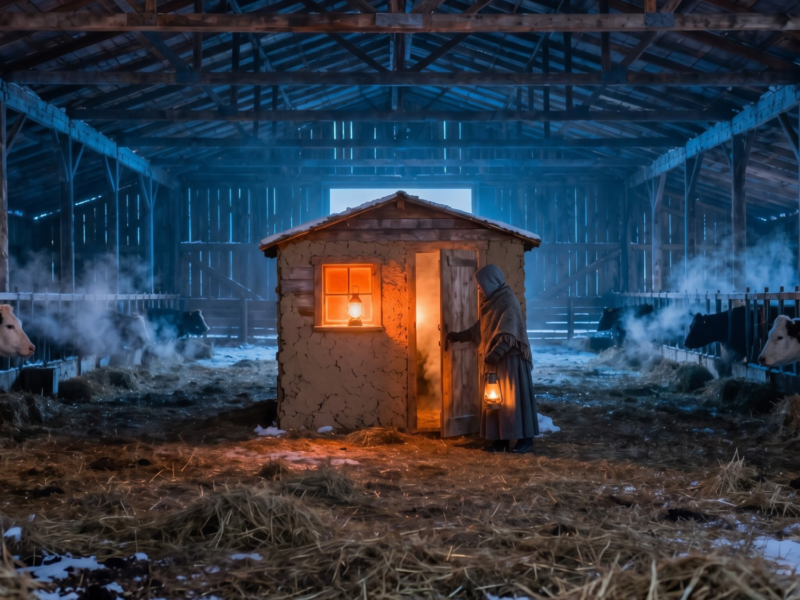
Nobody Believed Her When She Insulated the Cabin Inside Her Barn Until Temperatures Dropped 30°F
THE CARRYING OF THE DEAD
Six months earlier, in the blazing, oppressive heat of July 1880, Ingred Halverson had arrived in Kingsbury County with precisely forty-seven dollars, two children under the age of eight, and a dead husband’s unproven homestead claim.
She had never before laid eyes on the American prairie. She had never built anything larger than a backyard chicken coop. And every single person who looked her way saw a woman who was already dead—she just didn’t know it yet.
The letter had arrived in Minnesota on a Tuesday, carried east by a stranger traveling from the territories. Lars Halverson was dead. Cholera had claimed him three weeks after he filed his homestead claim, before he could send word that the land was secured, before he could tell Ingred to pack up the children and come west. He had been hastily buried in the raw Dakota dirt with a crude wooden marker that wouldn’t survive two punishing winters.
Ingred read the letter twice, her hands trembling. Then she sold every stick of furniture they owned, settled her modest debts with the landlord, and bought three tickets on the next westbound train.
She arrived at the claim in early July with two children who had never seen an horizon without trees, a canvas sack containing their worldly possessions, and the forty-seven dollars that remained after burial and travel expenses.
The claim itself was free under the Homestead Act—one hundred and sixty acres of open, windswept grassland, twelve miles from the nearest nascent town—but it demanded five years of continuous residence and grueling cultivation before the deed became hers. Five years of proving she could outlast the country.
Lars had left her a half-finished barn measuring thirty-two by twenty-four feet. The skeleton of heavy timber rose from the prairie grass like the ribcage of some colossal beast that had died standing up. There was no roof, no protective siding, just rough-cut lumber he had hauled fifty miles from Tracy, Minnesota, before the sickness took him.
There was no house. Lars had planned to finish the barn first to shelter the livestock that represented their entire capital, and then construct a proper sod shanty before winter. He had simply run out of days by about four months.
Ingred stood in the doorway of that skeletal barn on her very first morning and counted her assets: four milk cows, two massive oxen, and eight laying hens. The animals were worth perhaps two hundred dollars total, but selling them would leave her with no way to farm, no food to carry them through the winter, and no capital to rebuild in the spring.
The livestock had to live. And she had forty-seven dollars to her name.









