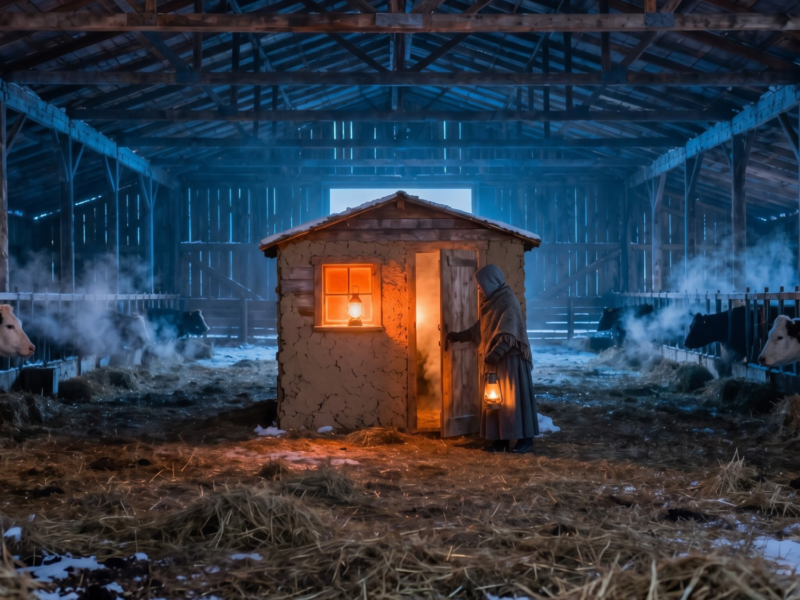
Nobody Believed Her When She Insulated the Cabin Inside Her Barn Until Temperatures Dropped 30°F
THE CALCULUS OF SURVIVAL
Winter arrived in late October, giving her approximately sixteen weeks to construct a habitable shelter for her family and her livestock, gather six months of fuel, and store enough food to keep three human beings alive until the spring thaw.
The nearest timber stood eighteen miles away along the Big Sioux River. Cutting eight cords of firewood—the absolute minimum a frontier family needed to survive a Dakota winter—would require weeks of intense labor, a wagon, draft animals, and the physical stamina to fell trees, buck logs, and haul thousands of pounds of fuel across open, pathless prairie. For a man with grown sons, it was backbreaking work. For a widow alone with two toddlers, it was a physical impossibility.
Coal was the alternative. The dealer in Tracy sold it for six dollars a ton, but freight charges would double the price by the time it reached Kingsbury County. A family required four tons minimum. That equaled forty-eight dollars—more than everything she possessed in the world.
Lumber for even a tiny claim shanty cost between eighteen and twenty-five dollars. Food for six months—flour, salt pork, dried beans, potatoes—would run another thirty to forty dollars for a family of three.
The mathematical reality of her survival did not balance. She needed between ninety and one hundred and fifteen dollars. She had forty-seven, and there was no legal or physical way to earn the difference before the first killing snow fell.
The county land agent, Ezra Woodworth, sat in a cramped, drafty office in De Smet that smelled permanently of stale tobacco, dust, and the localized despair of people who had gambled their lives on dirt. Woodworth had spent fourteen years watching the frontier consume people alive across Minnesota, Nebraska, and the Dakota breaks. He knew what survival cost. He knew what Ingred Halverson lacked.
When she came to his office on her third day in the territory, with Christopher and Marta waiting outside in the wagon, Woodworth processed her paperwork, stamped the documents, and pushed his pen aside.
“Mrs. Halverson,” he said gently, “I am going to speak plainly because I believe you deserve the truth. I have seen stronger men than your husband give up after a single winter—men with grown sons to help them, men with real money in the bank. You are a woman alone with two small children.”
He shook his head slowly. “The closest timber is eighteen miles away. Coal costs six dollars a ton in Tracy, and freight doubles it. You cannot survive November on forty-seven dollars, let alone January.”
“I have livestock,” Ingred said steadily.
“Livestock that will freeze in an open barn. Livestock that need hay you do not have time to cut. Livestock that will eat through your meager food budget just staying alive.” Woodworth leaned forward across the desk. “I will buy your claim for twenty-five dollars right now, Mrs. Halverson. I will provide train fare back to Minnesota for you and both children. You can find work there. You can live.”
Ingred stared at the paper on his desk. Twenty-five dollars and a clean escape from a mathematical trap.
“My husband died for this land,” she said softly.
“Your husband died of cholera,” Woodworth countered bluntly. “The land had nothing to do with it.”
“He believed we could make a life here. He believed he would live to see the first harvest.”
“He was wrong about that, too.” Ingred stood up, her chair scraping against the wooden floorboards.
“I will not sell,” she said, her voice dropping into a register that brook no argument. “I will not leave. I will prove up this claim, or I will die on it. But I will not run.”
Woodworth sighed, recognizing the fatal stubbornness of the doomed. “Then I will see you in the spring, Mrs. Halverson. Or I will not.”









