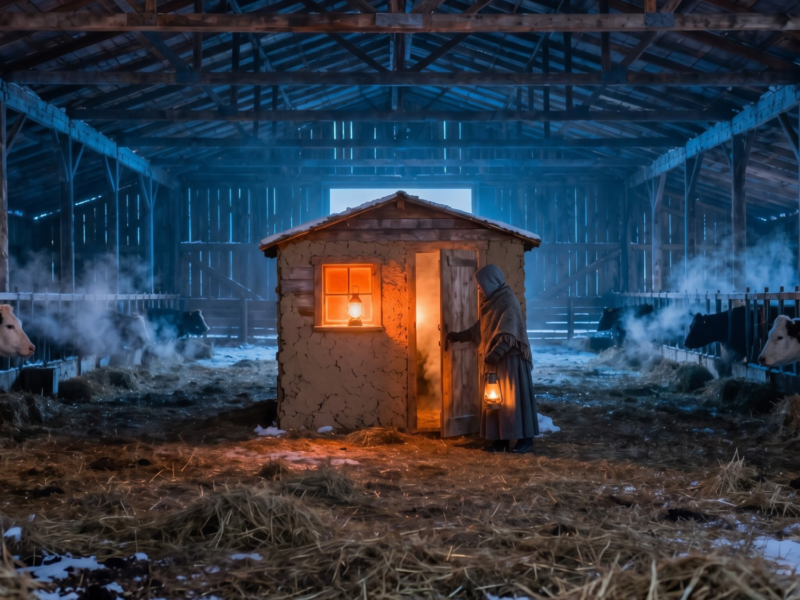
Nobody Believed Her When She Insulated the Cabin Inside Her Barn Until Temperatures Dropped 30°F
THE HARD WINTER OF '81
November brought teeth. Temperatures dropped lower each week—zero, ten below, fifteen below. On the worst nights, snow fell in relentless waves, burying the prairie under a white silence that swallowed all sound.
Inside the barn, Ingred’s system held. On November 15th, the outside temperature fell to eighteen below zero. The barn interior, warmed by six large animals digesting and breathing, maintained a steady twelve above zero. The inner cabin never dropped below thirty-four degrees. Cold, but survivable.
She fed the cattle extra hay on the worst nights, knowing that active digestion produced internal warmth. She kept ventilation shutters cracked by day to release moisture, sealing them tight at night to trap heat.
December brought a brief respite, but Christmas Day was celebrated in a sub-zero freeze. Ingred gave her children dried apple slices saved from autumn, carved a small wooden horse for Christopher and a hay doll for Marta, and told them stories about their father. That night, she lay awake listening to the cattle breathe, knowing the worst was still to come.
It arrived on January 8th, 1881.
The temperature at dawn was twenty below. By noon, thirty below. By nightfall, the killing cold arrived with a blizzard like the end of the world.
Wind screamed against the barn with physical weight. Ingred checked the sleeping children and tried the barn door. It was frozen shut, packed solid by drifted snow under immense wind pressure. Pushing with all her might, she forced a two-inch gap, letting in a knife-blade of air sharp enough to make her gasp.
Inside, the livestock were restless. The cattle lowed; the oxen stamped. The thermometer showed the barn interior dropping.
By midday, the barn stabilized at ten above zero, while the inner cabin held at thirty-two—right at freezing. Ingred checked hourly. Christopher was watchful; Marta complained her feet were cold, so Ingred wrapped them in extra wool and held her daughter close.
On the second day, Marta woke with a fever and a harsh, barking croup cough that tore from her small chest, threatening to close her airway.
Panic surged. She could not light a wood fire in the cabin—one spark would ignite the hay and canvas, burning them alive. She could not take Marta outside into the minus-thirty-five-degree air.
She looked at the chickens huddled on their roost. Eight small, warm bodies.
Moving quickly, she emptied a wooden crate, placed it on the sleeping platform near Marta’s head, and transferred the chickens inside, covering it loosely with a cloth. She lit three small candles, hanging a blanket across the doorway to create an even smaller micro-climate.
The thermometer crept upward: thirty, thirty-two, thirty-five degrees.
Ingred held Marta through the night, her body wrapped around her daughter, her hand resting on the small, heaving chest. Sometime after midnight, the fever broke in a drenching sweat. Marta’s breathing steadied, and she fell into a healing sleep.
Three miles east, the Gruber family was not as fortunate. Their livestock shelter was a three-sided open shed. Two of Gruber’s cows froze where they stood. Having burned his kitchen table and chairs for fuel, Gruber watched helplessly as his eighteen-month-old daughter succumbed to the cold before dawn, stopping breathing quietly in her crib. Gruber lost two fingers to frostbite trying to dig a shallow grave in the frozen ground.









