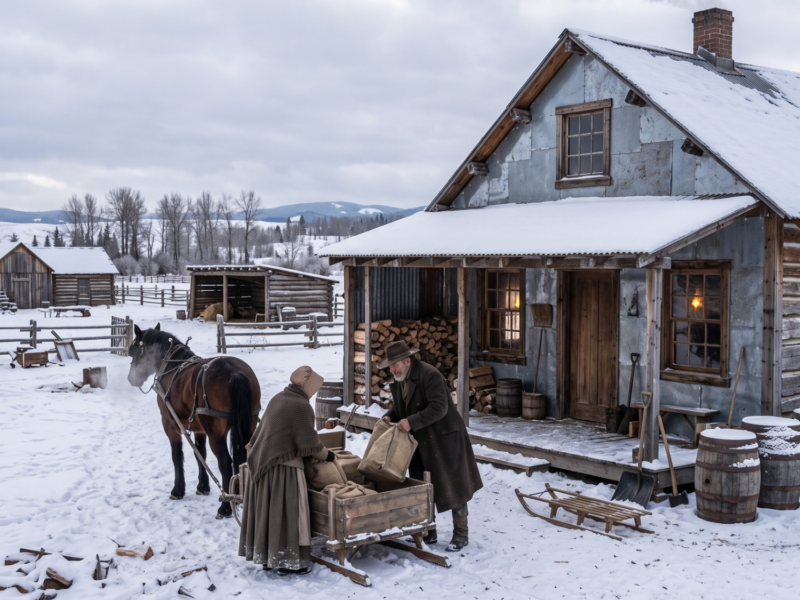
Settlers Laughed at His Sheet-Metal Wrapped Cabin — Family Lived While Neighbors Froze
THE WET SPONGE WALL
The fundamental problem, as Friedrich analyzed it, was not the log cabin itself. The conventional frontier wisdom was sound as far as it went: a thick log wall made of solid pine was a decent barrier against dropping temperatures.
The structural failure was far more subtle, hidden deep within the physics of materials. The true enemy wasn’t merely the drop in the thermometer; it was the moisture carried relentlessly by the biting wind.
In Iron River, standard cabins—such as the one belonging to the Omali family down by the creek, or the Svensons up on the rise—all suffered the exact same agonizing fate. Their owners were locked in a constant, unwinnable war against air infiltration.
The winter wind, carrying microscopic ice crystals and high humidity, was a relentless engine of convective heat transfer. It didn’t just blow around the cabins; it blew through them. It forced its way into the primitive chinking packed between the heavy logs. No matter how carefully the gaps were stuffed with mud, moss, and dried grass, every fierce gust of winter wind acted as an invisible pump, forcing warm indoor air out through thousand of hidden gaps while dragging frigid, damp air in.
Worse still, Friedrich understood what that migrating moisture did to the logs themselves.
A dry log is a magnificent thermal insulator. Its natural cellular structure is packed with millions of tiny, trapped air pockets, and still air is one of the greatest insulators known to science.
But when the wind forces dampness and ice vapor deep into the wood fibers, those microscopic air pockets fill with water. Water, compared to trapped air, is a thermal superhighway. A seasoned pine log with a moisture content of thirty percent loses nearly three-quarters of its natural insulating capacity. It abruptly ceases to act as a barrier and becomes a thermal bridge, actively conducting precious indoor heat out into the frozen wilderness.
The settlers were living inside walls that were actively betraying them, wicking away warmth from the very fires they labored day and night to feed. They saw only the superficial symptom—the desperate need for more firewood, always more firewood—but they were entirely blind to the hidden cause.
They were trying to heat a house built with a wet sponge for a wall.
Friedrol watched them, observing the dark circles under their eyes, the strain on their faces, and the ever-dwindling woodpiles. He knew their entire approach was fundamentally flawed. They were merely fighting the cold.
He intended to seal it out completely.









