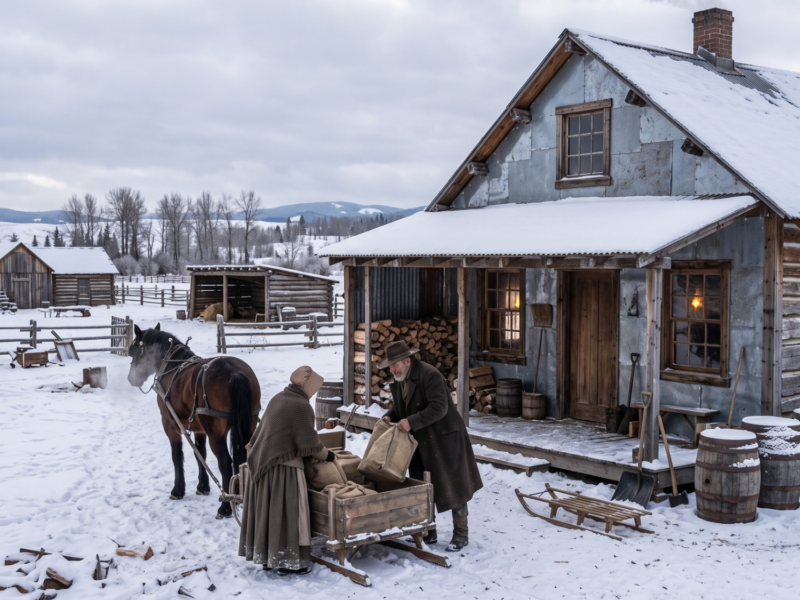
Settlers Laughed at His Sheet-Metal Wrapped Cabin — Family Lived While Neighbors Froze
THE APOCALYPSE OF ICE
That November, winter did not arrive with a gentle, seasonal decline. It struck as a sudden, brutal military assault.
A severe weather phenomenon known to the old-timers as a “northern forest inversion” settled over the Iron River basin. For eleven consecutive days, the ambient temperature never once climbed above thirty degrees below zero. At night, it plunged to a staggering minus thirty-four.
There was no wind, no blowing snow—just a dead, heavy, suffocating calm that pulled the heat out of the cutover like a physical, grasping hand.
The silence across the forest was absolute, broken only by a terrifying sound that chilled newcomers to the bone: the sharp, cracking reports of massive pine trees splitting down their centers as their internal sap froze and expanded with unimaginable force. The sound echoed through the two o’clock darkness like rifle fire, reminding every man in the camp of the immense, indifferent power of the northern wilderness.
For the families in the settlement, existence contracted into a desperate siege. Life shrank to the tiny, flickering circle of warmth surrounding the wood stove. The daily task of survival became a grim, unyielding mathematical calculation of fuel against time.
The Omali family burned through an entire cord of seasoned hardwood in four desperate days, their children huddled together, coughing ceaselessly in the drafty, ice-choked air. At the Svenson homestead, the windows were caked with rime frost so thick and opaque it turned midday into a gloomy twilight. They hung heavy woolen blankets over every doorway, but the cold still crept across the floorboards like a living thing.
Even Mortimer Krenshaw, secure inside his well-built camp office, kept his iron box stove glowing a dangerous, cherry red, yet the black ink in the glass well on his desk froze solid every single night. He had to thaw it out over the stovetop every morning just to log the daily tallies.
The camp had slipped into a state of quiet, desperate hibernation.
Yet inside the tin-wrapped cabin at the edge of the clearing, an entirely different reality unfolded.
The cold outside was acknowledged merely as a distant, external fact, not an immediate, life-threatening emergency. Friedrich fed his small iron stove sparingly—just a few split birch logs at a time.
Because the heat generated inside could not escape through convective drafts or conductive wet wood, it accumulated and stayed. The air inside the cabin was still, calm, and remarkably dry. There were no drafts dancing across the floor to chill the children’s ankles.
The windows displayed only a delicate, lace-like filigree of frost at the extreme outer edges, leaving the clear glass centers wide open to watch the frozen world outside. Anelise baked thick loaves of rye bread, and the warm, yeasty aroma filled the small space—a comforting smell of normal life that had vanished from every other home in the township.
Klaus and Marta sat at the wooden table, drawing on school slates with bare hands, their fingers nimble and warm. Friedrich, watching them by the light of a tallow candle, felt a profound, quiet satisfaction settle deep in his chest. His hands, which had known only cold sheet metal in the old country, had built a sanctuary of life from principles as unyielding as a soldered seam.









