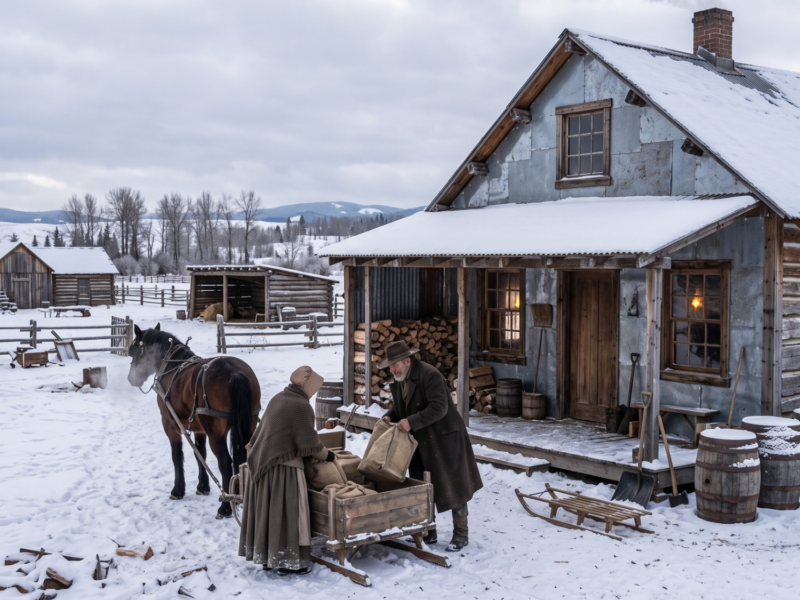
Settlers Laughed at His Sheet-Metal Wrapped Cabin — Family Lived While Neighbors Froze
THE BOWL OF SOUP
The breaking point for the camp’s skepticism arrived on the ninth day of the great inversion.
A young French-Canadian logger named Baptiste, working a distant section of the cutover, had his hand caught and crushed between two heavy pine logs while skidding timber. By the time the crew hauled him back to the bunkhouse, two of his fingers were stark white, stiff, and dead with frostbite.
The camp foreman, a pragmatic Scotsman named Sullivan, knew that without immediate, sterile care, the boy would lose the fingers—or worse, contract gangrene.
The only person in the entire settlement with medical supplies beyond whiskey and filthy bandages was Mortimer Krenshaw, who kept a private stock of specialized salves and ointments locked in his ledger desk.
Sullivan dispatched the timekeeper at first light. “Mortimer, take the frostbite ointment down to Baptiste’s cabin, and make it quick. The boy’s in a bad way.”
Krenshaw bundled himself in heavy layers of wool, canvas, and fur, and stepped out into the crushing, diamond-hard air. The atmosphere was so frigid it felt like inhaling shards of broken glass.
His direct route took him right past Friedrich Fohl’s property. As he trudged through the deep, powdery snowdrifts, he saw the familiar shapes of the settlement’s log cabins. Each one looked less like a human dwelling and more like an organic, distorted feature of the landscape, heavily bearded with a thick, three-inch white crust of hoarfrost.
The frozen breath of the families inside, combined with the microscopic humidity leaking through their walls, had condensed continuously upon the freezing logs, encasing every structure in a thick, crystalline armor of ice. It was the universal trademark of a Wisconsin winter—the unmistakable visual sign of a house fighting a desperate, losing battle against the cold.
Krenshaw braced himself for the sight of Fohl’s cabin, expecting his earlier predictions to be hideously vindicated. He half-imagined seeing the tin sheets sheathed in a monstrous, glittering wall of ice, the soldered seams groaning and perhaps already split wide open under the thermal stress.
What he saw instead stopped him dead in his tracks, his breath catching in his throat.
Fohl’s tin cabin was utterly clean.
Under the pale, weak light of the dawn, the galvanized metal was bare—a dull, uniform industrial gray contrasting sharply against the blinding white snowdrifts. There was no ice, no heavy frost, not even a light dusting of powdery rime anywhere on its surface. It stood stark, artificial, and completely untouched by the atmospheric phenomenon that had encased every other building in the valley in a tomb of ice.
Krenshaw approached the structure slowly, a profound sense of disbelief warring with the undeniable evidence of his own eyes. It made no rational sense. A polished metal skin exposed to sub-zero air should have been the coldest object in the entire forest—a magnetic canvas for moisture to freeze upon.
He reached out a gloved hand toward the wall, then hesitated. With a sudden motion, he pulled his heavy leather glove off with his teeth, his bare skin instantly stinging in the cruel air.
He expected to touch a surface so intensely cold it would instantly bond and tear the flesh from his palm. Instead, he laid his bare hand flat against the galvanized tin at chest level.
The sensation was a profound shock.
The wall was not hot, nor was it aggressively, bitterly cold like frozen iron left out in the snow. It was merely cool—neutral to the touch, possessing the steady, unchanging temperature of a stone pulled deep from a root cellar.
It was bone-dry.
Krenshaw ran his bare fingers down one of the long, vertical solder seams. It was smooth, continuous, and just as free of frost as the flat sheets beside it. He pressed his ear tightly against the metal and heard nothing—only a deep, profound silence. There was no whistling draft of wind, no settling creak of stressed timbers.
Then he noticed the final, irrefutable proof.
On the wide wooden sill of the front window, clearly visible through the un-frosted glass pane, sat a simple ceramic bowl. It was Anelise’s supper bowl, left out on the sill to cool the night before. Krenshaw could see the contents clearly: a thick, hearty stew of cabbage and salted pork.
As he stared in utter bewilderment, Friedrich Fohl walked up to the window from inside. The German casually picked up the bowl to bring it in, and as he lifted it, he gave the contents a slight nudge with a spoon.
The dark broth at the center of the bowl trembled.
It was still liquid.
Krenshaw stood frozen in the snow, his mind reeling into chaos. He thought of his own office inkwell, frozen solid as a rock just three feet away from a roaring red-hot stove. He thought of the stew pots in Baptiste’s cabin, which he knew would be frozen solid blocks of gray ice and meat that could be lifted by the bone like a club.
And here, resting on an exposed exterior windowsill at thirty-four degrees below zero, was a bowl of soup that was still soup.
In that single, crystalline moment, Mortimer Krenshaw understood the profound depth of his own ignorance. The mockery, the confident predictions, the absolute certainty born of his frontier experience—it all collapsed into dust. He wasn’t looking at a foolish immigrant’s mistake.
He was looking at a masterpiece.









