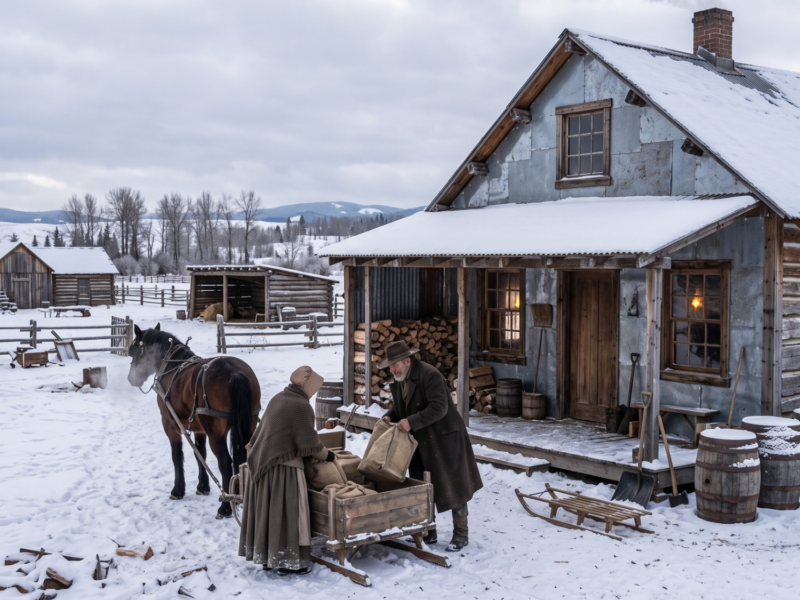
Settlers Laughed at His Sheet-Metal Wrapped Cabin — Family Lived While Neighbors Froze
THE DRY SKY
Krenshaw delivered the frostbite salve to Baptiste, his mind wandering in a daze. Later that afternoon, after the pale sun had completed its brief, useless arc across the white sky, he walked back down to Fohl’s clearing.
Friedrich was outside in the snow, calmly splitting a few pine logs from his modest, half-full woodpile. He worked with an unhurried, efficient rhythm, his axe biting cleanly into the wood.
Krenshaw stood silently at the edge of the clearing for a long moment, simply watching. Finally, the German looked up, resting his hands on the axe handle, his expression calm and impassive.
“Fohl,” Krenshaw began, his voice raspy and dry in the cold air. “I was wrong.”
It was a painful, difficult admission for a man who ruled his life by unyielding ledgers and infallible facts. “I told everyone your seams would fail. I told them your tin house was a ridiculous joke.”
Friedrich simply reached down, picked up a split billet of pine, and tossed it neatly onto the stack. “It is not a joke.”
“No,” Krenshaw said, shaking his head slowly, a look of quiet awe washing over his hardened features. “No, it’s not.”
He looked closely at the stark, metallic walls of the cabin, seeing them now not as a crude container, but as an absolute boundary line between two different worlds. He searched for the right words to capture the revelation that had shattered his worldview.
He thought of the heavy, frosted, suffocating log walls of his own office, walls that trapped damp misery inside. Then he looked back at the clean, sharp, unbroken lines of the tin exterior.
“I thought you built a tin can,” Krenshaw whispered, his voice trembling slightly. “But I was wrong. You didn’t build a wall at all, Fohl. You built a dry sky around your house.”
The conversion of Mortimer Krenshaw was as swift as it was total. As a man driven entirely by hard facts and empirical results, the undeniable truth that Fohl’s family was warm, safe, and dry while the rest of the settlement suffered in misery carried immense weight.
When Krenshaw delivered his verdict to the camp—describing the bare metal, the frost-free walls, and the liquid soup sitting in sub-zero air—the mocking laughter that had dogged Friedrich all autumn died instantly, replaced first by stunned silence, and then by a deep, grudging respect.
When the great cold finally broke with the arrival of March, local families began to visit the tin cabin—not to scoff, but to learn.
Friedrich, a man of few words, would simply demonstrate his craft. He would point to the shining silver soldered lap, tap the dry galvanized sheet, and then lead them inside to experience the calm, draft-free warmth.
He explained his philosophy in simple, direct terms: “The enemy is not the cold, my friends. The enemy is the damp. Keep your logs bone-dry, exactly like a good roof. What the rain cannot penetrate from without, the frost cannot steal from within.”
EPILOGUE: THE ANCESTOR OF HIGH PERFORMANCE
News of the German metal smith’s miraculous cabin spread rapidly through the logging camps and remote settlements of northern Wisconsin.
That spring, the story reached Milwaukee and caught the attention of a pastor involved with the Deutsche Lutherische Hilfsverein—an immigrant aid society dedicated to helping newcomers from the Old World survive the ferocious climate of the American Midwest.
The society was constantly battling the deadly ignorance of fresh arrivals who were utterly unprepared for the savagery of a Midwestern winter, publishing advisory pamphlets filled with practical guidance on everything from planting seasons to treating severe frostbite.
Intrigued by the reports from Iron River, the society dispatched a representative—a young, sharp-eyed German-American civil engineer—to investigate.
The engineer spent two full days with Friedrich Fohl, sketching details, taking precise measurements, and listening intently. He was utterly astounded. Fohl had used the simple, traditional tools of his rural trade to create a near-perfect building envelope—a conceptual breakthrough decades ahead of its time.
Returning to Milwaukee, the engineer drafted a formal, highly detailed technical diagram of Fohl’s method: the lapped tar-paper underlayment, the precise one-and-a-half-inch overlap on the galvanized tin sheets, and the crucial technique of the continuous lap-soldered seam.
The diagram, titled Ein Verfahren für eine trockene und warme Winterwohnung (“A Method for a Dry and Warm Winter Dwelling”), was immediately added to the Hilfsverein’s winter readiness bulletins. By the autumn of 1889, those pamphlets were being placed directly into the hands of bewildered German immigrants stepping off trains in Milwaukee, Chicago, and St. Paul.
The hard-earned wisdom of one quiet, observant smith was rapidly becoming the protective shield of hundreds.
What Friedrich Fohl accomplished in the snowy woods of northern Wisconsin was far more than a clever frontier construction trick. He was anticipating the core thermodynamic principles of modern building science by more than half a century.
In the twenty-first century, modern builders wrap high-performance homes in sophisticated synthetic membranes like Tyvek, utilizing specialized industrial acrylic tapes to seal every potential air leak. Modern engineers speak endlessly about “air barriers” and “vapor retarders” as if they were recent high-tech inventions born in university laboratories.
Yet back in 1888, a humble German metal worker, armed with nothing more than sheet tin, tar paper, a charcoal brazier, and a hot copper iron, created an exterior envelope so thermally effective it met the rigorous standards of modern passive-house construction. His soldered metallic skin was the direct, spiritual ancestor of the fully taped, high-performance wall systems that remain the gold standard in extreme cold-climate engineering today.
Fohl did not possess the modern academic vocabulary of R-values, dew points, or vapor transmission rates. But he possessed something far deeper and more tactile: an earned mastery through trade over the absolute integrity of a seam.
There remains a profound, timeless lesson in Friedrich Fohl’s story—one that echoes the simple theme by which he lived his life: What the rain cannot get under, the cold cannot get through.
One single, perfectly sealed seam had conquered two brutal seasons. His true genius lay not in the invention of an entirely new material, but in the brilliant application of an ancient, rigorous principle within a hostile new context. He recognized instantly that the physical forces attempting to drive water into a roof from the outside were precisely the same forces attempting to drive heat out of a living space through a wall.
It was all a matter of uncontrolled infiltration. By focusing with absolute, unyielding rigor on the physical integrity of the seam, he solved both catastrophic problems at once.
The American frontier never rewarded academic credentials, family lineage, or blind tradition. It didn’t care where an immigrant came from or what language he spoke at home. It rewarded only what actually worked.
And in the brutal, freezing winter of 1888, what worked above everything else was the quiet, methodical perfection of a man who understood that the strongest wall in the world is never the thickest one—it is simply the one that is most perfectly sealed.









