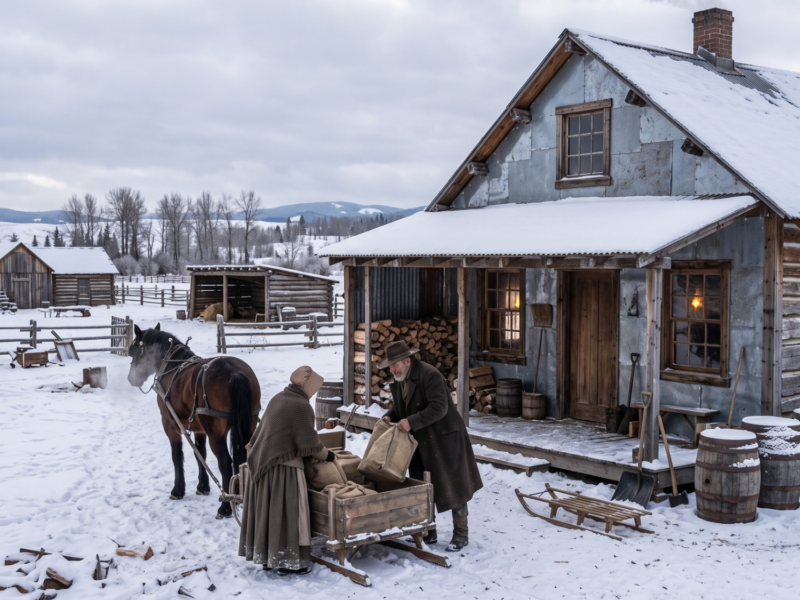
Settlers Laughed at His Sheet-Metal Wrapped Cabin — Family Lived While Neighbors Froze
THE INVERSION
To understand the profound genius of what Friedrich Fohl was achieving, one had to look past the crude appearance of a tin-wrapped box and examine the three fundamental ways heat moves: conduction, convection, and radiation.
The frontier settlers understood conduction well enough; they knew empirically that a thick wall resisted cold better than a thin one. They had a rough, intuitive grasp of radiation, knowing they had to stand close to the iron stove to feel its direct glow.
But they fundamentally underestimated the devastating role of convection—specifically, the bulk movement of air and its destructive accomplice, water vapor.
A cubic foot of air at thirty degrees Fahrenheit might seem insignificant, but billions of those cold molecules driven by a twenty-mile-per-hour gale represented a massive, continuous theft of thermal energy. This was convective heat loss. A standard log cabin, with its thousands of microscopic gaps in the chinking, acted like a wire sieve against the wind.
Fohl’s soldered metallic skin addressed this flaw head-on. The lapped, soldered seams created an exterior building envelope that was, for all practical purposes, entirely airtight. Air simply could not force its way through the walls. At a single stroke, he had eliminated convective heat loss.
Yet controlling moisture was the greater, more brilliant triumph. As Fohl well knew, a wet log is a thermal disaster. The scientific measure of insulation is R-value; a dry, seasoned pine log possesses an R-value of roughly 1.4 per inch of thickness, giving an eight-inch log wall an insulation value of around 11.
However, when that same pine log becomes saturated with wind-driven ice vapor, its R-value plummets to less than 3. The wall stops insulating and begins conducting heat away at an alarming rate.
Fohl’s tin sheathing acted as a flawless, impenetrable vapor barrier. It presented an absolute shield to the elements. No wind-driven moisture could ever reach the underlying logs. The tar paper beneath provided a secondary defense, and the crucial half-inch air gap between the paper and the tin created an essential thermal buffer.
While his neighbors lived inside damp, freezing thermal conductors, Friedrich Fohl’s family was sheltered by a warm, bone-dry insulator. He hadn’t merely wrapped his cabin in metal; he had locked its natural insulating power safely inside and locked the brutal weather permanently out.









