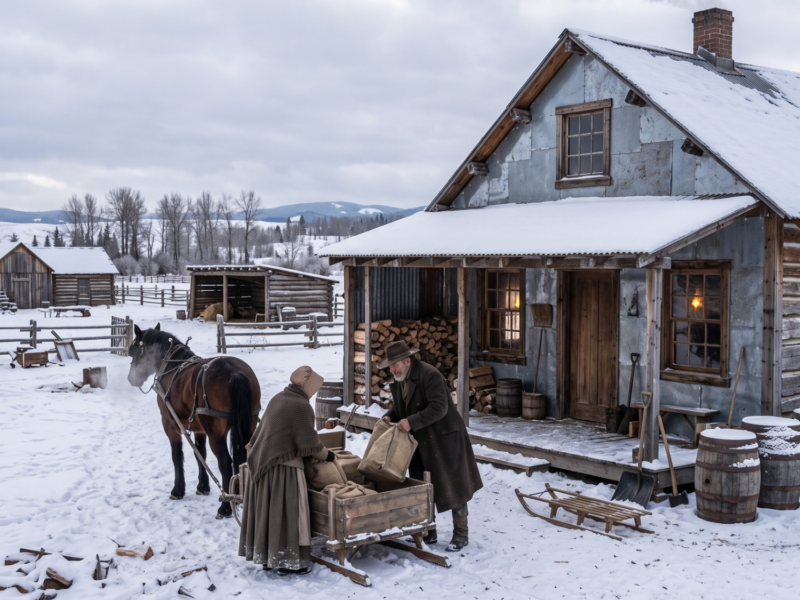
Settlers Laughed at His Sheet-Metal Wrapped Cabin — Family Lived While Neighbors Froze
THE SEAM OF INTEGRITY
Fohl’s construction project began in late September, executed with the methodical discipline of a master craftsman.
First, he covered the entire exterior log structure—from the stone foundation all the way to the eaves of the roof—with sheets of thick, heavily tarred building paper. He overlapped each heavy sheet by a full six inches, creating a continuous, dark, impermeable sheath over the logs.
The curious neighbors viewed it as a bizarre, funereal shroud. Friedrich saw it merely as his first line of defense—a durable barrier designed to block the brute force of the wind.
Then came the tin.
He had spent a significant portion of their meager savings on heavy crates of two-by-eight-foot galvanized iron sheets, hauled overland by wagon from Duluth. He worked with a quiet, unhurried precision that baffled the onlookers.
He hung the first sheet, checking it repeatedly with a plumb bob to ensure absolute verticality. The succeeding sheet overlapped the first by exactly one and a half inches.
This lap was the crucial element—the entire soul of the operation.
Using a small charcoal brazier to keep his heavy copper soldering irons glowing hot, Fohl set to work. He cleaned the overlapping metal edges with a wire brush, applied a thin smear of acidic flux that hissed and smoked angrily in the crisp air, and then drew the hot, tinned tip of the copper iron smoothly down the length of the joint.
A bright, liquid bead of silver-gray solder flowed instantly behind the iron, cooling within seconds into a permanent bond that was not merely mechanically fastened, but hermetically, molecularly sealed.
It was this meticulous, slow process that drew Mortimer Krenshaw’s most pointed public criticism. As camp timekeeper, Krenshaw understood mechanical stress and load distribution. He looked at the dead weight of the tin sheets and imagined the far greater, crushing weight of ice and packed snow that would inevitably cling to them.
Krenshaw made his authoritative pronouncement right inside the camp office:
“He’s wasting his time and his silver,” Krenshaw declared to the assembled loggers. “That solder is for patching leaky wash-tubs, not holding a house together. Come the first real ice storm, the weight of that sheet metal will pop those little silver seams like buttons off a tight shirt. Mark my words: by January, Fohl will find forty feet of tin peeled right off his logs and dumped into the snowdrifts.”
The logic seemed airtight, rooted firmly in every bit of harsh frontier experience. Ice was a powerful, destructive lever; every man in the camp had seen winter frost split solid granite boulders and heave heavy cabin foundations out of plumb. The idea that a German immigrant’s delicate silver lines could resist that kind of geological force seemed utterly absurd.
When a Scottish logger named Peterson repeated Krenshaw’s gloomy prediction directly to Friedrich, the metal smith merely glanced up from his brazier, his expression placid.
“The seam is for water,” Friedrich said quietly, his thick German accent softening the harsh words. “The iron nails hold the dead weight. The seam will hold the sky.”
He turned back to his fire, leaving the logger utterly baffled. The mockery lasted through October. The validation, Friedrich knew, would last a lifetime.









