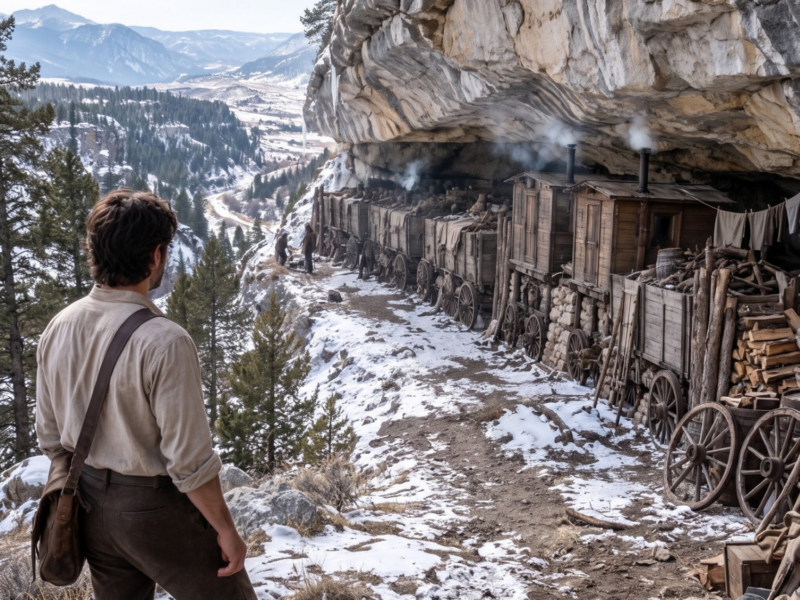
The Supply Train Never Made It Through the Pass—He Found Where They Spent Their Last Winter
The Supply Train Never Made It Through the Pass—He…
The Supply Train Never Made It Through the Pass—He Found Where They Spent Their Last Winter
He was nineteen years old and the only man in the valley willing to ride up into the pass after the snow closed it.
No one had asked him. No one had offered him wages. There was only a valley short of flour and seed and lamp oil, a supply train that had never come through, and a story going around the bunkhouses that the teamsters had cut the traces and run.
Samuel Weaver did not believe that story. What he found buried past the drifts in a line shack no one had thought to check would turn the story on its head.
Samuel Weaver had been born in the long, low valley the ranch hands called Willowbottom nineteen winters back to a mother who did not live past his fourth birthday and a father who worked the McCrae outfit as a fence rider until a horse rolled on him in the spring of Samuel’s twelfth year and left him a man who could sit a porch but not a saddle.
After that, it had been the two of them in a plank house near the creek: the father mending harness for coin and reading aloud from a Bible with a broken spine, and the boy taking whatever wages the valley would put in his hand. He carried water for the cook at the McCrae place when he was thirteen. He shoveled the stalls at the livery when he was fourteen. By fifteen, he was riding fence himself on a borrowed roan, and by sixteen he had learned to shoe a horse, dress a deer, patch a wagon tongue with rawhide and green oak, and read weather off the shoulder of the mountains the way other boys read the faces of their sisters.
The man who taught him most of it was an old teamster named Halvor Bench, seventy-one that last winter, a widower who lived in a one-room cabin at the mouth of the pass and drove a mule string down to the rail town twice a year when his knees allowed. Halvor had known Samuel’s father in better days and had taken to the boy without ceremony, the way certain solitary men take to a stray dog that shows sense.
He taught Samuel how to pack a mule so the load rode balanced through switchbacks. He taught him the names of the passes and the shape of the trails through them, which creeks ran under ice in February and which did not, and how to read the set of a wagon rut to tell how many days had passed since a wheel had gone over it. He taught him to build a fire in wet timber with nothing but a knife and patience. And he taught him more than once that a man’s word about what he saw in the mountains was the only thing he brought back down that mattered.
Halvor had died in the fall of Samuel’s eighteenth year, quiet in his chair with the stove still warm and a tin cup of coffee gone cold at his elbow. He had left the boy his mule string, his harness, his brass-cased pocket compass, and a folded pair of wool gloves lined with rabbit fur that Halvor’s wife had sewn for him forty years earlier, and that Halvor had never worn once, only carried the way a man carries a photograph.
Samuel kept the compass in his coat pocket at all times, and the gloves wrapped in oilcloth in his saddlebag, and he had not put the gloves on his hands even once, though he had cold ones often. Some things you carried because carrying them was the point.
His father had died the following spring in his sleep at the plank house by the creek, and Samuel had buried him beside his mother on the low rise above the willows and had gone on riding for the McCrae outfit because there was nothing else to do and no one left to do it for.
He was not a talker. He was not a churchgoer. He was known in the valley as the weaver boy: quiet, dependable, a good hand with a mule and a better one with a wagon, and the sort of young man the older ranchers would nod to across a store counter without needing to say his name. He had in the leather pouch at his belt the compass, eleven dollars, and a folding knife with a bone handle that Halvor had given him on his seventeenth birthday. That was the whole of what he owned outright in the world.
Related Articles

They Mocked the Widow’s Dirt Cellar—Then the Freeze Left Every Cabin Cold but Hers Warm
They Mocked the Widow’s Dirt Cellar—Then the Freeze Left Every Cabin Cold but Hers Warm…

A Homeless Veteran and His German Shepherd Inherited a Ridge No One Wanted — 35 Feet In, They Found
Chapter 1 / 7 A Homeless Veteran and His German Shepherd Inherit… A Homeless Veteran…

Neighbors Laughed When He Built A Cabin Inside An Old Barn—Until It Kept His Home 35 Degrees Warmer
Chapter 1 / 8 Neighbors Laughed When He Built A Cabin Inside An… Neighbors Laughed…

His Sod House Had No Woodpile in January – Until the Trains Stopped and the Town Came Begging
Chapter 1 / 10 His Sod House Had No Woodpile in January – Until t……

She Built Her Cabin Over the Woodshed and Never Burned Wet Wood Again
Chapter 1 / 8 She Built Her Cabin Over the Woodshed and Never Bu… She…

The Duke Abandoned Her on Their Wedding Day—Years Later, He Discovered What He Had Lost
Chapter 1 / 7 The Duke Abandoned Her on Their Wedding Day—Years… The Duke Abandoned…

He Wedged a Tiny A Frame Into a Crevice Before Winter and His Family Slept at 75°F While Town Hit
Chapter 1 / 7 He Wedged a Tiny A Frame Into a Crevice Before Win……

He Was Too Old to Ride—So He Bought the Ruined Ranch and Found the Room Behind the Fireplac
Chapter 1 / 5 He Was Too Old to Ride—So He Bought the Ruined Ran……

Settlers Laughed at His Underground Heat Recovery Duct — Until It Kept His Cabin 71°F Warmer
Chapter 1 / 9 Settlers Laughed at His Underground Heat Recovery… Settlers Laughed at His…

A Navy SEAL Built a Home Inside a Mountain—Then His Dog Warned Him Before the Storm
Chapter 1 / 5 A Navy SEAL Built a Home Inside a Mountain—Then Hi… A…