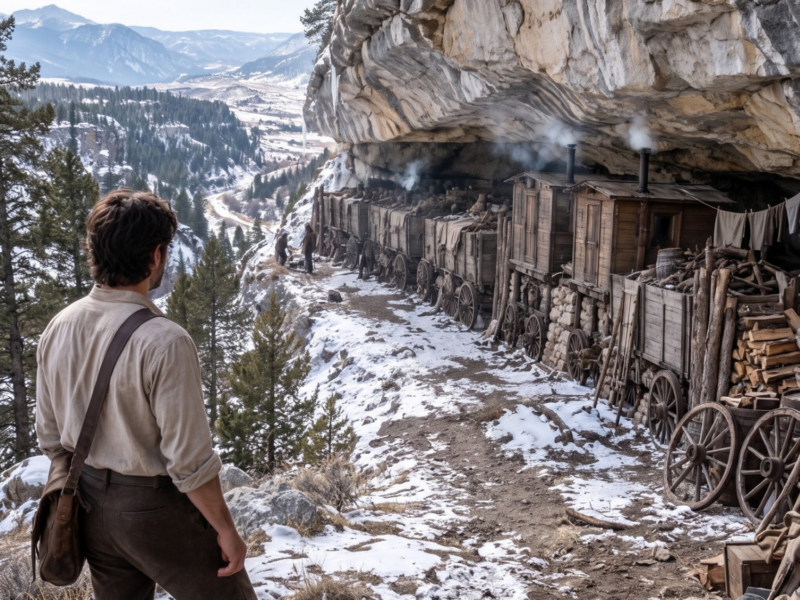
The Supply Train Never Made It Through the Pass—He Found Where They Spent Their Last Winter
The Ledger Read Aloud
He told it at the store that evening with the seven sheets on the counter and the leather sack beside them, and the men of the valley standing three deep to the door.
And he told it plain, in short sentences, the way Halvor had taught him a man told a thing he had seen in the mountains. When he was done, the foreman who had spoken the sentence about honest drivers took off his hat and did not put it back on. And a woman at the back of the store whose husband had been the boy Micah Reed’s uncle sat down on a flour barrel and cried without covering her face.
No one in the store spoke against Aught Pearlman that night or after.
In the spring, when the notch opened, twelve men went up with fresh mules and brought the four wagons down whole, and every parcel in them went to the household whose name was on it. And the little sack of flour that had been eaten was made up out of the McCrae crib without anyone asking who would pay for it.
The board over the boy’s grave was replaced with a proper cut stone hauled up on a sledge, and Aught Pearlman himself set it in the ground, and Samuel Weaver stood beside him while he did it and held the level and said nothing, which was what was wanted in the valley.
After that, Samuel was no longer called the weaver boy. He was called Samuel by the older men and Mr. Weaver by the younger ones. And when a wagon needed taking through country that other men did not care to cross, his name was the one that came up first at the store.
Ward McCrae raised his pay by a third without being asked and gave him the use of a small cabin at the north end of the McCrae place—one room with a stove and a bunk, and a window that looked up the road toward the pass.
Samuel moved his blankets, his slicker, and his spare shirt into it. And on the wall above the bunk he drove two wooden pegs and hung Halvor’s rabbit-lined gloves there in their oilcloth, unfolded now for the first time in a year so that anyone who came in could see them. On the shelf beside the stove, he set Halvor’s brass compass and the bone-handled knife. And beside them, wrapped in the blue checked apron cloth, the seven penciled sheets which Aught Pearlman had told him to keep, because a record like that belonged with the man who had gone to find it.
The forty-two dollars was gone—half to Micah Reed’s people and half to the widow of Harl Dolvet in Fenton, delivered in person by Aught Pearlman in April, with Samuel riding beside him. The leather sack had come back empty and was on the shelf too, folded flat.
On winter evenings after that first year, Samuel would sit on the bench inside the small cabin with the stove ticking, the window black, and the road up to the pass invisible in the dark. And he would look at what he had on the shelf and on the pegs, and understand what each thing was.
The gloves were from a man who had taught him how to read a wagon rut and had died in a chair with cold coffee at his elbow and had left him a pair of gloves sewn by a wife forty years gone. The seven penciled sheets were from a man he had known only by name at the store, who had sat in a shack ten by twelve with a sick boy and a sick friend and had kept a tally of a broken sack of flour so the valley would not be cheated of an ounce.
Two strangers, in a way—and neither of them strangers at all. And both of them had trusted that someone would come after and find what they left and understand it.
Samuel understood it.
The men who had said the teamsters had cut and run were quiet at the store now when he came in, and the foreman who had spoken the sentence nodded to him and did not look at him long. Samuel Weaver was nineteen and had ridden alone into Martin Pass in December with a lame mule, eleven dollars, and a folding knife, and he had come back down with the truth about four men. It was the best ride he had ever made.









