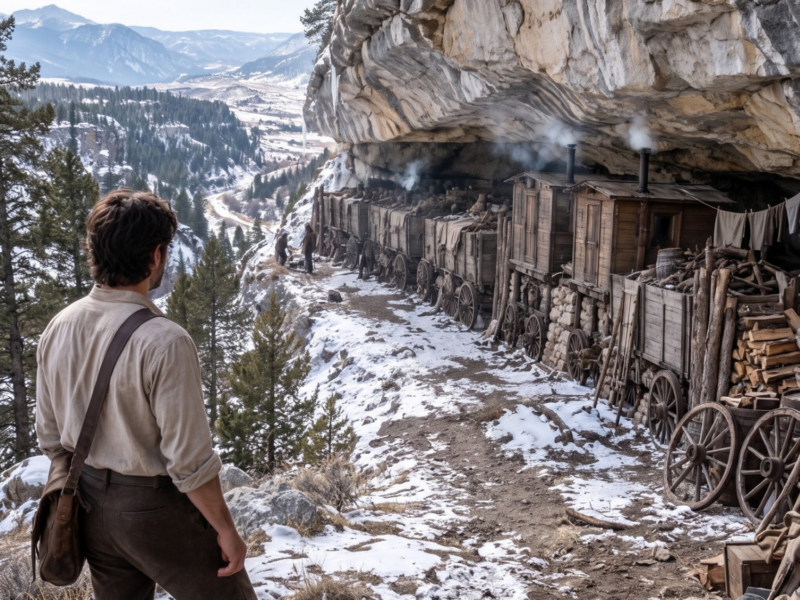
The Supply Train Never Made It Through the Pass—He Found Where They Spent Their Last Winter
The Ascent
In the bunkhouse, he rolled his blankets, his slicker, and his spare shirt into a tight bundle and tied it with the length of manila rope he kept coiled under his bunk. He packed into a flour sack the hard bread, the cold bacon, the twist of coffee, and the small tin of salt the cook had set out for him without a word the night before. He put the sack inside an oilcloth, and the oilcloth inside a canvas pack.
He took down from the nail above his bunk the folding knife with the bone handle and put it in his belt pouch beside the eleven dollars and the brass compass. He took the oilcloth bundle with the rabbit-lined gloves out of his saddlebag and set it on top of the blankets so that it would ride against his back.
He went out to the back pen and looked at the small brown mule a long time, then went to the forge and heated a paring knife, trimmed the split hoof clean, packed it with pine tar, and wrapped it with a strip of leather. By afternoon the mule could walk without favoring, and by evening she could carry a pack, and by first light of the next morning, Samuel Weaver was on the north road out of the valley with the small brown mule behind him on a lead, the wind at his back, and no one on the porch to watch him go.
The road climbed slow for the first six miles through the willow bottoms and the fenced hay meadows, and passed the low rise where his father and mother lay under two flat stones. He stopped there a moment and put his hand on the nearer stone and did not speak. Then he took up the lead again and went on.
The sky was the color of scoured pewter, and the wind came down off the peaks in long, even pulls that smelled of stone and of old snow. By noon the last fence line was behind him, and the country opened into the roll of gray grass and scattered pine that ran up to the foot of the pass. He walked more than he rode, saving the mule for the harder ground ahead, and he ate a piece of bread in the saddle without stopping.
By the short winter dusk, he had made the timbered flat below the first switchback and had put up a small camp under a leaning spruce, with the panniers hung high against the porcupines, the mule tied close, and a fire small enough to warm his hands and boil coffee, and no larger. He slept in his blankets with the compass in his coat pocket against his ribs and the gloves in the oilcloth under his head.
In the night he heard an owl, heard the mule shift her weight, and heard the wind change once and settle back. He woke before the light, drank the last of the coffee cold, and was moving again while the sky was still the color of iron.
The second day the trail steepened and the timber closed in. By afternoon he was walking in the ruts of Halvor’s old summer track, and he could read where a rider had come down two weeks back, and where nothing had come down since. By the third day he was in snow to the mule’s fetlocks, and by the fourth to her knees, and the wind that came down through the notch above was a cold that got in through the seams of a coat and stayed.
He rested the mule often and talked to her in a low, steady voice about nothing in particular, the way Halvor had talked to his own string. He watched the sky, watched the drifts, and watched the tops of the pines for the way they were bent.
On the evening of the fifth day, with the light already gone out of the west and the cold coming down out of the notch like water down a chute, he pushed up around the shoulder of the last long switchback and saw ahead of him the flat white bench above the creek where Halvor had once told him a line shack stood.
He saw nothing there but snow.









