The Supply Train Never Made It Through the Pass—He Found Where They Spent Their Last Winter
The Line Shack
He stopped in the trail, stood a long time with his hand on the mule’s shoulder, and looked.
There was a shape under the snow that was not a drift. It was too square at one end and too flat along the top, and the wind had scoured a small dark seam along its north edge where a stovepipe stuck up no higher than a man’s fist.
He led the mule off the trail and up onto the bench, breaking through crust to his thigh in one place and standing on a hard old drift in the next. When he reached the shape, he cleared the snow from what he judged to be the door side with his gloved hand and with the flat of his hat. After a quarter hour, he had uncovered the upper half of a plank door hung on iron strap hinges rusted the color of old blood.
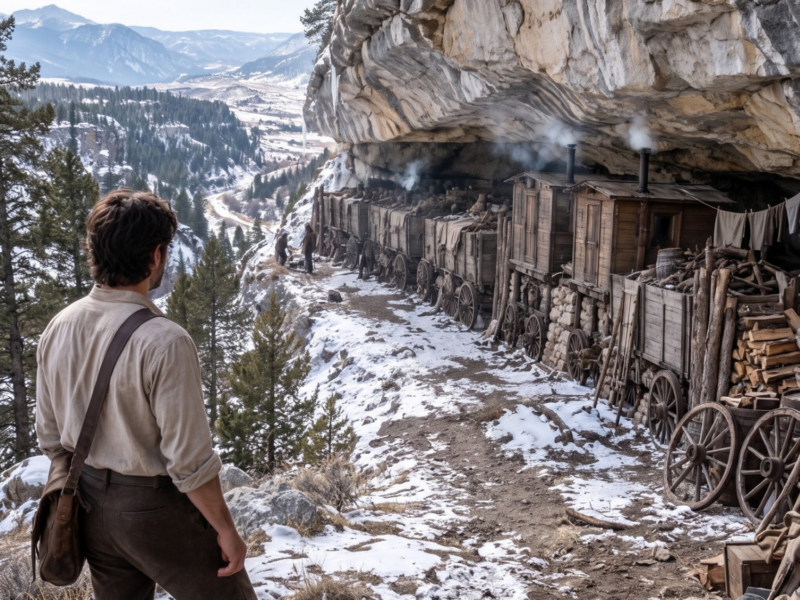
The shack was small—ten by twelve feet at the most—built of squared spruce logs chinked with clay and horsehair, with a shed roof pitched low toward the back and a single window on the south wall covered from inside with a nailed square of oilcloth. The ridge log was sagged in the middle where forty winters of snow had pressed it, and one corner of the roof had lost its shakes and been patched at some earlier time with a piece of tin roped down through the eaves.
The door was frozen shut at the sill. He kicked the snow away from the bottom, worked the point of Halvor’s bone-handled knife into the seam, and pried until the ice let go with a soft, dry crack. The door swung inward on its stiff hinges into a dark that smelled of cold ash and old canvas, and faintly of hay.
He stood a moment on the sill and let his eyes come to it. Inside was one room. To the left of the door stood a sheet-iron stove no bigger than a nail keg, its pipe going up through a tin thimble in the roof, its door hanging open and half a burnt stick still sitting in the grate. Along the back wall ran a plank bunk wide enough for two men to lie shoulder-to-shoulder, and on the bunk was folded a gray wool blanket, coarse and mouse-chewed at one corner, but whole. Beside the stove was a short bench with a tin cup on it, and on the floor beneath the bench, a coffeepot black as pitch. A shelf on the wall held a candle stub in a tin saucer, a box of matches wrapped in waxed paper, a small tin of salt, and a book with a limp cloth cover that he did not touch yet.
Above the door, on two wooden pegs, rested a cross-cut saw with the teeth still bright. In the corner opposite the bunk was a small heap of split spruce, dry enough for three or four fires.
He brought the mule up under the eaves on the lee side where the drift had cut back and made a hollow, tied her to a peg driven into a log end, packed snow away from her feet, gave her a double handful of grain from the pannier, and put the canvas over her back. Then he went in, closed the door behind him, and stood in the dim, letting the shack take the wind off him for the first time in five days.
He built a small fire in the stove with shavings from a piece of the split spruce and a match from the waxed paper. When the flame caught, he fed it slowly—first pencil-thin pieces, then thumb-thick pieces—and when the stove began to tick and pop with the heat, he sat down on the bench and put his hands out to it and did not move for a long time.
When he could feel his fingers again, he took stock. The bunk boards were sound. The stove drew clean. The chinking had fallen out in three places along the north wall, but could be patched with rag and mud. The oilcloth window was intact. There was a broom of tied willow twigs behind the door, and on the floor, half under the bunk—pushed there as if kicked in a hurry, or set carefully out of the way—was a wooden crate. Stamped on its end in faded black letters were the words Fenton Mercantile, and beneath that a stenciled number 4.
He knelt down and pulled the crate out into the light of the open stove. It was a nail crate of the sort that came up from the rail town by wagon, the boards planed on one side and rough on the other, and the top had been lifted off and set back on without being nailed down.
He took the top off.
Inside were nails, yes—a double handful of ten-penny nails at the bottom. But on top of the nails, wrapped in a piece of blue checked apron cloth folded twice, was a bundle of papers, and on top of the papers was a small leather sack tied with a rawhide thong.
He sat back on his heels, set the sack aside without opening it, and lifted out the papers.









