The Supply Train Never Made It Through the Pass—He Found Where They Spent Their Last Winter
The Tally Book
There were seven sheets of the ruled kind torn from a teamster’s tally book, and they had been written on in pencil on both sides in a hand he had seen a hundred times on freight receipts down at the store: the plain, square hand of Aught Pearlman.
He carried the sheets over to the bench, laid them out in order by the numbers penciled at the top of each, added another piece of spruce to the stove for the light, and began to read.
The first sheet was dated the 16th of November. It said:
“We are four wagons and eight mules and four men and are stopped at the line shack on the bench above Elk Creek because the notch is filled to the second blaze and no team will take it and no man on foot will come back down through it living. We have decided to hold here with the load until a break in the weather or until we know for certain no break will come.”
The wagons were pulled up under the north wall and covered with the tarps roped double. The mules were in the lee of the shack with what grain we have. There followed eight names of the mules, each with a note on its condition, and then the four names of the men: Aught Pearlman, Jim Dolvet, Peter, and the boy Micah Reed, aged fifteen. And beside each name, the state of his boots and his coat and the weight he could still lift.
Samuel read the first sheet through twice. Then he laid it down flat on the bench, put his hand on it, and looked at the stove for a long moment without seeing it.
He read the second sheet. It was dated the 18th. It said the wind had held from the north for two days, and the drift at the notch had risen half a wagon length in that time, and that Harl Dolvet and Jim Dolvet had gone up the trail as far as the second blaze to see whether the wind had scoured a passage on the west side, and had come back at dark saying it had not.
It said the mules were fed a short ration of grain and given brows cut from the young spruce along the creek, and that one mule—the near wheeler of the second wagon, called Bess—had begun to favor a foreleg. It said the men had gone through the loads and set aside a small sack of flour, a tin of lard, and a paper of salt from a broken parcel, and were eating from that so as not to break any bill of goods paid for down in the valley.
Samuel read that line twice as well. He read the third sheet and the fourth, and the shack around him grew warm enough that the frost on the door hinges melted and ran down in a slow bead.
On the third sheet, Aught Pearlman had written that the boy Micah Reed had a cough and had been given the inside place on the bunk and Harl Dolvet’s second blanket, and that Jim Dolvet had shot a snowshoe hare at the edge of the willows along the creek, and they had made a broth of it that had gone four ways.
On the fourth sheet, dated the 23rd, he had written that the flour from the broken parcel was gone, and that they had opened a second sack—the smallest one in the load—and had marked its weight on the tally to be paid for out of their wages when they came down. It said Harl Dolvet had begun to cut the crate boards for stove wood, working the nails out clean and setting them by in the empty crate so nothing was wasted, and that the boy was no better and no worse.
The sixth sheet was dated the 4th of December. It was shorter than the others. It said:
“The boy died in the night, quiet, and we have laid him under stones at the foot of the big spruce east of the shack because the ground will not take a spade. Harl is sick now, the same way. The grain is gone, and the mules are on brows only. Jim and I have talked it over, and in the morning we will start down on foot with Harl between us, and try for the timber camp at the head of Elk Creek, which is nine miles. And if we make it, we will send men back for the wagons in the spring. We are leaving the loads under the tarps, and the shack shut, and this account on the bench for whoever comes.”
The goods in the wagons belong to the people in the valley and are all here except for the flour eaten, which is tallied on the last page and is owed. Signed: Aught Pearlman, Teamster, for himself and Jim Dolvet and Harl Dolvet and the boy Micah Reed.
And below the signature, in the same square, penciled hand, a last line:
We stayed with the load as long as we could.
Samuel read the last line and then he read it again, and he sat on the bench in the small, ticking heat of the stove, and he did not move for a long time.
When he moved, he untied the rawhide thong on the leather sack and looked inside and found forty-two dollars in coin and a folded paper on top of the coin in the same hand that said:
“This is the balance of the wage money for the four of us, held by Aught Pearlman to be given to the families if we do not come down.”
He folded the paper back, retied the sack, put it with the seven sheets inside the blue checked apron cloth, wrapped the whole in his oilcloth, and set it inside his coat against his ribs beside the brass compass. Then he took the candle stub from the wall shelf and the box of matches, put on his coat and his hat, and went out into the last blue light of the short day.
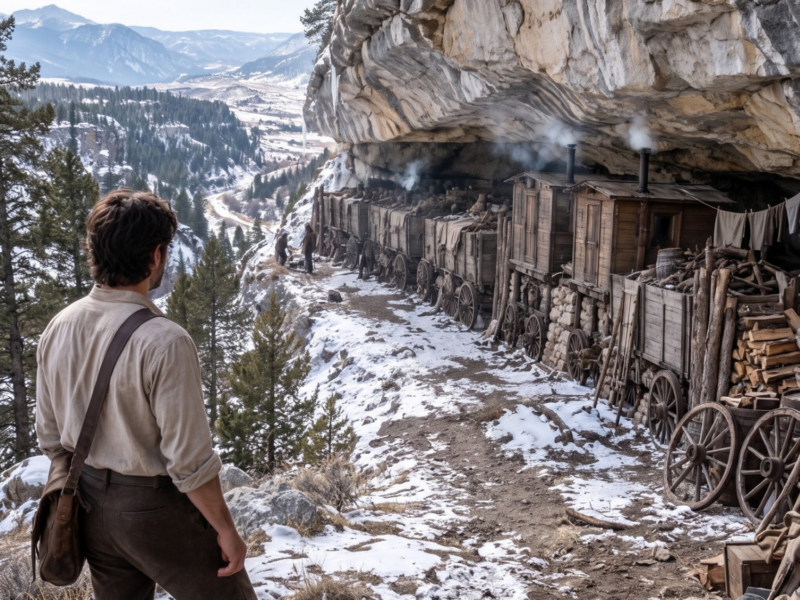
He walked along the north wall of the shack in the drift trough where the wind had scoured, and after twenty paces his boot struck wood. He knelt and cleared with his hands, and there under a foot of packed snow was the corner of a tarp roped down over the top of a wagon box, and beyond it the ridge of another. And beyond that, another and another. Four in a row under the north wall, exactly as the first sheet had said, pulled up close and covered and lashed. The ropes were stiff as iron. The tarps had held.
He walked the length of the four wagons and back, and he put his hand on the end of each tarp in turn, and he said aloud quietly, so that the mule under the eaves could hear him if she was listening: “They stayed.”
He went east from the shack in the last of the light until he came to a big spruce with its lower branches heavy to the ground. And at the foot of it, on the south side, out of the wind, he found a low mound of stones the size of loaves, laid close and even, and at the head of the mound a piece of wagon board driven into the frozen ground with the name Micah Reed cut into it with the point of a knife, and beneath it the words Aged 15, and beneath that the date.
Samuel took off his hat and stood in front of the little board for as long as the light lasted. And then he put his hat back on and walked back to the shack in the dark by the shape of the roof against the sky.









