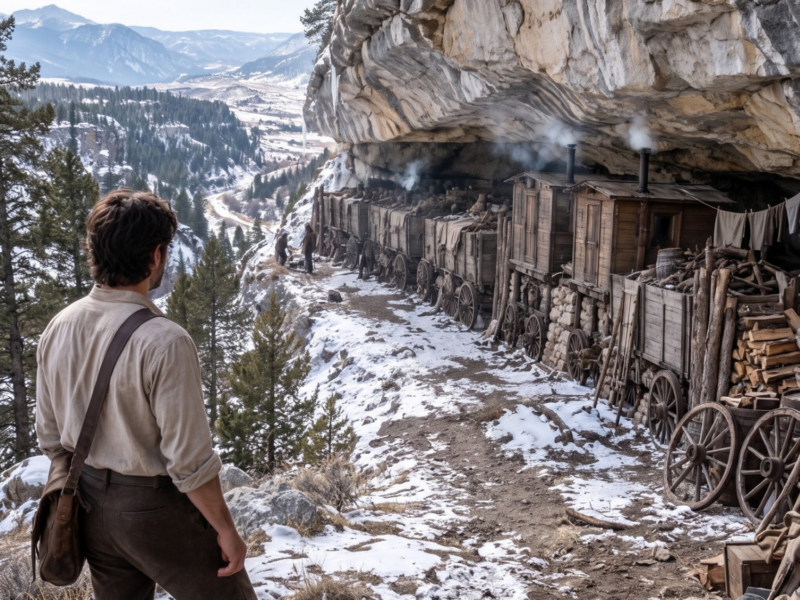
The Supply Train Never Made It Through the Pass—He Found Where They Spent Their Last Winter
The Return
That night he ate a strip of bacon and a piece of hard bread by the stove and drank coffee from the black pot with water melted from snow. He wrote nothing and read nothing more. He slept on the plank bunk under the mouse-chewed gray blanket with his own blankets over it and the oilcloth bundle of papers and money against his ribs.
In the morning he was up before light. He fed the mule the last of one day’s grain, split it with the second day’s, patched the three fallen places in the north chinking with rag from his spare shirt and mud from a clot of clay he thawed on the stove, swept the floor with the willow broom, banked the stove clean, closed the door with a peg through the hasp, and started down the trail out of Martin Pass with the small brown mule behind him, the seven sheets and the leather sack against his ribs, and Halvor’s compass in his coat pocket beside them.
He came down slower than he had gone up, because he was saving the mule, and because the drifts on the south sides of the switchbacks had settled since he had passed, and now took his weight on top for three steps before dropping him to the thigh on the fourth.
He camped the first night in the same place under the leaning spruce, and the second night at the edge of the last fence line above Willowbottom. On the afternoon of the third day, he walked into the yard of the McCrae place with the mule behind him, stopped at the porch of the main house, and took off his hat.
Ward McCrae came out and looked at him a long time and did not speak.
Samuel took the oilcloth bundle out from inside his coat, unwrapped it on the porch rail, and laid the seven sheets in order along the boards, and on top of them the leather sack, and beside them the folded note that named what the sack was for.
He said, “The wagons are up there. They are covered. Nothing is gone but a little flour, and it is tallied.”
He said, “The boy is buried under stones by the big spruce east of the shack, and his name is on a board.”
He said, “Aught Pearlman and Jim Dolvet started down on the tenth to try for the timber camp at Elk Creek, which is nine miles. And if they made it, they will send men back for the wagons in the spring.”
Ward McCrae read the first sheet standing on the porch, and then he read the last sheet, and then he sat down on the bench beside the door and read all seven through in order. And when he was done, he sat with his hands on his knees and did not look at Samuel and did not look at anyone.
Then he stood up and told the yard boy to ride down to the store and tell them to shut the talk about Aught Pearlman and to bring back every man who could sit a horse.
By the next morning, six men were in the yard with horses and pack mules and shovels and axes. And by noon, a rider had gone the long, low way around the south flank to the Elk Creek timber camp with a copy of the last sheet in his saddlebag.
The rider came back on the fourth day with word that Aught Pearlman and Jim Dolvet had walked into the camp on the eleventh of December carrying Harl Dolvet between them, and that Harl Dolvet had died there on the fourteenth and was buried in the camp cemetery, and that Aught Pearlman and Jim Dolvet had been trying since the first thaw to find a way back around to the wagons and had been turned back twice by open water in the creek.
Ward McCrae read that word out to the men in the yard from the porch, and when he was done, he said, “We have owed those two men an apology for four months, and we will pay it.”
He looked at Samuel then and said, “You will ride down to the store and tell what is in these papers in your own words, and they will listen because it is you telling it.”
Samuel put his hat on and went.









