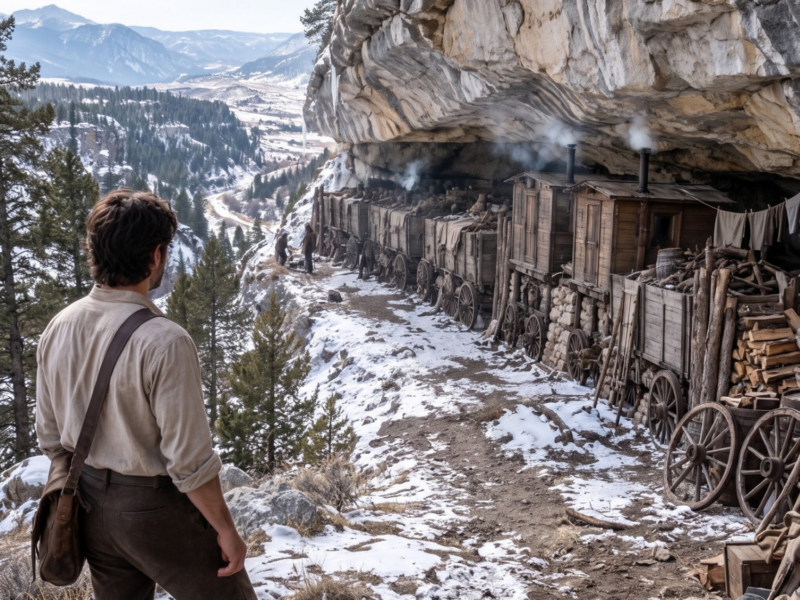
The Supply Train Never Made It Through the Pass—He Found Where They Spent Their Last Winter
The Missing Wagons
The winter that turned everything came on early in the last week of October with a hard sky over the peaks and a wind that stripped the aspens in two days.
The supply train out of Fenton—four wagons, eight mules, three teamsters, and a boy—had been due through Martin Pass by the middle of November, carrying the valley’s winter flour, its garden seed for spring, its coffee and salt, nails, bolts of muslin, and the small things a hundred small households had ordered and paid for and been waiting on since summer.
The train had left Fenton on the seventh. It had been seen at the trailhead station on the ninth. After that, nothing.
No wagon came down the west side of the pass. No teamster walked out. The first snow closed the high notch on the twelfth, and the second closed it deeper on the fifteenth, and by the first week of December, the valley understood that the supplies were not coming. The talk in the bunkhouses and the store began to sharpen into a shape.
They had run, the talk said. They had sold the load off the back of the wagons at some rail siding and taken the money south. Teamsters were like that. Fenton men were like that.
One of the McCrae foremen said it plain over supper: “No honest driver abandons four wagons in a pass. And if the wagons are not down here, it is because the men are not up there. And if the men are not up there, it is because they have chosen not to be.”
Samuel had listened to that and had not spoken. He had known one of the teamsters by name—a lean, quiet man called Aught Pearlman, who had driven mules with Halvor on the Fenton run for a dozen years. And he knew in the private and unarguable way a boy knows what his mentor would have known, that Aught Pearlman had not cut and run from any load in his life.
He said nothing about it at the table. He finished his plate. He went out to the barn and sat a while with his hand on the neck of the roan and thought about the pass. He thought about it for three more days. And in that time the talk did not soften, but only settled the way a bad smell settles into cloth, until by the third evening it was no longer a rumor in the bunkhouse, but a fact in the store. Men who had never driven a mule in their lives spoke of Aught Pearlman and the others as thieves, repeating the foreman’s sentence back to one another as though they had thought of it themselves.
On the fourth morning, Samuel walked up to the main house before breakfast and stood on the porch with his hat in his hand and told the elder McCrae—a heavy gray man named Ward McCrae, who had run the outfit for thirty-one years—that he meant to ride up the trail as far as the drifts would let him, and then walk, and see for himself whether the wagons were in the pass or not.
Ward McCrae listened without moving, and then said plainly and without heat, that there was no wage in it, and no company horse for it, and no company blanket, and no company grain; and that if a man went up into Martin Pass in December on a private errand, he went as a private man, and if he did not come down again, the outfit would not send after him.
Samuel said he understood.
Ward McCrae looked at him a while longer and then said that the roan Samuel had been riding was a company horse and could not go. He said the boy could take the small brown mule out of the back pen—the one with the split hoof that had been retired in the fall—if he could get her sound enough to travel, and he could take a week’s grain out of the crib against his last pay. And that was the whole of what the outfit would give him. He said it was not meanness. He said it was the rule.
Samuel said he understood that too. He put his hat back on, walked down off the porch, did not argue, did not thank the man, and did not turn around.









