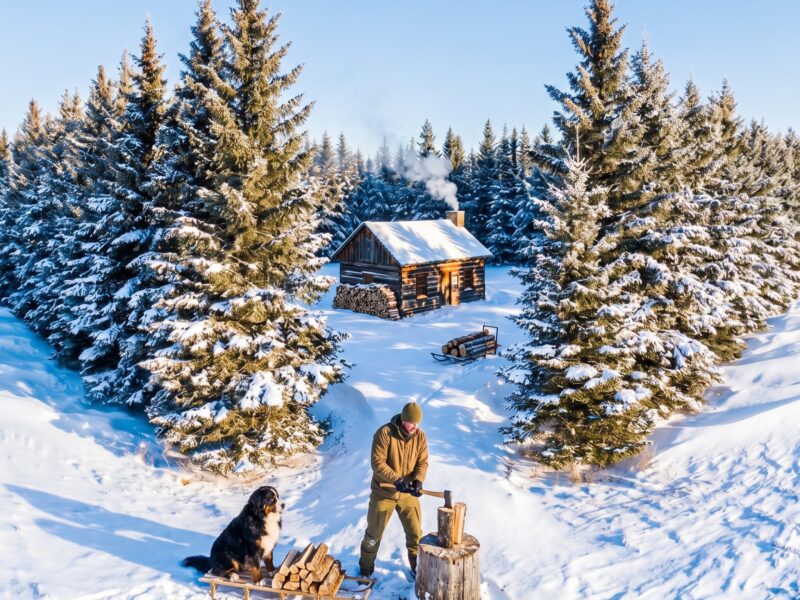
They Said Planting a Wedge of Pines Around His Cabin Was Crazy — Until Winter Made It a Fortress
They Said Planting a Wedge of Pines Around His Cab…
They Said Planting a Wedge of Pines Around His Cabin Was Crazy — Until Winter Made It a Fortress
In the northern Dakota territory, the wind does not gust. It runs.
It is a living, breathing entity that crosses the open prairie from the northwest in a single, unbroken push. It bends the tallgrass flat against the earth and holds it there with a heavy, invisible hand. It pulls smoke sideways from stone chimneys, refusing to let it rise. It finds every minute crack in every timber wall, whistling through the gaps with the terrifying patience of something that has absolutely nowhere else to be.
On a quarter section of land, six miles from the nearest reliable stand of timber, Warren T. Voss crouched in a trench he had dug by hand. He pressed a frail, green seedling into the black dirt. His fingers were split, the knuckles bleeding and dark with frozen soil. Behind him sat a cabin no bigger than a freight wagon. And behind that, on a slight, wind-scoured rise, stood a single cottonwood post.
It marked the only other thing he had planted in this unforgiving earth.
Warren had never stood on ground this flat. He was a man of the sea, born and raised in Bath, Maine, where the Atlantic coast broke itself violently against ancient granite. In Maine, the wind always had something to argue with—a towering hill, a dense stand of white pine, a ship’s hull canted on the ways. Warren knew wind the way a sailmaker’s son knows it: as a force with habits. It could be read. It could be split. It could be negotiated with and made to go around things.
But that was in Maine, where the world gave the wind something to do. Here, in the last week of October 1879, the wind had nothing to do but run.
Warren had arrived four days earlier on a rattling freight wagon out of Fargo. Beside him sat his wife, Eliza; their daughter, Ruth, who was nine with eyes too old for her face; and their son, Abel, a wide-eyed boy of five. They brought with them one draft mare named Birch, a heavy trunk of iron tools, and thirty-nine dollars in mixed coin.
The homestead claim was a half-paid quarter section along the Sheyenne River bottoms. A man named Pollard had filed on it the year before, planted absolutely nothing, built almost nothing, and sold the improvement rights for eleven dollars and a saddle. Warren had given him the saddle and the cash he could not spare. In return, he received a partially constructed cabin, twelve by sixteen feet, with cottonwood walls chinked badly with river mud, and a roof of split poles covered in sod that already sagged ominously at the northwest corner.
On their first evening, Eliza had stood in the doorway of that cabin and pressed her pale palm against the wall. The mud chinking had cracked where the relentless wind had dried it too fast. Thin, whistling lines of freezing air cut into the room.
“The cabin breathes, Warren,” she had said, her voice thin. She did not mean it as a compliment.
He spent their first week re-caulking. He mixed freezing mud with prairie grass, pressing it into every seam he could reach, working with his bare fingers because the trowel he had brought from Maine was sized for boat hulls and too narrow for the timber gaps. While he worked, Ruth and Abel scoured the frozen plains for buffalo chips and dried cow dung for fuel. Eliza tended to the cracked cookstove—a Number Four box stove with a split firebox plate that leaked noxious gray smoke whenever the draft pulled wrong.
Warren stuffed the crack with a folded strip of tin cut from a peach can. It held, but barely. When the wind backed northwest and gusted, the stove coughed smoke into the cabin, and the children coughed with it.
He had two and a half cords of cottonwood and willow stacked against the south wall. He knew it wasn’t enough. The freight driver had told him, “Six cords minimum for a family in a tight cabin.” And this cabin was far from tight.
Thirty-nine dollars. A cracked stove. Two and a half cords of soft wood. A cabin the wind whistled through. And winter had already sent its first messenger: a thin skin of ice on the rain barrel every morning, melting by noon, thickening by the day.
Then, Eliza got sick.
It started in November as a dry, persistent hack—the kind of sound that wakes a cabin at three in the morning and leaves everyone staring at the dark ceiling. By December, the cough turned wet and rattling. By January, the cold had settled deep into her chest like a tenant that intended to stay.
Warren boiled willow bark. He hung every blanket they owned across the cabin rafters to trap whatever meager heat the stove produced near her pallet on the floor. He burned through a full cord of wood in three weeks, trying to keep the ambient temperature high enough to ease her labored breathing. It did not ease. The nearest doctor was in a river town twenty-two miles away, and the roads were blown shut under four feet of impassable, hard-packed drift.
Eliza Voss died on the fourteenth of February, 1880, in a cabin that was not warm enough, on a homestead she had lived on for less than four months. She was twenty-nine years old.
Warren wrapped her in the heavy quilt her mother had sent from Portland. He carried her outside alone, because the children should not watch what a man must do to the frozen earth.
He dug the grave himself. The ground was frozen solid to a depth of fourteen inches. It took him two agonizing days, alternating between swinging a heavy mattock and building fires directly on the earth to thaw it inch by inch. He set the grave thirty feet south of the cabin, on a slight rise where the snow would not drift heavily, marking it with a jagged cottonwood post because he had no stone.
Ruth stood at the edge of the grave, holding little Abel’s hand. She did not cry. At nine years old, the prairie had already taught her that crying used energy the body could not spare.
Warren had twenty-one dollars left. He had one and a quarter cords of poor fuel. He had a mare that needed feed he could not buy. He had two children who needed a mother he could not replace. And he had a cabin that shuddered violently every time the northwest wind crossed the open quarter.
He could not leave. Leaving meant abandoning the claim, losing the eleven dollars, and arriving penniless in Fargo. His nearest relatives were in Maine, and passage east for three cost a fortune he did not possess. Eliza was buried here. The ground held her. Warren would not walk away from the ground that held his wife.
Related Articles

They Mocked the Widow’s Dirt Cellar—Then the Freeze Left Every Cabin Cold but Hers Warm
They Mocked the Widow’s Dirt Cellar—Then the Freeze Left Every Cabin Cold but Hers Warm…

A Homeless Veteran and His German Shepherd Inherited a Ridge No One Wanted — 35 Feet In, They Found
Chapter 1 / 7 A Homeless Veteran and His German Shepherd Inherit… A Homeless Veteran…

Neighbors Laughed When He Built A Cabin Inside An Old Barn—Until It Kept His Home 35 Degrees Warmer
Chapter 1 / 8 Neighbors Laughed When He Built A Cabin Inside An… Neighbors Laughed…

His Sod House Had No Woodpile in January – Until the Trains Stopped and the Town Came Begging
Chapter 1 / 10 His Sod House Had No Woodpile in January – Until t……

She Built Her Cabin Over the Woodshed and Never Burned Wet Wood Again
Chapter 1 / 8 She Built Her Cabin Over the Woodshed and Never Bu… She…

The Duke Abandoned Her on Their Wedding Day—Years Later, He Discovered What He Had Lost
Chapter 1 / 7 The Duke Abandoned Her on Their Wedding Day—Years… The Duke Abandoned…

He Wedged a Tiny A Frame Into a Crevice Before Winter and His Family Slept at 75°F While Town Hit
Chapter 1 / 7 He Wedged a Tiny A Frame Into a Crevice Before Win……

He Was Too Old to Ride—So He Bought the Ruined Ranch and Found the Room Behind the Fireplac
Chapter 1 / 5 He Was Too Old to Ride—So He Bought the Ruined Ran……

Settlers Laughed at His Underground Heat Recovery Duct — Until It Kept His Cabin 71°F Warmer
Chapter 1 / 9 Settlers Laughed at His Underground Heat Recovery… Settlers Laughed at His…

A Navy SEAL Built a Home Inside a Mountain—Then His Dog Warned Him Before the Storm
Chapter 1 / 5 A Navy SEAL Built a Home Inside a Mountain—Then Hi… A…