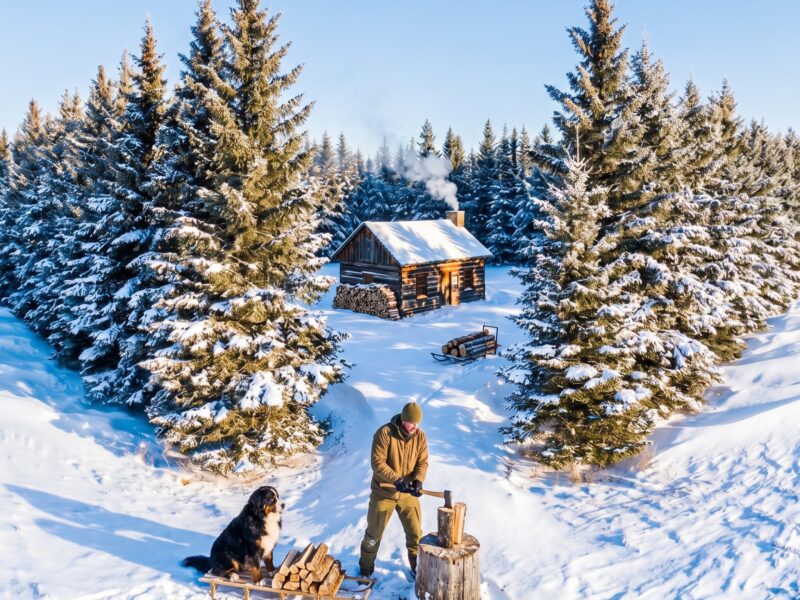
They Said Planting a Wedge of Pines Around His Cabin Was Crazy — Until Winter Made It a Fortress
The Currency of Ridicule
Jonas Rudd was the first to see the drawing. Jonas was thirty-seven, a burly Canadian from Ontario who had filed on the adjacent quarter section and successfully planted sixty acres of wheat in his first year. He was practical in the way only successful farmers are. He did what worked, and he distrusted anything that hadn’t already worked somewhere else.
Jonas walked into the cabin a few days later, stood before the charcoal wall, and frowned.
“You came here for land, Warren. Now you are planting a wall across it.”
“Not a wall,” Warren said softly, adjusting the tin patch on the stove. “A wedge.”
Jonas traced the angled lines with a thick, dirt-stained finger. “How many acres does this steal from your wheat?”
“Close to two.”
“Two acres of the best black loam in the territory. And you are going to fill it with pine trees?” Jonas turned, his face a mixture of pity and exasperation. “Trees take years, Warren. Winter comes every year. You cannot eat a seedling. You cannot burn a sapling. What are you going to do this December while your wedge is six inches tall?”
It was the right question. Warren did not have a good answer. He said he would haul fuel from the river bottoms, trade his labor for cordwood, patch the cabin tighter, and burn less.
Jonas shook his head sadly. “I have seen men try to burn less. They freeze. I am not saying your drawing is stupid, Warren. I am saying it is backwards. Fix the cabin. Break more ground. Plant wheat, sell it, and buy proper fuel and a heavy stove. Then, in five years, if you have the money, plant your trees.”
“In five years, I will have burned through twenty-five cords of wood, hauled six miles on bad roads,” Warren countered, his voice rising in quiet defiance. “Every cord costs time I cannot spend on anything else. The wind does not wait five years, Jonas.”
Jonas left unconvinced. Warren couldn’t blame him.
The true test of his resolve came at Mercer T. Blaine’s general store. Blaine was forty-five, built wide, with a smile that made the person across the counter feel like they had already lost the negotiation. He sold flour, nails, seed, and patience, the last at the highest markup. He held the town’s credit notes with the relaxed grip of a spider sitting on a web.
Warren came to the store in June with his meager list: a new stove plate ($6.50), flour ($2.10), nails, salt, soap. He also asked if Blaine could order Eastern Red Cedar bundles from the nursery downriver.
Blaine set the heavy iron stove plate on the counter. “Your account stands at eighteen dollars, Voss. You want to add to it. I can work off part of it. I will split rails for you.”
Blaine leaned forward, his eyes gleaming with mocking amusement. The store had four other men in it. Warren could feel them listening. This was how reputation was built or destroyed on the prairie: in the general store, in front of witnesses, with the storekeeper holding the scales.
“I have rail splitters,” Blaine said loudly. “What I do not have is a reason to extend more credit to a man who plants trees instead of wheat. You have heard about the wedge, boys? Voss here is farming shade.”
The men in the store chuckled.
“What I want to know,” Blaine continued, his voice dripping with condescension, “is what your children will eat while you wait for your shade to grow.”
Warren stared straight ahead, his jaw tight. “Are the cedar seedlings bundled wet?”
Blaine stared at him, then burst into a loud, booming laugh. The room erupted with him. Blaine had asked about the survival of Warren’s children, and Warren had answered with the species of tree. To them, he wasn’t just a fool; he was a madman.
“Two hundred cedar seedlings,” Blaine sneered, writing in his ledger. “I will order them. I will add them to your note. And when you cannot pay, Voss, I will take your land.”
He said it plainly, a stated fact.
Warren took the stove plate and the flour. When the seedlings arrived three weeks later, he walked the six miles home carrying eighty pounds on his back, because the mare was needed to haul water to the planting trenches.
The phrase traveled. Voss’s useless forest.
Warren started planting in the first week of July under a blazing, merciless sun. Breaking sod with one mare and a walking plow on ground that had never been turned was agonizing work. He marked the wedge point 280 feet northwest of the cabin with a cottonwood stake. He sighted the arms using his chimney smoke; every afternoon, when the northwest breeze picked up, the smoke bent southeast. The angle of the bend told him exactly where the wind drove hardest.
He dug the trenches by hand to eight inches deep, angling the soil so water would drain toward the roots, not pool and freeze. Ruth carried water from the slough in two heavy pails suspended from a willow harness Warren had carved. Little Abel dragged brush to the trenches for mulch.
His hands blistered and bled. His back seized. He lost weight his gaunt frame could not afford to lose. Ruth started leaving his dinner plate on the stove when he came in long after dark.
By mid-August, the heat was brutal, and the rain did not come. Thirty-one of his carefully planted seedlings turned a sickly, pale yellow. Fourteen died completely, standing in their shallow dirt basins like small, brown bones.
Warren stood at the wedge point one evening, looking down the arms. The seedlings were pitiful. Tiny, sparse, none taller than his knee. Between the trees and the cabin was nothing but open, dead grass. Boer’s words mocked him: Trees on open prairie die.
But then, he looked at the ones that lived. The cedars in the first row were green. They weren’t tall. They couldn’t stop a breeze. But they were alive, their roots gripping the Dakota earth.
He had 229 living seedlings, eighteen dollars of debt, and a cracked stove. Winter was fourteen weeks away. Warren picked up his shovel and went back to the trenches.









