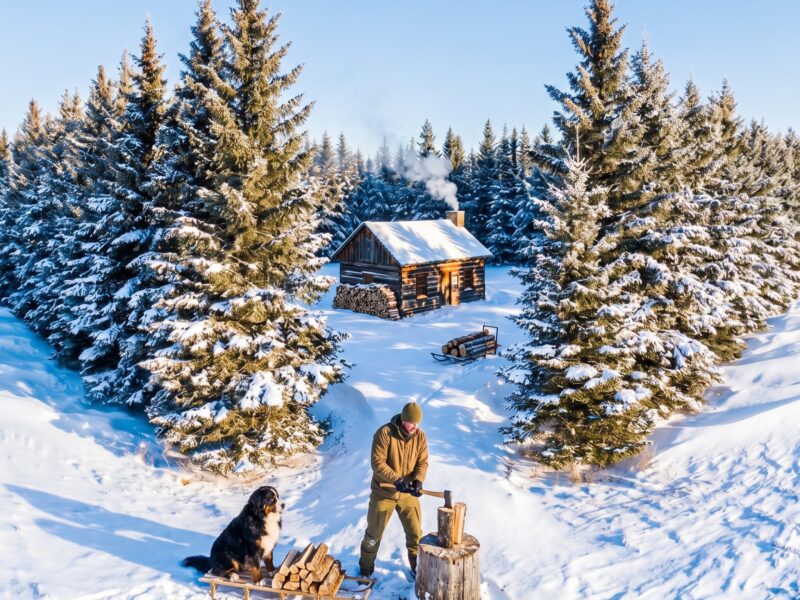
They Said Planting a Wedge of Pines Around His Cabin Was Crazy — Until Winter Made It a Fortress
Fire and Irony
The following spring, Jonas Rudd came to Warren. He didn’t ask if the wedge worked; he asked where to plant his own. Warren walked Jonas’s property, showed him how to read the bend of the grass to find the wind line, and told him what species to plant. Jonas listened. The settlement was beginning to shift.
But Mercer Blaine saw an opportunity.
Blaine had copied Warren’s charcoal diagram from Inspector Boer’s clipboard. Soon, Blaine was selling “Voss Pattern Protection Lots”—quarter sections with a pre-drawn planting plan included—for a premium of three dollars.
But Blaine was a merchant, not a sailmaker. His copies were sloppy. The arm angles were wrong. He sold cheap, fast-growing deciduous cottonwood instead of the necessary evergreens. Worse, he instructed buyers to plant the trees thirty feet from their cabins—dangerously close.
Warren tried to warn the buyers, but the damage was done. The true test of Blaine’s arrogance, however, came from the earth itself.
In April of 1888, a devastating prairie fire swept from the west, driven by an east wind. It moved through the cured grass faster than a horse could run.
Warren smelled the acrid smoke before he saw the sky turn the color of dried blood. He had minutes. The fire was roaring toward the outer arms of his beloved wedge. If the flames hit the resin-rich cedar needles, the entire windbreak would crown and explode.
“Buckets!” Warren screamed.
He took his plow and his aging mare, Birch, and frantically cut a firebreak—a strip of turned sod five feet wide along the windward face. It wasn’t deep enough. The fire slammed into the south arm before he could finish.
The outer mulch caught. The flames licked the trunks of the outermost cedars. Warren, Ruth, and little Abel fought like demons, beating the flames with soaked burlap sacks. The radiant heat was a physical wall, blistering the skin on the backs of Abel’s young hands.
They lost the two outer rows. Fourteen magnificent cedars, representing six years of life, burned into black skeletons.
But the inner rows held.
The dense, green, moisture-heavy interior of the wedge refused to burn. The fire hit the turned sod, scorched the third row, and died. The wedge had stopped the wind, and now, its sheer density had stopped the fire.
The settlement suffered, but Warren’s home was safe. He stood in the ashes, looking at the fourteen dead trees. A gap in the wedge was a death sentence; the wind would funnel through it next winter. He had to replant.
He didn’t have to do it alone.
The next morning, Jonas Rudd appeared with a shovel. Nell Caro, a local widow whose wind-line Warren had marked for free, sent her son with a bundle of spruce seedlings. The trees that replaced the burnt cedars came from four different homesteads. No money exchanged hands. The knowledge had been given freely, and the community was paying the sailmaker back.
Mercer Blaine, however, found no such salvation.
In the winter of 1891, the flaws in Blaine’s copied designs were exposed. A thirty-five-mile-an-hour blow hit the short, deciduous cottonwood row Blaine had planted behind his own store. The wind curled violently around the edges of the bare trees, creating a horrific vortex. The snow funneled through the gap and packed a three-foot drift directly against Blaine’s loading doors, sealing him inside. His shutters tore loose again.
When Inspector Boer arrived to evaluate the damage, Blaine stood behind his counter, humiliated. He looked at Boer. He looked at Warren, who happened to be buying flour.
“Then mark it right,” Blaine muttered to Warren.
It was a grinding, agonizing surrender. Blaine paid Warren three dollars to walk the storehouse perimeter and mark the correct angles for a true evergreen wedge. Warren took the money, used it to buy seedlings for Nell Caro, and never spoke of the feud again.









