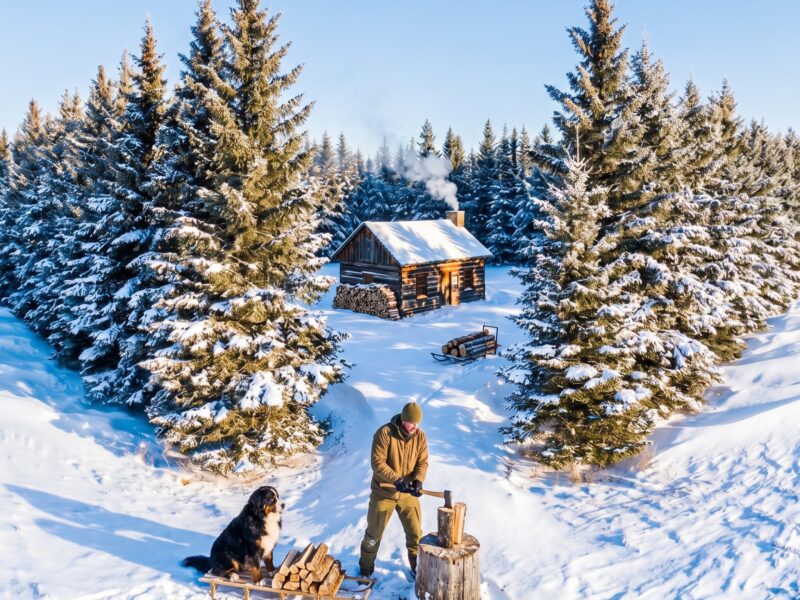
They Said Planting a Wedge of Pines Around His Cabin Was Crazy — Until Winter Made It a Fortress
The Inspector and the Sailmaker
That spring, the earth thawed into a sea of black mud. Ephraim Boer rode into the Voss claim on a gray gelding and did not dismount for the first four minutes.
He sat high in the saddle, a man carved from old hickory, and looked at the cabin, the pathetic woodpile, the sagging sod roof, and the solitary grave marker. He looked at Ruth and Abel, who were sitting on an overturned crate, silently shelling the last of their seed corn. Boer made his assessment before his boots ever touched the dirt.
Boer was sixty-one years old, a county tree-claim inspector and former timber cruiser who had spent twenty years in the Wisconsin pineries. The government had sent him west to ensure settlers planted new timber. He had a face like a clenched fist and a voice that carried the grim authority of a man who had seen five hundred homesteads fail.
He walked the perimeter of the cabin first. He pressed his heavy thumb into the mud chinking at the northwest corner. It crumbled to dust. He counted the remaining fuel—unseasoned, punky willow. He looked at the stove, noting the tin patch on the firebox plate.
Finally, he looked at Warren. “You do not have a house,” Boer said, his voice flat. “You have a box the wind has not opened yet.”
Warren said nothing.
Boer walked the quarter section. He kicked at the soil—rich, black loam under the tough prairie sod. “Good wheat ground,” Boer muttered. Then he looked at the horizon. He noted the absolute absence of any windbreak, any tree line, any rise or depression that might shelter the homestead.
“A family in a cabin this loose needs six cords before January,” Boer said, turning back to Warren. “You have a cord and a half of wood that will burn fast and dirty. You owe money at the store. You have no crop in. Your wife is dead. Your children are thin.”
He paused. Warren could see the man was not being cruel; he was simply counting. “I have inspected three hundred claims in this territory. The ones that fail look exactly like this.”
“I filed a tree claim,” Warren said quietly.
Boer stared at him. The Timber Culture Act allowed a settler to claim an additional quarter section of land if they planted forty acres of trees and kept them alive for thirteen years. On paper, it was free land. In practice, it was a way to break a man’s back. The rain did not come. The wind stripped seedlings out of the ground before they could root. The failure rate was staggering.
“Trees on open prairie die,” Boer said bluntly. “Rain cannot be trusted past the James River. Weeds will take any seedling you plant before its second summer. And a man with two children and no wife cannot wait ten years for shade.” He glanced respectfully at the grave marker. “I am sorry about your wife, Mr. Voss. But I am telling you what I know.”
“I know wind,” Warren replied.
“Everyone on this prairie knows wind,” Boer scoffed. “It does not help them.”
Boer mounted his gray gelding, looking down from the saddle. “You have a season. Use it to sell what you can. Take those children somewhere with a roof that holds.”
Warren watched the inspector ride east until the horse was nothing but a smudge against the waving grass. Then he turned and looked northwest, where the wind was born. He thought about his father. He thought about sails.
The realization did not come in a single, dramatic flash of lightning. It came in pieces across the spring and early summer of 1880, the way a man assembles a thought when he is too busy surviving to sit down and philosophize.
The first piece came during a violent May rainstorm. Warren had taken Ruth and Abel to the slough to cut willow switches for basket weaving—a skill Eliza had taught Ruth, and one of the few things they could sell in town. The wind blew hard from the northwest, driving the freezing rain sideways.
But at the edge of the slough, an abandoned, broken wagon board leaned against a cottonwood stump at a sharp angle to the wind. Warren noticed something strange. The rain behind the slanted board fell differently. It was not dry behind the board—the rain still reached the ground—but the force was broken. The drops fell softly, vertically, instead of driving like horizontal bullets.
The board did not stop the storm. It changed where the storm spent its energy.
He stood in the freezing rain and watched it for a long time, so long that little Ruth tugged his sleeve and asked if he was sick.
The second piece came a week later inside the cabin. Ruth had hung Eliza’s heavy wool shawl on two pegs near the stove to dry. The cabin door was open to the spring air, creating a cross-draft. Before the shawl went up, the stove flame guttered wildly, and the smoke drifted sideways into the room. After the shawl went up, the flame instantly steadied.
The wool did not stop the air. It slowed it. It broke its direction. It bled off its deadly force.
Warren sat on the dirt floor of the cabin, staring at his dead wife’s shawl, and remembered his father’s sail loft in Bath.
Samuel Voss had been a master sailmaker for thirty years. His method of teaching involved holding objects near open flames and watching what happened. He would take a strip of heavy canvas, hold it at a sharp angle to a candle, and show young Warren how the flame bent. He showed him how the air divided around the cloth—how some spilled over the top, how some curled underneath, but how the air directly behind the canvas lost its deadly speed.
“A sail does not fight the wind, boy,” his father’s voice echoed in his memory. “A sail negotiates with it. A flat wall fights the ocean, and eventually, the wall breaks. The bow of a ship splits the sea.”
That night, after the children were asleep, Warren took a piece of blackened stove charcoal and walked over to the cabin wall.
He did not draw a square grove of trees. He did not draw the straight, parallel lines of timber that every other desperate settler planted to satisfy the government law.
He drew a wedge.
The sharp point faced northwest, aimed directly into the throat of the prevailing winter gale. The two arms of the wedge spread apart as they extended southeast, widening until they opened entirely behind the cabin, leaving roughly seventy feet of open space between the end of the trees and his home.
The cabin sat in the protected pocket at the wide end, exactly the way a man stands behind a ship’s bow and lets the hull break the sea.
The logic was pure maritime physics. A flat wall of trees fights the wind and eventually loses. A wedge splits it. The wind hits the point and divides, half streaming down the north arm, half down the west arm. By the time the wind reaches the open pocket behind the wedge, it has exhausted its force.
The cabin did not need to be windproof. It just needed to be placed where the wind arrived tired.
Warren planned the specifics on the wood with his charcoal. The wedge point would begin 280 feet northwest of the cabin. Each arm would run roughly 360 feet. The outer, windward rows would be Eastern Red Cedar and whatever hardy spruce he could acquire—dense evergreens with needles that held through the brutal winter, unlike bare deciduous trees that were useless against the cold. The inner “nurse rows” would be Boxelder and Willow, fast growers that would hold soil moisture and protect the slower evergreens from the blazing summer sun.
The rows would be staggered twelve feet apart, the seedlings set six feet apart within each row, creating a dense, living, impenetrable wall that the wind could not punch through.
If it worked—and it would take years to know—the cabin would sit four to five tree-heights behind the densest row. That was the distance Warren’s instinct told him mattered. Close enough to sit in the wind-shadow, but far enough back to avoid the violent turbulence that curled over the top of any barrier.
The risk was staggering. The design stole nearly two acres from prime, money-making wheat ground. It required hauling thousands of gallons of water, mulching, and years of time he did not have. If the trees died, he lost his crop acreage and gained nothing but ridicule. Even if it worked perfectly, the trees could not help him this winter. Or the next.
He stared at the black charcoal drawing on the wall. It looked like the prow of a ghost ship.
A ship does not argue with the ocean, he thought. It goes through.









