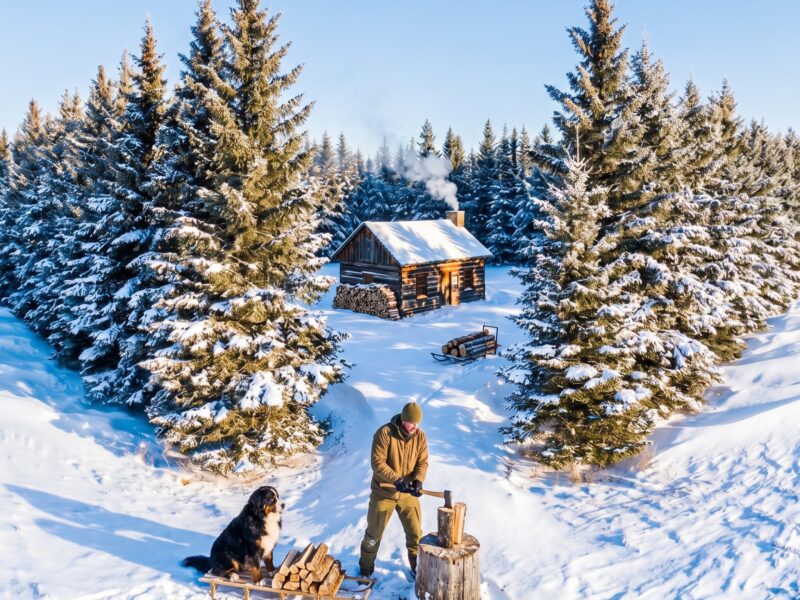
They Said Planting a Wedge of Pines Around His Cabin Was Crazy — Until Winter Made It a Fortress
The Woman from the Red River
She appeared on foot in the second week of September, walking the dusty slough road from the east like an apparition.
She carried a canvas sack over one shoulder and a heavy iron spade strapped across her back. Warren saw her from the trenches and paused. Nobody walked the slough road on foot unless they had no horse, and nobody lacked a horse unless life had gone terribly wrong.
Her name was Barbro Vanen. She was fifty-eight years old, a Norwegian widow who had buried a husband, two draft horses, and a failed tree claim in the Red River Valley forty miles northeast. She had walked here because walking was free, and she had heard a freighter laughing about a madman west of the Sheyenne who was planting trees in a triangle. She wanted to see if he was a fool, or a visionary.
She did not introduce herself. She walked straight past Warren, marched to the nearest cedar seedling in the first row, knelt in the dirt, and pulled it gently by the stem. The root ball came up far too easily. She crumbled the dirt between her calloused thumb and forefinger, then looked up at Warren.
“This one died yesterday,” Barbro said, her accent thick and sharp. “You have not buried it yet.”
Warren climbed out of the trench, exhausted, expecting another critic.
But Barbro was not looking at the overall plan. She was analyzing the dirt.
“The soil is good,” she muttered, wiping her hands on her apron. “The spacing is good. The shape I have not seen before, but your wind reading is correct. I can see the snow scour lines on the grass.” She turned the dead seedling over. “Your roots dried before they went in the ground. You did not puddle them.”
“Puddle?” Warren asked.
Barbro sighed, a sound of profound, weary patience. She grabbed her spade, marched to the edge of the slough, and dug a shallow hole. She mixed the heavy, clay-rich subsoil with slough water until it became a thick, brown slurry, the consistency of thick porridge. She grabbed a fresh, bare-root seedling from Warren’s wet burlap sack and plunged the roots directly into the mud.
The thick clay coated the microscopic root hairs, sealing them perfectly against the air. When she planted the seedling, the roots went into the earth wet and armored.
“My husband filed a tree claim in ’76,” Barbro said quietly, tamping the dirt down. “He planted twelve hundred cottonwood whips in straight, stupid rows. He lost eight hundred the first summer. I told him the roots were drying out in the wind before they hit the dirt. He told me he had been planting trees since Norway.” She paused, her eyes dark with memory. “He was a good man. He was also wrong.”
Warren looked at her. “What happened to the claim?”
“The trees died. Then he died of a fever. Then the horses died. I sold the claim to a man from St. Paul who wanted the sod broken and didn’t care about trees.” She pointed a dirty finger toward the cabin door, where the charcoal drawing was visible on the inner wall. “That is not a tree claim. What is that?”
Warren told her. He told her about the sail loft in Bath, about the canvas near the flame, the rain behind the wagon board, and Eliza’s shawl bending the draft.
Barbro listened. She did not interrupt. When he finished, she walked the entire length of the wedge, counting her paces, checking the angles against the afternoon wind.
She stopped at the point, looking back at the cabin. “The idea is not foolish,” she said finally. “It is incomplete.”
Barbro stayed for three days. In that time, she taught the sailmaker more about keeping things alive in the dirt than he had learned in his entire life.
She taught him puddling. Warren spent agonizing days digging up every surviving seedling, dipping their roots in the clay slurry, and replanting them. He lost eleven trees in the shock, but the rest immediately stopped yellowing.
She taught him basin planting, carving wide, deep saucers around each trunk so rain would pool exactly over the root mass. “A seedling does not need a river,” she scolded. “It needs a cup that does not spill.”
But her most brutal lesson was weed control. The prairie grass was the true enemy—a dense, ancient, competitive root-mat that drank every drop of water before the trees could reach it. She stripped the grass eighteen inches from every trunk by hand, then laid a thick ring of slough hay and manure as mulch to smother the regrowth.
“You will do this every spring for five years,” Barbro commanded, her hands bleeding alongside his. “If you stop before the trees are tall enough to shade out the grass, the grass will win.”
Warren calculated the math. Hundreds of trees. Eighteen inches of hand-weeding, twice a summer. It was a sentence of unimaginable, backbreaking labor.
Barbro saw the look on his face. She offered no sympathy. She had done the same arithmetic on twelve hundred cottonwoods alone, while grieving her husband.
On the fourth morning, she strapped her spade to her back and prepared to walk the forty miles home. At the edge of the slough road, she turned back to Warren.
“The shape is right,” she said. “The species are right. Whether you can keep them alive long enough is not about the trees, Warren. It is about you.”
She walked east, disappearing into the vastness of the prairie. Warren picked up his spade and went back to the trenches.









