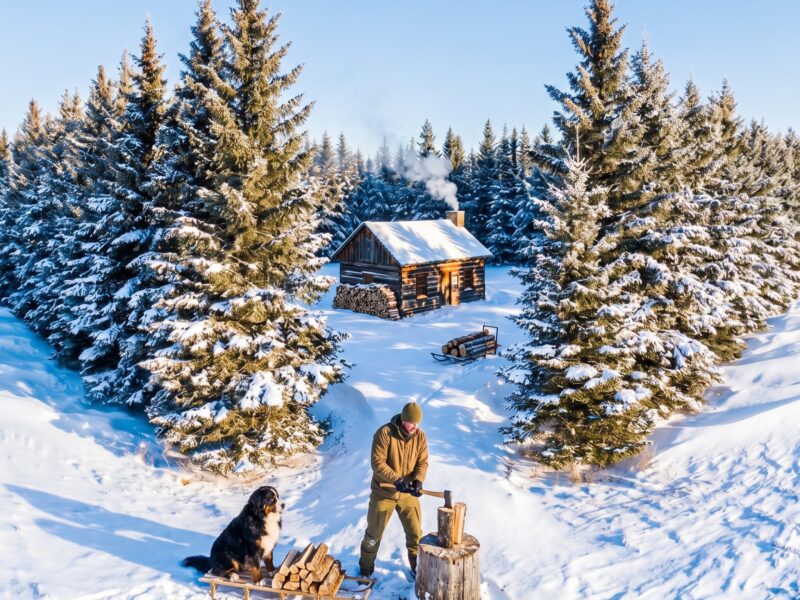
They Said Planting a Wedge of Pines Around His Cabin Was Crazy — Until Winter Made It a Fortress
The Arrow and the Gale
The years compressed the way frontier years do: not gently, but by blunt force. The only way Warren could measure the passage of time was to stand at the wedge point and count what had survived.
Year One ended with 600 trees planted. 140 died. That first winter nearly broke him. He hauled fuel for miles, freezing, in debt, listening to Ruth cough in the night—a terrifying echo of Eliza.
Year Two brought Barbro back in the spring. She brought bundles of willow cuttings. Together, they added a second, staggered line to the windward rows. The willows grew incredibly fast, shooting up waist-high by August, acting as a rapid-response nurse crop to shelter the slower evergreens from the blazing summer sun.
Year Three brought the grasshoppers. They stripped the deciduous boxelders to skeletal veins in two days, but spared the resinous cedars. Warren built an ugly, temporary brush fence of dead branches at the wedge point to buy the young cedars one more winter of protection. It was sticks and rope holding back the apocalypse, but it worked.
Year Four brought tragedy. Little Abel broke his arm hauling water. The doctor cost three dollars. The three dollars came from the seed-wheat fund, meaning no crop, meaning more debt to Mercer Blaine. When Blaine called in the note, Warren sold his last valuable possession—his deep-breaking plow blade—to pay it down. “Your forest is growing,” Blaine had sneered, pocketing the cash. “Your debt is growing faster.”
But Year Four also brought a silent grace. Jonas Rudd, the skeptical neighbor, began leaving two full water barrels at the slough before dawn. He never said a word about it. Warren never thanked him aloud. But the water was there, and the trees drank.
By Year Five, the wedge became visible from the county road.
It looked like a dark, green arrowhead driven deep into the golden prairie grass. The point was aimed flawlessly northwest. The tallest boxelders stood fourteen feet high. The cedars and spruce formed a dense, interlocking, shoulder-high wall.
Inspector Boer returned. He dismounted his horse this time. He walked the rows, pressing his thumb against the thick cedar bark.
“You have lost fewer than I expected,” Boer said, calculating. But he looked at the sky. “But shoulder-high cedar does not stop a gale. A hard wind is not the same as a killing blow. When a true gale comes—fifty miles an hour, twenty below zero, snow driving horizontal—you will know if your wedge is a shelter, or a decoration.”
The killing blow arrived on the 4th of December, 1886.
The barometer at Blaine’s store dropped an inch and a half between dawn and noon. The sky turned a terrifying, bruised blue-black—the shadow of air so fast and so violently cold that it colored the light ahead of it. By two in the afternoon, the temperature plummeted to four below zero.
Then, the wind stopped gusting. It became a constant, shrieking, horizontal force.
Inside the cabin, Ruth’s fever spiked. She lay on the pallet, shaking violently. Warren fed the stove with expensive oak splits. The first miracle happened almost immediately: the stove drew clean. In the old days, a storm like this would have caused a backdraft, choking the cabin with smoke. But tonight, sheltered behind the growing trees, the chimney drafted perfectly.
At 6:45 PM, Abel yelled over the roar of the storm. He pointed out the frosted window. A lantern was bobbing wildly in the whiteout near Jonas Rudd’s property line, moving low to the ground.
Warren pulled on Eliza’s old wool coat—the warmest thing he owned—and threw open the cabin door.
He stepped into the “pocket” behind the wedge. The cold was savage, but he could stand upright. He could breathe. He looked up. The cedars were roaring, vibrating under the apocalyptic weight of the gale, but they were holding. The snow was streaming along the outer arms of the wedge in two massive, divergent white rivers, leaving the pocket behind the cabin in a surreal, fractured stillness.
Warren pushed past the end of the North Arm into the unprotected prairie. The wind hit him like a physical wall of concrete. He found Ephraim Boer crawling on his hands and knees in the snow.
The inspector had been trying to reach Warren’s cabin because Jonas Rudd’s stovepipe cap had blown off, and Jonas’s cabin was rapidly filling with deadly smoke and freezing air. Warren hauled the half-frozen inspector into the wedge’s pocket. Boer collapsed against the lee side of the trees, gasping, realizing instantly that the wind had lost its killing edge.
Warren left him and plunged back into the whiteout toward Jonas’s claim. He found the Rudd cabin in chaos. Clara Rudd was standing on a chair, desperately holding a blanket over the open pipe hole while Jonas frantically tried to nail a board from the outside with numb, bleeding hands.
Warren climbed the icy roof. Using his father’s sailmaker knots and a square of canvas he always kept in his pocket, he lashed the fabric over the hole. The canvas bellied and snapped, but it held. The draft reversed.
“Come with me!” Warren shouted over the storm. “My cabin is warm! The stove is drawing!”
The desperate crossing nearly killed them all. But when they finally reached the protection of the North Arm, Clara and Jonas stopped dead in their tracks. The screaming, horizontal blizzard instantly transformed into a rough, falling snow. The wind hissed through the needles instead of roaring.
Jonas looked at the massive, dark wall of cedars. He looked at the smoke rising cleanly from Warren’s chimney.
“I hear it,” Jonas whispered, shivering in awe. “The difference. I hear it.”
That night, seven people huddled in a twelve-by-sixteen cabin. And the cabin was warm.
At midnight, Warren stepped out into the pocket one last time. The gale was shrieking over the plains. A massive, four-foot drift had piled up against the outer, windward face of the trees. The wedge had caught the snow like a net. But the seventy-foot gap between the trees and the cabin was completely clear. A soft, four-inch dusting of snow lay on the ground.
He went back inside and checked his woodpile. In ten hours of the worst storm in a decade, he had burned only three armloads of wood. In an unprotected cabin, he would have burned ten.
The wedge did not stop winter. It did not melt the snow. It did something far more profound: it bought time. It slowed the rate at which the cold extracted heat from the home, stretching his meager fuel supply from three weeks to three months. It gave a man the hours he needed to outlast the storm.
By morning, the gale broke. Warren opened the door to a quiet, white world. The Voss cabin stood untouched.
A mile away, Mercer Blaine’s unprotected storehouse had its shutters ripped off. Three flour sacks were ruined, two kerosene barrels were shattered, and his dairy cow was dead, frozen standing up in the open lot.
Six days later, Inspector Boer returned. He walked the wedge, sinking his arm up to the elbow in the massive drifts caught by the outer trees. He checked the dry, bare grass near the cabin.
Boer walked up to Warren. His face was a portrait of a man whose lifelong belief system had just been dismantled.
“I told you trees would not save a bad house,” Boer said quietly. “I was right about your house. Your chinking is still poor. Your roof sags.” He took a deep breath. “But I was wrong about the trees.”
He pulled out a piece of paper. “Draw me the plan, Voss. I want to show it to the other claimants.”









