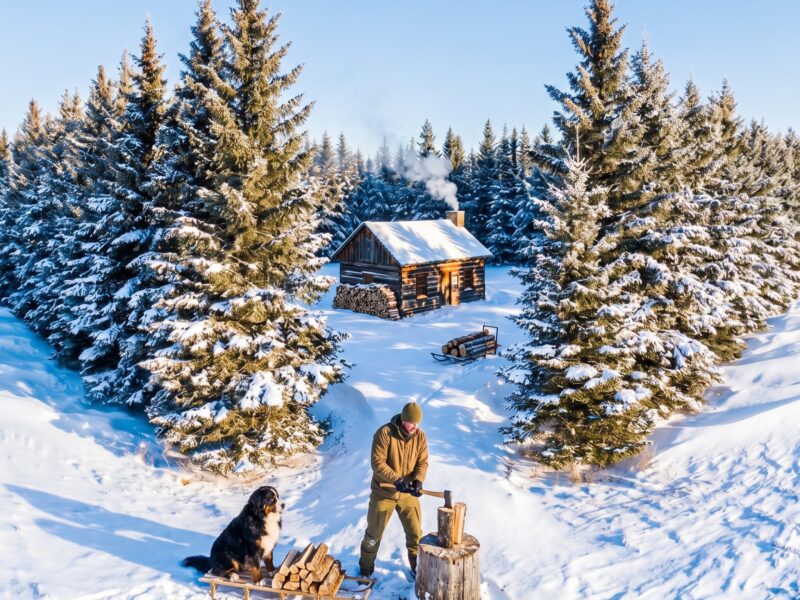
They Said Planting a Wedge of Pines Around His Cabin Was Crazy — Until Winter Made It a Fortress
The Roots We Leave Behind
Nell Caro came into Warren’s life the way the trees had: slowly, through diligent work, without grand announcements.
After Warren marked her property lines, she began visiting his claim. She helped in his nursery trench, sharpening his spades, sorting seeds. She was methodical, resilient, and she understood that careful work was the only kind that survived the weather.
They married in the spring of 1892. Nell brought her milk cow, her teenage son, and a warmth to the 12-by-16 cabin that it hadn’t seen since Eliza died. Warren’s back was failing him—a decade of digging in frozen earth had taken its toll—but Nell’s son took over the heavy plowing.
The years flowed gently now. They had a daughter in 1893, naming her Seagree, after Barbro’s mother. The wedge reached full maturity. The cedars stood twenty feet tall. The mighty boxelders towered at twenty-five feet, casting deep summer shade over a lush, leeward orchard of plums and chokecherries that Barbro had envisioned before she died.
The “Voss Wedge” was no longer just a windbreak. It was a destination. Settlers traveled from the James River and the Red River Valley just to stand in the quiet pocket of air behind the cabin and listen to the wind roaring impotently through the canopy above.
Warren never charged for his advice. He would walk a visitor to the edge of the trees, let them feel the violent gale pushing against their coat, and then pull them behind the dense cedars, letting the sudden, shocking stillness do the teaching.
By the winter of 1910, Warren was sixty-three and nearly blind. Cataracts had clouded his eyes, reducing the world to shapes and the quality of light. But his hearing had sharpened into something profound.
He sat in the expanded cabin, listening to a steady thirty-mile-an-hour push from the northwest. He knew every voice in the wedge by now. The cedars moaned, a deep, resonant bass. The spruce whistled a high, sharp tenor through their tight needles. The bare boxelders rattled like percussion.
His son Abel came in from checking the livestock. Abel had built his own cabin on the south end of the claim, protected by a second-generation wedge he had planted himself.
“Is the point row holding?” Warren asked, his milky eyes staring toward the window.
“It is bending, Father,” Abel replied.
Warren smiled, leaning back in his chair. “Then it is working.”
A sail does not fight the wind, he thought. It negotiates. A tree does not stop the gale. It gives, it bends, it lets the force pass through, and it stands back up when the danger moves on. He had carried a lesson from a candle in a Maine sail loft across a continent, planted it in the dirt, and waited thirty years for the earth to prove it true.
Warren Voss died in the spring of 1912. He asked to be carried out to the porch so he could hear the spruce one last time. Nell sat beside him, holding his curled, scarred hands.
Mercer Blaine had once laughed at him in a crowded store, saying, “You cannot eat pine needles.”
Blaine had been right. The needles never became bread or money. But they became something infinitely more valuable. They became still, quiet air around a stove on a night when the temperature dropped to twenty below. They became a door that opened during a blizzard without being torn from its hinges. They became a sanctuary where a little girl with a fever could keep breathing until morning.
Snow began to fall that afternoon, driving hard across the open, unforgiving prairie. But when the blinding white gale reached the dark, towering point of the Voss Wedge, the wind broke. Half streamed down the north arm, half streamed down the south.
And in the hushed, protected pocket behind the trees, where the cabin had stood defiant for thirty-three years, the snow fell gently, vertically, peacefully to the earth.









