Table Nine
CHAPTER ONE — Friday Service
The rules of Maison Vale were written on the inside of the staff-room door, in a neat black hand, and Nora Quinn had read them four hundred times.
One. The guest is not always right, but the guest is always welcome.
Two. Nobody carries more than they can balance.
Three. If you drop it, you pick it up. If someone else drops it, you pick it up faster.
Four. When in doubt, ask Paolo.
She read them again now, at ten minutes to five on a Friday afternoon, with her coat half off and her hair scraped into the severe low bun that regulations required. The staff room was a windowless cupboard on the mezzanine, smelling of floor polish and cold coffee, with a bank of battered grey lockers down one wall and a mirror above the sink that had been cracked since the Obama administration. Her reflection stared back at her from three angles: a pale, serious, narrow-faced girl of twenty-two, with a grey uniform that was a size too large and a small brass name badge pinned crookedly to the pocket.
NORA.
Nothing else. No surname. That had been the one condition.
“Quinn!” Paolo’s voice came up the stairwell like a thrown shoe. “Are you dead or are you coming? We have a full house and the soup is making a revolution.”
“Coming!”
She straightened the badge. She tucked a stray hair behind her ear. She looked herself in the eye in the cracked mirror, for exactly one second, and thought what she thought every evening: you chose this.
She had been choosing it for fourteen months.
Maison Vale occupied the whole ground floor of the Meridian Tower in the heart of the financial district, and it had been, for twenty-two years, the best restaurant in the city. It had a Michelin star and a waiting list that stretched to the spring. It had a vaulted ceiling hung with brass lamps, and a long mahogany bar lined with amber bottles, and sixty-two tables set with white linen and heavy silver that the staff polished every morning on their knees. It had a gold-panelled private lift at the back, which went up to the offices on the fortieth floor, and which no one on the dining staff had ever seen carry anyone but delivery men and accountants.
It had a founder, a woman named Marguerite Vale, who was said to be fifty-four, and fierce, and fair, and a little frightening. Nobody on the floor had met her. She existed as a signature at the bottom of the staff handbook, and a framed portrait in the corridor by the kitchens, and a weekly email about standards. She was, said Paolo, the sort of woman who could fire you with an eyebrow.
Nora had never told a single person that Marguerite Vale was her mother.
It had begun with an argument, as these things do.
She had been twenty, then, in her second year of a hospitality degree she had hated, with a first-class mind and a ten-thousand-pound loan, and her mother had said, over the long white dining table in the penthouse, in that dry, cool, patient voice that Nora had spent her whole childhood trying to impress: Of course, when you graduate, there’ll be a place for you in the business. Assistant general manager, to start. We’ll sort out the rest.
Sort out what?
Your path.
I haven’t got a path, Mum. I’ve got a surname.
She had not meant it to come out so bitter. But it had hung in the air between them, and she had seen her mother’s face go very still. Marguerite Vale had built an empire from a single sandwich counter in a railway arcade. She had worked eighteen-hour days for twenty years. She had buried a husband, and raised a daughter, and turned a failing hotel restaurant into a temple. And she had never in her life been told, by a person who shared her blood, that what she had made was an inheritance and not an achievement.
Then earn another, Marguerite had said, quite quietly.
It was meant as a rebuke. Nora had taken it as a dare.
She had dropped out of university the following week. She had taken her father’s surname, Quinn, which was her middle name and which nobody had used since the funeral. She had applied for a waitressing job at a Greek taverna across the river, and been rejected, and applied for another, and got it, and spent seven months on her feet carrying moussaka for a man who did not tip. She had learned to carry four plates up one arm. She had learned to smile at someone who was shouting. She had learned that there was a particular kind of silence that fell over a dining room when a manager lost his temper, and that the only thing to do in it was to keep moving.
And then, last spring, she had gone to her mother’s office, on the fortieth floor, in a clean white shirt, with a reference from the taverna in her hand, and said: I want a job on the floor of Maison Vale. I want to start at the bottom. I don’t want anybody to know who I am.
Marguerite had looked at her for a very long time.
That, she had said at last, is the stupidest thing I’ve ever heard.
I know.
They’ll find out.
Not if you don’t tell them.
Her mother had laughed. It was a short, dry, startled sound, the first real laugh Nora had heard from her in a year. Then she had picked up a pen, and written a single line on a sheet of paper, and slid it across the desk.
Report to Paolo Ferrante, Monday, 4 p.m. Do not be late.
Nobody knew. Not the kitchen, not the bar, not the other waiters. Only Paolo, who had worked for Marguerite for twenty-five years, and who had looked at the new girl on her first afternoon with his dark, tired, shrewd old eyes and said, in a low voice, in the stairwell: I will say nothing, signorina. But if you break my glasses, you pay for them like everybody else.
She had loved him from that moment.
“Quinn!”
She ran down the stairs.
The dining room hit her like warm water: the clink of silver, the hum of conversation, the rich low golden light from sixty brass lamps. It smelled of butter and truffle and good red wine. It was, she thought, as she thought every night, the most beautiful room she had ever been in, and she was allowed to be in it for six hours at a stretch, in sensible shoes, carrying other people’s dinner.
Paolo Ferrante stood at the host stand, a small, stout, silver-haired man in a black dinner jacket, running his finger down the reservation book. He did not look up.
“Table nine,” he said.
She stopped.
It was a quiet word. But it went round the dining room like a draught, and she saw the whole front-of-house staff stiffen, subtly, down the long line of the bar. The sommelier set down a glass. The young bartender, Dev, who was nineteen and wore his hair in an unconvincing quiff, let out a long soft whistle between his teeth.
“Whitaker,” said Dev, under his breath. “He’s in.”
“He is early,” said Paolo.
“He’s never early.”
“Tonight he is early.” Paolo closed the book. His face was composed, but Nora saw a muscle jump in his jaw. “He has brought two guests. He wishes the tasting menu. He wishes it fast. And he wishes, as he always wishes, to be served by someone new.” He looked, at last, straight at her. “I am sorry, Quinn. It is your turn.”
She felt her stomach drop.
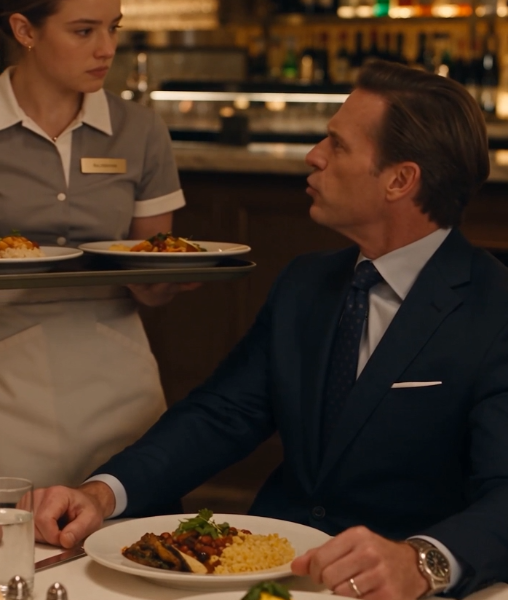
Everyone on the floor knew about Grant Whitaker. He was fifty-one, and handsome in a heavy, polished, expensive way, with a square jaw and a salesman’s tan and a navy suit that cost more than her yearly rent. He ran an investment firm called Whitaker Capital, which owned a great many buildings, and he had been coming to Maison Vale every Friday for eleven months. He never booked. He never apologised. He always sat at the same corner table, number nine, with his back to the wall and a clear view of the room. He tipped nothing. He sent back, on average, three dishes a night.
And he held, so the kitchen whispered, a loan against the building that Maison Vale stood in.
It was a story that had passed from mouth to mouth for months, the way stories do in kitchens. A crash. A bad year. Madame Vale borrowed fourteen million to refit the whole restaurant, and it was Whitaker who lent it, and the note is due in two weeks, and if she cannot pay, he takes the lot. The building, the lease, the name. Nobody quite believed it. Nobody quite disbelieved it either.
Nora knew it was true.
She had known since the Sunday dinner in March, when her mother had put down her fork in the middle of a story about a sommelier and said, in a thin voice that Nora had never heard before, I have made a mistake, Nora. She had said it like a woman reading out a diagnosis. I trusted the wrong man. I’ll fix it. But I want you to know that it’s possible, for a few weeks, that I may not.
She had never asked for help. She had never asked for anything. And Nora, who had said at twenty that she did not want an inheritance, had sat across the table from her mother, in the quiet of the penthouse, and understood for the first time what it might cost to be the person who gave one.
“Quinn,” said Paolo gently.
She took a breath.
“I’ll take it,” she said.









