Table Nine
CHAPTER FOUR — Page Three
Grant Whitaker was enjoying himself enormously.
It was a feeling he knew well, and he had been chasing it for thirty years. It started somewhere behind the breastbone and spread outwards, warm and golden, like the first mouthful of good whisky. It was the feeling of a room turning towards him. The feeling of power, absolute and unchallenged, over a small and helpless thing.
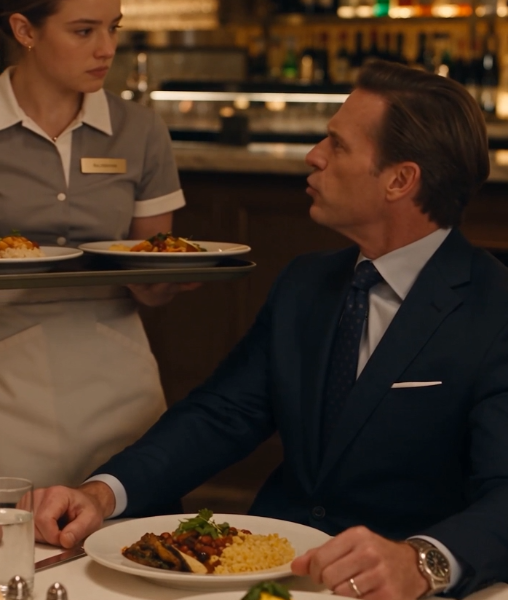
He stood in the middle of the restaurant with his jacket hanging open and a long dark stain down his trouser leg, and he looked down at the girl on the floor, and he thought, as he often thought: this is what they are for.
He did not hate them. That was the funny part. People assumed that men like him must hate. But he felt no malice towards the waitresses, the clerks, the maids, the small grey interchangeable figures who moved through the margins of his life with their trays and their forms and their weary patient faces. He felt something much simpler. He felt that they existed in order to be reminded of where they stood. A tip was a kindness. A reprimand was a favour. He was, in his own small way, a teacher.
And he had been looking forward to this evening for a very long time.
Two more weeks. Thirteen days, if one was being exact. After a year of lunches and handshakes and carefully worded emails, after a year of watching Marguerite Vale’s polished, patient, impenetrable face across a boardroom table, he was about to take the whole thing. The tower, the lease, the famous name. He had been planning it since the day he first read her accounts. A good restaurant, he had realised, was not a business. It was a location. And this one stood on the most expensive corner in the city.
He had come early tonight on a whim, to savour it.
He had brought the Pearsons, a fat, nervous pair of potential investors, to witness. He had ordered the tasting menu, to be served by the youngest and plainest waitress on the floor. He had found, with the sharp, bright intuition of a connoisseur, that she was the sort who would take it. Plain, tired, composed, with her hair scraped back and her chin trembling, a girl who had learned to swallow things. He had seen it in the first ten seconds.
The swing of the arm had been a pleasure. He did not pretend otherwise. He had done it before, in other restaurants, to other girls, and there was always a moment, a small bright pulse in the air, when the tray tipped and the plates began to slide and he felt, rather than saw, the whole room gasp. It was like pulling a cork.
But he had not expected the girl to say it.
You moved your arm.
The words hung in the quiet. He had seen the Pearsons exchange a look. The thin woman in beige had put down her glass of water with a tiny clink, and was looking at the waitress with an expression that he did not like at all.
He turned his smile on the room.
“Get me your manager,” he said. “Now.”
The manager did not come.
That was the first odd thing. He stood there for a full minute, with his hands on his hips, in a silence that was beginning to be uncomfortable, watching the swing door of the kitchen. It did not open. He heard, in the distance, a cough. A bar stool scraped. At the host stand the old Italian, Ferrante, stood stock-still with his hands folded in front of him, looking not at Whitaker but at something in the middle distance, over his shoulder.
Whitaker turned.
Across the long room, from the far end of the dining floor, a woman was walking towards him.
She was tall. She was dressed entirely in black: a double-breasted jacket, narrow trousers, flat shoes that made no sound on the floor. Dark hair, cut in a strict line at the jaw. She walked slowly, without hurry, with a thin leather portfolio held in front of her chest, and as she passed between the tables the diners drew back, one after another, in a ripple, like corn in a wind.
He knew her face at once.
It was the face from the corridor portrait. The face from the boardroom. The face across the table at the meeting in March when he had slid a document across the polished wood and said, I’m afraid my hands are tied. He had waited for that face to crumple. He had waited eleven months.
It had never crumpled once.
“Madame Vale,” said Whitaker, with a smile. It spread across his handsome face like oil. “What an honour. I was just telling my guests. I’m so sorry for the disturbance. There’s been a rather unfortunate incident with one of your girls.”
She did not answer.
She reached the table. She stopped. She was a good six inches shorter than he was, and she looked up at him with her chin lifted and her dark eyes quite level, without anger, without fear, with a calm so complete that he felt, for a second, an absurd urge to take a step back.
“May I?” said Marguerite Vale.
She drew out a chair, the one on his left, and sat.
She did it so smoothly that nobody objected. She laid the leather portfolio on the white cloth in front of her. She folded her hands on top of it. And she waited, composed and still, with her eyes on his face, like a woman at a bus stop.
“Mr. Whitaker,” she said. “I’d like you to look at something.”
“Madame, I really don’t think this is the time—”
“It will only take a moment.”
She opened the portfolio. She drew out a clipped sheaf of papers, perhaps a dozen pages, and laid it in front of him, squarely, with the top sheet facing him. She did not push it. She simply let go.
“Page one,” she said.
He sat down.
He did not decide to. It was a social reflex, the ingrained courtesy of a man who has been taught to sit when a lady does. He lowered himself into the banquette, and pulled the papers towards him with a faintly condescending air, and glanced down.
It was a letter, on the heavy cream stationery of a Swiss private bank.
CONFIRMATION OF FULL SETTLEMENT. Re: Facility Agreement dated 11 March of the preceding year between Whitaker Capital Partners Ltd. and Vale Hospitality Group Ltd. We hereby confirm receipt, at 18:52 on this date, of the sum of £14,306,418.22 in full and final satisfaction of all principal, interest, fees and penalties outstanding—
He read it twice.
He did not understand it. It was perfectly clear, perfectly simple, a bald, brief sequence of numbers and legal phrases that any schoolboy could have followed. But it did not fit. It slid off the surface of his mind like water off glass. He felt his smile stiffen on his face. He looked up.
“This is—” he said. “This isn’t—”
“Page two,” said Marguerite Vale.
He turned it.
It was a shorter document, on a firm’s letterhead, signed in black ink. NOTICE OF WITHDRAWAL OF CONSENT TO ENTER PREMISES. He saw his own name, spelled out in full. He saw the words effective immediately, and the words any further attendance on the premises will constitute trespass, and, at the bottom, in a firm, small, upright hand, a signature that he had seen on a hundred pieces of correspondence: M. Vale.
A cold bead of sweat slid down the back of his neck.
“You can’t,” said Grant Whitaker. His voice had gone odd, thin and high. “This is— This is a forgery. I never received— The note is not due until the— This is not valid, it isn’t—”
“Page three,” said Marguerite.
She said it very softly. And something in the quiet, inexorable gentleness of it made every hair on the back of his neck stand up.
He turned the page.
It was a photograph.
It was a single black-and-white still, grainy and slightly blurred, printed on thick paper, with a date and a time stamped in white digits in the lower corner. It showed the corner of a restaurant, from above. A table. A woman in a grey uniform, bent at the waist, with a black tray in her hand. And a man in a dark suit, turned half away, with one arm swinging back through the air in a clear, wide, unmistakable arc, directly into her wrist.
Beneath it, in plain black type, were two lines.
Exhibit A. Evidence preserved. Referred to counsel for Vale Hospitality: assault; harassment of staff; public intimidation.
He stared at it.
He stared at his own arm. He stared at the long clean flicker of the swing. And he heard, from a very long way off, in the roaring silence of the dining room, the small, distinct, dreadful sound of a woman in beige beginning, very softly, to cry.
“That,” said Marguerite Vale, “is my daughter.”
The room dropped away from him.
He did not hear the Pearsons. He did not hear the faint, shocked, rustling murmur that ran round the tables. He did not hear Paolo Ferrante, at the host stand, take a long shuddering breath and put a hand over his eyes. He heard only a thin, high, singing noise in his own ears, like a wine glass struck with a spoon, and he looked, slowly, up from the photograph, into the dark, level, merciless eyes of the woman across the table, and for the first time in his entire life, Grant Whitaker could not think of a single thing to say.









