Table Nine
CHAPTER FIVE — Do You Know Who I Am?
Nora heard it from the floor.
She was still on her knees. She had not moved since the plates broke, and her trousers were soaked through, and the cut on her palm had begun to throb in a slow hot beat that matched her heart. She had stopped being able to feel her face. All she knew was that a shadow had fallen across the boards in front of her, long and narrow and dark, and that the shadow had a shape she knew.
She had not looked up.
She could not. She had understood, in the first moment, with a kind of cold, dreamlike horror, what she would see. A black jacket. A straight back. A pair of dark eyes in a long, stern, beloved face that she had spent fourteen months carefully avoiding on the ground floor of this building. Don’t, she had thought. Please, don’t. Not here. Not like this.
But her mother had walked straight past her.
She had walked to the corner banquette, and pulled out a chair, and sat. She had laid down a leather portfolio. And Nora had stayed where she was, on the cold floor, in the wreckage, with a fragment of porcelain in her fist, listening to the soft, even, measured voice that she had known all her life say, Page one. Page two. Page three.
She heard the paper turn.
She heard a man stop breathing.
And then, in a silence so complete that it seemed to hum, in the middle of the most famous dining room in the city, in front of a hundred and twenty strangers, her mother said, in the dry, clear, level tone of a woman reading out a verdict:
“That is my daughter.”
Nora’s head came up.
She had never been so frightened in her life. It was not the fear of a blow, or a bell, or a harsh word. It was the fear of a dam breaking. For fourteen months she had built a small, plain, tidy life out of silence, out of rules and rotas and the smell of floor polish, out of the quiet, stubborn conviction that she could be something without being given it, and in a single sentence it had fallen down around her like a house of cards.
She stared across the room.
Her mother was sitting very upright in the banquette, with her hands folded in front of her and her dark eyes fixed on Grant Whitaker’s face. She did not look at Nora. She did not need to. But Nora saw her hands. They were folded quite tightly. The knuckles were white. And a very small, very fine tremor ran through the left one, a trembling that no one else in the room would have noticed, like a leaf in the lee of a wall.
Oh, Mum, thought Nora.
She understood. She understood it in a rush, all at once, with the clean sharp ache of a splinter coming out. Her mother had not wanted to say it. She had stood in the dark of the corridor, and watched, and decided; and what she had decided was that fourteen months of her daughter’s pride were worth less than a single moment of her daughter’s dignity.
It was the most terrible gift she had ever been given.
Grant Whitaker came to his feet like a man who has been stung.
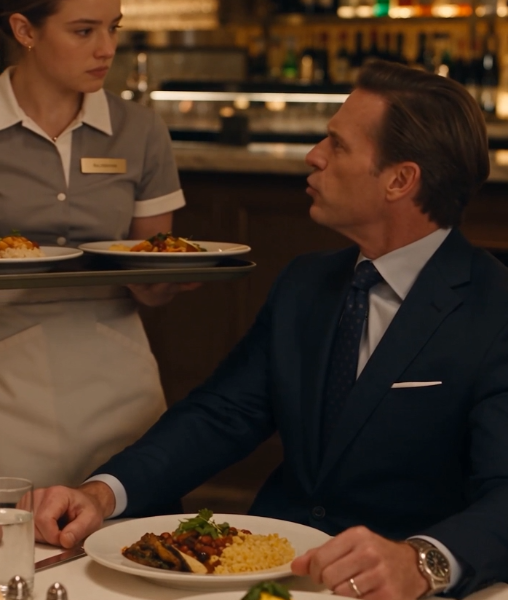
He did it so violently that the table rocked. A water glass toppled, and rolled, and fell to the floor, and shattered, and nobody so much as blinked. He stood with both fists clenched at his sides and his face the colour of raw beef, and when he spoke, it was in a high, cracked, shaking bellow that bore no relation to the smooth, rich, confident voice that had addressed her ten minutes earlier.
“This is outrageous!”
The room did not stir.
“This is— This is a set-up! You planned this! You—” He rounded on the man in the grey suit, who had shrunk against the wall of the banquette, white as chalk. “Pearson! Pearson, are you seeing this? A trap! She had it all arranged! She— She planted the girl! She’s—”
“Grant,” said Pearson, in a voice like a mouse’s, “I really think that we ought—”
“I’ll sue. I’ll sue the lot of you. I’ll have this place shut down in a month, I’ll have your licence, I’ll— Do you have any idea,” shouted Grant Whitaker, throwing out his arm and sweeping it round the whole silent restaurant, so wildly that a man at table six flinched, “any idea, what I can do?”
“We saw,” said a voice.
It was a small voice. It was thin and quavering and quite distinct. It came from the other side of the table, from a woman in a beige dress with a heavy pearl necklace, who had been sitting for ten minutes with a glass of water clutched in both hands. She had put it down. She had risen. She stood now with her hands pressed flat against the tablecloth, trembling all over, and her face was wet.
“Elspeth,” said Pearson, in horror.
“We saw, Gerald.” The woman’s voice shook. But she did not stop. “I was looking right at his hand. I was— He swung it. He swung it on purpose. He did it so— So casually. As if it were nothing.” She turned and looked, with enormous swimming eyes, across the table at the girl in the grey uniform on the floor. “I’m so sorry, my dear. I should have said at once. I should have said. I’m so ashamed.”
Nora did not know what to do. She could not speak. She sat back on her heels with the broken plate in her hand and stared at the thin woman in beige, and then a little to the left, at the next table, where a stout old gentleman in a bow tie was rising slowly to his feet, with his napkin still tucked into his collar.
“I saw it as well,” said the old gentleman, in a deep, rumbling, indignant bass. “Disgraceful. In sixty years of dining in this city I have never seen such a thing.”
“I’ve got it on video,” said a girl at the birthday table, in a small shocked voice, holding up her phone. “I was filming the cake. I swear. It’s all there.”
And then somebody else was standing, and somebody else, and the whole great gleaming golden room seemed to rise at once, table by table, in a long slow ripple of black jackets and silk dresses, until a hundred and twenty people were on their feet in the lamplight, silent, and shaken, and burning with a quiet, unanimous, appalled outrage that none of them had ever felt before.
Grant Whitaker looked around him.
For the first time, something flickered across the broad handsome face that was not anger. It was the dawning, slow, stupefied bewilderment of a man who has stepped onto a floor that is not there.
“I—” he said.
They came out of the shadows without a sound.
There were four of them. Two were big, broad-shouldered men in dark suits, with close-cropped hair and the unhurried, patient, weighty tread of those who are paid to stand in doorways. They had been waiting in the lobby for twenty minutes, in their jackets, as instructed, drinking coffee from the staff urn and looking at nothing. The third was Teddy Ruiz, with a radio at his collar and his jaw jutting. The fourth was a quiet, pale, bespectacled young man from the Meridian Tower’s own building security, who looked, to judge from the expression on his face, as though he had been waiting all year for someone to give him permission.
They stopped around the table.
They did not touch him. They had been told not to. They only stood, at a respectful distance, in a loose semicircle, filling the space with their quiet, solid, courteous bulk, so that wherever Whitaker turned his head, there was a black suit, an impassive face, and a pair of folded hands.
“Mr. Whitaker,” said Teddy Ruiz.
“Take your hands off me!”
“We’re not touching you, sir. We’d like you to come with us.”
“I’ll do no such—”
“Sir,” said the larger of the two big men, mildly, “it would be a great deal easier if you did.”
He took one step forward. It was only a step. But it was an enormous step, the step of a man who weighed a hundred and ten kilos and had once been a rugby prop, and Grant Whitaker shrank from it like a child from a dog. His eyes darted round the circle. He looked at the Pearsons, who were backing away. He looked at the old man in the bow tie, who was glaring at him through his monocle. He looked at the wall of staring, standing, silent faces, and he looked, at last, at the woman in black, who was sitting perfectly still in the banquette with her hands folded on the leather portfolio.
She was watching him calmly. She did not look triumphant. She did not look angry. She looked, he thought, with a sudden strange cold prickle, almost sad.
“Do you know,” said Grant Whitaker, in a thin, wavering, furious whisper, “who I am?”
Marguerite Vale tilted her head.
She considered the question. She considered it gravely, with her dark eyes level and thoughtful, as one might consider a question from a child. And then, in a voice as quiet and polite and unhurried as a woman giving directions to a stranger on the street, she said:
“Yes. A guest. A former one.”
It landed in the silence like a stone in a well.
There was a small sound at the back of the room. It was Dev, the bartender, who had put his face into the crook of his arm. His shoulders were shaking. The sommelier had bent double behind the bar. Paolo Ferrante, at the host stand, had closed his eyes, and his lips were moving, very slightly, as though in prayer.
Grant Whitaker opened his mouth.
Nothing came out.
Then the big man took his arm, very gently, above the elbow, as one would take the arm of an elderly relative, and the second took the other. They did not drag him. They did not need to. They simply turned him, and walked, and he went with them, stiffly, like a man in a dream, with his head up and his mouth working and one polished shoe leaving a long wet smear on the boards.
He did not look back.
They took him down the long length of the dining room, in a slow, solemn, silent procession, between the standing tables and the golden lamps and the hundred and twenty faces. They took him past the bar. They took him past the potted palms. They took him to the tall glass doors at the front of the restaurant, with their brass handles and their gilded EXIT sign, and Teddy Ruiz, ahead of them, put out one hand and pushed, and the doors swung wide, and the cold black night of the city came rushing in.
The last thing she saw was his back.
It was a broad, navy, expensive back, framed in the glass doorway against the glittering street. It seemed to have shrunk. It was surrounded by black-suited shoulders, and as she watched, it passed through the doors, and the doors swung closed behind it with a soft, heavy, final sigh.









