Table Nine
CHAPTER THREE — Run It Back
Forty floors above the dining room, Marguerite Vale was reading the last page of the most important document of her life, and she was not thinking about it at all.
She was thinking about her daughter’s hands.
It was an odd thing to be thinking about, at ten past eight on a Friday evening, at the end of a mahogany table in a glass-walled office, with a fountain pen in her fingers and a city of ten million lights spread out beneath her like a dropped necklace. She had been awake since four. She had spent the day on the telephone with lawyers in three countries and a banker in Geneva, and sold, since breakfast, two properties, a vineyard, and her late husband’s collection of first-edition sailing logs. She had signed her name, by her own count, one hundred and eleven times. And what she kept seeing, with an almost physical clarity, was a pair of narrow, red-knuckled, chapped young hands, carrying a tray down a corridor.
She had seen them two Sundays ago.
Nora had come up for dinner, as she did every other week, in a plain jumper and jeans with a hole in the knee, and had stood at the sink in the penthouse kitchen rinsing a glass. Her hands had been rough, and red, and slightly swollen at the joints, with a plaster across one thumb. They had been the hands of a woman who worked for her living. And Marguerite had stood in the doorway with a bottle of wine in her fist and felt something inside her chest turn over, slowly, like a heavy door on a hinge.
I did that, she had thought. I said earn it. And she has.
It had been the proudest moment of her life, and the worst.
“That’s the last of them, Marguerite.”
She looked up.
At the other end of the table sat a slim, serious, copper-skinned woman in a charcoal suit, with half-moon glasses pushed up into a cap of tight grey curls and an expression of faintly feline satisfaction. Ayodele Adeyemi had been Marguerite’s solicitor for twenty years. She had a reputation, in the legal quarter of the city, for being able to find a hole in a mountain. She slid a final sheet of paper across the polished wood, squared its edges with two fingers, and said, “Initial there, and date it, and you are done.”
Marguerite initialled.
She put down the pen.
The room went very quiet. Outside the glass wall, a helicopter drifted past, winking red, a long way off. On the wall behind her a clock ticked softly. It was eleven minutes past eight, and the note that Grant Whitaker held on the Meridian Tower, fourteen million pounds, due in thirteen days, was gone.
She had paid it at 6:52 that evening, by wire, from an account in Zurich. Every penny. Principal, interest, penalty. There was no further obligation. There was no further lien. The building, the lease, the kitchen, the brass lamps, the name, all of it belonged to her again, free and clear, for the first time in eleven months.
“I keep waiting to feel something,” said Marguerite.
“You will.” Ayodele took off her glasses and rubbed the bridge of her nose. “On Monday morning, when I serve it on him in person, in front of his board, with a courier and a stamp. It’ll be glorious. I’ve been drafting the letter since March.”
“I wanted to do it myself.”
“You will. You’ll be sitting at the end of the table in the room where he thought he was going to have you evicted. You’ll hand him the folder.” The lawyer’s thin mouth curved. “I’ve seen your face when you’re angry, Marguerite. It’s better than a lawsuit.”
Marguerite smiled, tiredly. She was fifty-four. She had been angry for eleven months. It had settled in her like sediment, a cold hard layer beneath the surface of everything, and she had been waiting, with infinite patience, for the day she could clear it.
The telephone on the desk buzzed.
It was a text message. It came from a number she had saved under a single word, and she had never, in twenty-five years, seen it light up on a Friday night.
PAOLO.
She picked it up. She read it. And a small, cold, perfectly clear stillness came down over her, like a pane of glass.
Table nine. It is Nora. Please come down.
There was no punctuation after that. There was no explanation. Paolo Ferrante, who had not once in a quarter-century used a telephone for anything but the ordering of fish, had written four words and a plea, and she understood from the economy of them that something very bad had happened, and that it had happened to someone he loved.
She stood up. Her chair rolled backwards and struck the wall.
“Marguerite?” said Ayodele sharply.
“Whitaker’s in the restaurant.”
“He’s what? It isn’t— He never comes on a—” The lawyer’s eyes narrowed. “He doesn’t know. He can’t know. Nobody outside the room knows.”
“He’s at table nine.” Marguerite was already moving. She snatched her black jacket from the back of the chair and shrugged it on, and as she crossed the thick grey carpet to the door, she heard the other woman rise behind her, a quick brisk rustle of papers, and a voice, calm and cold, say: “Take the folder.”
“I don’t need—”
“Take the folder, Marguerite. I will not have you walk into that room with empty hands.”
A thin black leather portfolio was pressed into her grip. She looked down at it. It was lighter than she had expected.
“What’s in it?”
“Everything,” said Ayodele Adeyemi.
The gold lift took forty seconds to descend.
It was a small, panelled, silent box, lined with mirrored brass, and she stood in the middle of it with her back very straight and her hands folded round the leather portfolio, watching the numbers slide down. Thirty-eight. Thirty-one. Twenty-six. She did not look at her reflection. She knew what she would see. A tall woman in black, with a severe dark bob, strong brows and a long straight mouth, looking exactly like the portrait in the corridor of the restaurant that bore her name.
She thought of the day she had opened it.
It had been a wet October afternoon, twenty-two years ago. She had been thirty-two, and pregnant with a child she had not planned and did not yet know how to want. Her husband Daniel had stood beside her on the pavement outside, in a borrowed suit, with his arm around her shoulders and a bunch of supermarket carnations in his fist. Look at that, he had said. They had looked at the sign. MAISON VALE. The gold leaf was still tacky. You did that, Marg. You, out of nothing.
We did it.
I held the ladder.
He had died when Nora was fifteen, of a clot, in the middle of an ordinary Tuesday, in the back seat of a taxi. He had been forty-six. She had stood in a hospital corridor in her coat with the sound of her own blood in her ears, and a doctor had said I’m so sorry, and she had felt something close inside her, like a trapdoor, and she had gone back to work the next day.
She had never regretted that. She had told herself so, many times. The business was what had kept them alive. But she knew what her daughter thought. She knew what it had cost them. A girl who watches her mother vanish into a restaurant for ten years will draw her own conclusions.
I haven’t got a path, Mum. I’ve got a surname.
The lift slowed.
She had thought, afterwards, that it was the cruellest sentence anyone had ever said to her. It had taken her a year to understand that it was also the truest. And that was why, when her daughter had stood in front of her desk in a clean white shirt and asked for a job at the bottom of the building, she had agreed. Not out of generosity. Out of a kind of terror. Because she had realised, with the cold clarity of a woman at the edge of a cliff, that if she said no, she would lose her.
The doors slid open.
She stepped out into the service corridor, a narrow carpeted passage behind the host stand, panelled in warm walnut and lit by a single brass sconce, and the sound of the restaurant came to her down its length like a distant sea. She stopped.
Something was wrong with the sound.
It was too quiet. In twenty-two years she had walked into this room perhaps a thousand times, and she knew its voice as she knew her own. It was a low steady golden murmur, like bees in a lime tree: a hundred conversations, a hundred forks, the chime of glass on glass. It was never silent. Even on a quiet Monday, even in the dead of winter, there was always something.
Tonight, from the far end of the corridor, she could hear a man’s voice. It was big, and flat, and carrying. It had the dreadful ringing quality of someone who is performing for an audience. And beneath it, so faint that she thought at first she had imagined it, thin and cracked and trying very hard not to break:
“You moved your arm.”
A hand closed round her heart.
She went forward. She did not run; Marguerite Vale had not run in public since 1998. But she walked fast, with the heels of her black shoes clicking on the parquet, to the little recess by the end of the corridor where a pair of flat screens were mounted on the wall, side by side, beneath a camera dome. A young man was standing in front of them, in a dark suit with a radio at his collar, with his arms folded and his jaw tight.
Teddy Ruiz, who ran the floor’s security, had been on duty for six years. He turned at her footstep. He went pale.
“Madame Vale,” he said. “I— I was about to call upstairs. It’s— I think you’d better—”
“Run it back,” said Marguerite.
She did not raise her voice. She said it as she might have asked for the time. And Teddy Ruiz, who had never in his life been addressed in that tone, picked up a remote control from the shelf with a hand that trembled very slightly, and pressed a button.
The left-hand screen flickered.
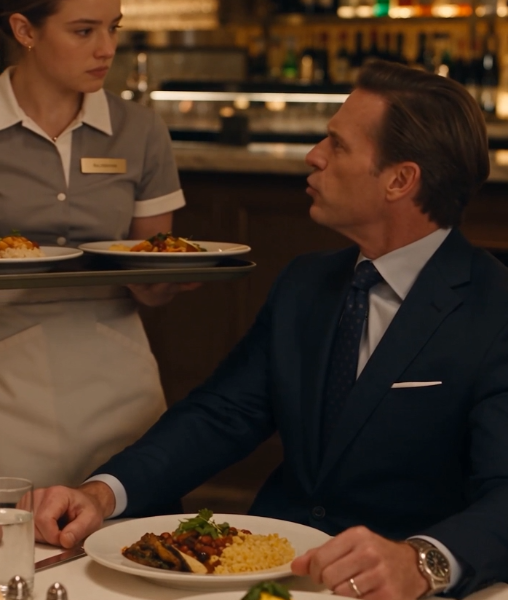
It was a high, grey-tinted bird’s-eye view of the dining room, shot from the camera in the ceiling above the bar. She saw the long dark rows of tables. She saw the brass lamps, glowing like fireflies. She saw, in the far corner, a small round table with a white cloth, and a man in a navy suit seated at it, and a slim figure in grey, with a black tray balanced on her palm, walking steadily across the floor.
Nora.
She knew her by the way she walked. She would have known her anywhere. She had her father’s gait: very straight, very careful, with a slight lift of the chin, as if listening for a distant whistle. Marguerite put one hand to her mouth.
On the screen, the figure reached the table. She paused. She bent a little at the waist. The man in the navy suit turned, with one arm lifted, still gesturing at someone else, and the girl put out her left hand to the rim of a plate.
The arm swung back.
It was a small clean movement, and in the grey, silent, slightly blurred picture it looked almost graceful. A man’s elbow. A woman’s wrist. A black tray tilting, slowly, with a kind of terrible inevitability, as the plates slid off it one by one.
“Again,” said Marguerite.
Teddy pressed a button.
The arm swung back.
“Again.”
It swung back.
She watched it four times. She watched it in slow motion, at a quarter speed, with the figure of a small grey-clad girl frozen in a half-bow and a man’s arm hanging in the air above her like a blade. She watched, with a still, cold, pitiless attention, until she could have drawn it from memory. There was no question. It was unambiguous. It was the sort of footage that a lawyer dreams about. Grant Whitaker had struck the tray with his own arm, deliberately, while looking in the opposite direction, in a gesture so smooth and so practised that she thought, with a flicker of sick, clear insight, he has done this before.
She took her hand from her mouth.
“Madame,” said Teddy Ruiz, miserably. “I’m so sorry. I didn’t see it happen. I was on the door, I—”
“Save that footage.”
“Yes, ma’am.”
“Copy it three times. Send one to Ms. Adeyemi, one to my personal address, and one to the police. Not tonight. Monday.” She was walking again. She had not known she was going to move. “And Teddy.”
“Ma’am?”
“Get the others. The two men from the lobby. The big one and the quiet one. Tell them I’d like them in the dining room in five minutes. Tell them to wear their jackets.”
He stared at her.
“Do you understand?”
“Yes, ma’am,” said Teddy Ruiz, with a sudden fierce gleam in his eye. “Yes, ma’am. With pleasure.”
She had reached the end of the corridor. She stood in the mouth of it, in the shadow, with the leather portfolio pressed against her chest, and looked out at the room.
It was the most terrible thing she had ever seen.
She saw it all at once, as one sees a car crash: a hundred and twenty people in a golden room, perfectly frozen, like a painting of a banquet. A man in a navy suit, standing, flushed and furious, with one finger pointed at the floor. And at his feet, on her knees, in a lake of wine and spilt food and broken china, her daughter.
She was picking up the pieces.
She was doing it so carefully. That was what undid Marguerite. Not the shouting, not the smashed plates, not the circle of staring faces. It was the care of it: the slow, deliberate, patient way that Nora knelt in the mess and gathered the shards in her cupped palm, one by one, as though it were a duty, as though it had been her fault. There was a thin bright line of blood across the heel of her hand. She had not noticed. She laid each fragment on the tray, very gently, like a person laying flowers on a grave.
If you drop it, you pick it up.
Rule three. She had written it herself, in 1999, in black ink, on the back of a staff-room door. She had meant it as a joke.
“Sir,” said Nora, looking up. Her voice carried across the silent room, high and thin and cracking. “Sir, please. I didn’t— You moved your arm.”
Marguerite closed her eyes.
She had imagined this moment. Not this one, exactly, but its cousin. Over the long grey year she had imagined a hundred ways in which the world might hurt her child, and in every one of them she had stepped forward, and spread her arms, and said no. She had been ready. She had been armed. And now she stood in the shadow of the corridor with her heart hammering and her nails cutting into the leather, and she understood, with a terrible clarity, that she could not.
Not yet.
If she ran across the floor now, if she dropped to her knees on the polished boards and gathered her daughter into her arms, in front of a hundred and twenty diners and the whole of the front-of-house staff, then the story would be over. The girl would be Madame Vale’s daughter, and the fourteen months of silent sweat and sore feet and quiet pride, the thing she had earned, would be erased in a second.
And Grant Whitaker would walk out of the room unscathed.
“Get me your manager,” said Grant Whitaker, softly, with a cold delighted smile. “Now.”
Marguerite Vale opened her eyes.
They were quite dry. They were dark and level and still, the eyes of a woman who had won a great many battles by waiting. She drew a long breath through her nose. She tightened her grip on the portfolio. And she stepped out of the shadow of the corridor, into the golden light, onto the floor of her own restaurant, and began to walk.









