Table Nine
CHAPTER SIX — Mom
It was the silence she would remember.
It lasted perhaps five seconds. It was not an empty silence. It was thick and bright and quivering, the silence of a hundred and twenty people who have just watched a wall come down, and who do not yet know how to breathe. A fork rang on a plate. A chair creaked. Somewhere in the kitchen a pan was dropped and nobody said a word.
Then Marguerite Vale stood up.
She stood slowly, with her hand on the back of the chair, and looked down the length of the restaurant at a small grey-uniformed figure on the floor. She was no longer composed. The mask had gone. It had slipped, while the doors closed, quite quietly, and what was left was a tired, pale, middle-aged face with a long straight mouth that was beginning, in spite of every effort, to tremble.
She crossed the floor.
It was only ten steps. It felt like crossing an ocean. She walked through the wreckage of the plates and the long wet smear of the wine, in her black shoes, in her black suit, with the whole room watching, and the diners stepped aside to let her through, silently, and she did not see a single one of them. She saw only the girl. She saw the narrow shoulders, the slipping bun, the grey uniform, the plaster-white face with its enormous swimming eyes. She saw the bleeding palm.
She stopped in front of her.
Nora got slowly to her feet.
They stood face to face in the middle of the dining room, a foot apart, mother and daughter, in the amber light of a hundred brass lamps. They were exactly the same height. They had the same dark eyes and the same long upper lip and the same stubborn, uncompromising set of the jaw. Nobody in that room, looking at them now, could have failed to see it. It was like watching someone meet their own reflection.
“You said it,” whispered Nora.
“I did.”
“In front of everyone.”
“Yes.”
“I asked you—” Her voice cracked. “I asked you not to. I wanted to— I wanted to do it. By myself. For once. I wanted to be—” She stopped. She pressed the back of her bleeding hand against her mouth. “I was so good, Mum. I was doing so well. Nobody knew. Chiara thinks I’m from Leeds. Yann taught me to make a roux. I was— I was just Nora.”
“I know.”
“And you came down here and—”
“I know.” Marguerite’s voice shook. She took a step closer. “I know, darling. I know what I took. I stood in the corridor for four minutes and I watched you pick up those plates, and I thought, if I speak, it’s over. And I thought, if I don’t, he’ll go on thinking you’re nobody. He’ll walk out of here thinking he was right.” Her eyes were wet. “And I couldn’t. I’m sorry. I couldn’t let him have it. I couldn’t let anyone in this room think that you were small.”
“I’m not small.”
“No.”
“I’m not.”
“You never were.” She was crying now. She did not try to hide it. The tears ran down her face, one by one, and fell on the black lapel of her jacket, and she did not wipe them. “You were never the one who dropped anything, Nora. Not the plates. Not— Not any of it. I was the one who dropped you. I dropped you for ten years, and you got up, and you walked out, and you earned every single thing you have, and you didn’t ask me for a penny. And I have been so proud of you, for fourteen months, that I could hardly breathe. And I never told you. I never said it. Not once.”
She drew a long shuddering breath.
“So I’m saying it now. In front of everyone. Because you’re allowed to be loved out loud.”
Nora stared at her.
She stood quite still. She felt the whole fourteen months go through her, in one long dark wave: the aching feet, the cold dawns, the stinging hands, the nights she had cried in the staff toilet with the tap running. She felt the tilt of the tray, and the roar of the plates, and the cold hard gleam of a stranger’s smile. And somewhere underneath it all, through all of it, like a thread running through a tapestry, she felt a thing that she had not allowed herself to feel since the day she walked out of her mother’s penthouse with a suitcase in her hand.
She felt seen.
“Mom,” she said.
It was a tiny sound. It was the voice of a fifteen-year-old standing in a hospital corridor. It came out of her chest like a sob, and she took one step, and her mother’s arms were round her, strong and thin and shaking, and her face was in the black wool of a jacket that smelled of jasmine and ink and cold air, and she was crying so hard that she could not stand up.
Marguerite held her.
She held her as one holds a thing that has been lost and found, with both arms, with her chin on the crown of the slipping bun, rocking her slowly from side to side in the middle of the floor. She said nothing. There was nothing to say. The room was perfectly silent. Above them the brass lamps glowed. And somewhere behind them, in a voice so soft that only the two of them could hear it, Paolo Ferrante said, in Italian, to nobody in particular, finalmente.
It began as a single pair of hands.
It was the old gentleman in the bow tie. He had not sat down. He stood, with his napkin still in his collar and his monocle gleaming, and he began to clap, slowly, gravely, with the deliberate dignity of a man applauding at the opera. Then the thin woman in beige joined in, and the girl with the phone, and the birthday table. Then Dev, over the bar. Then Chiara, in the kitchen door, with her apron pressed to her face. Then Yann, enormous, red-faced, in his stained whites, with tears pouring down his cheeks. And then all of them, the whole warm golden room, a hundred and twenty diners and forty staff, applauding in the lamplight for a girl in a grey uniform who was crying into her mother’s shoulder and did not hear a sound.
EPILOGUE — Rule Five
The plate is framed now, in the staff room.
It hangs on the wall above the lockers, beside the cracked mirror, in a plain black frame: a single curved shard of white porcelain, with a thin gold rim, and a small brown stain on one edge. Nobody remembers who put it there. The younger waiters, who joined in the spring, believe it is a relic of some famous kitchen disaster. Paolo, if asked, will only say, it is a reminder, and shut the door.
Beneath it, in a neat black hand on a sheet of cream paper, is a new line, pinned to the back of the door beside the old four.
Five. No one in this house will ever be made to feel small for carrying something heavy.
It was signed, in a different, rounder, more careful hand: N. Quinn Vale.
The story was in the newspapers for a week.
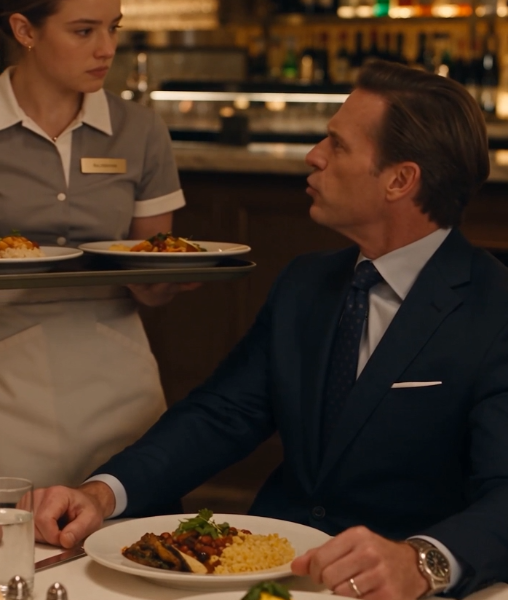
There had been the video, of course, three different angles, shared four million times before the weekend. There had been the police, who had come on Monday, as arranged, and a fortnight of statements, and a very brief and very unpleasant hearing at which Grant Whitaker had appeared in a charcoal suit, with a solicitor, and said almost nothing. There had been the Pearsons, who had withdrawn from the investment within the hour. There had been the Financial Authority, who had taken an interest. There had been, in the end, a plea, and a fine, and a suspended sentence for assault, and the quiet disappearance, from the glossier pages of the city’s business columns, of a certain navy-suited, gold-watched, smiling face.
The building had been bought by a trust.
It was a very small trust, with a very long name, administered by a firm of solicitors in Gray’s Inn. It held the freehold of the Meridian Tower’s ground floor, and it let the restaurant its lease on a peppercorn rent, in perpetuity, on one condition: that the staff of Maison Vale be paid a living wage, and given a share of the profits, and never, for any reason, be required to serve any guest who spoke to them as Grant Whitaker had spoken to Nora Quinn.
It was called the Daniel Quinn Foundation.
Nora had found out only in the spring. She had been working a Friday service, as she still did, on the floor, in the grey uniform that now fitted her, with her name pinned crookedly to the pocket. At six o’clock, in the lull before the doors opened, her mother had come down from the fortieth floor in the gold lift, with a thin leather portfolio under her arm, and handed it to her without a word.
She had read the first page standing up.
Then she had sat down on the staff-room bench, and read it again.
Assistant General Manager, said the letter beneath. Effective Monday. And, in a line of black ink at the foot, written in her mother’s own hand: If you want it. If not, the floor is yours. Either way, the badge stays. Love, M.
She had looked up. Her mother was standing in the doorway, with her arms folded and her chin lifted, trying very hard not to look as though she were holding her breath.
“I haven’t got a path,” said Nora, slowly. She felt her mouth begin to curve. “I’ve got a surname.”
“Two,” said Marguerite Vale.
“Two.”
“One you were born with. One you chose.”
“Which one goes on the door?”
Her mother smiled. It was the smile Nora had waited twenty-two years to see: wide, wet, unguarded, a girl’s smile on a woman’s face. “I thought,” she said, “you might like to decide.”
They are still deciding.
On the first Friday of every month, a table is kept free in the corner of the dining room. It is a small round table, number nine, with a white linen cloth and a single brass lamp. There is no reservation card. There is no name. It is set for two, with heavy silver and good glasses, and it is served, by arrangement, by whoever is on the floor.
They bring the lamb, medium-rare.
A tall woman in black sits on one side, with a leather portfolio at her elbow and her dark hair cut in a strict line at the jaw. On the other side sits a younger woman, in a plain grey uniform with a crooked brass badge, who has, by tradition, been given the night off. She eats quickly. She talks with her hands. She is, the waiters say, the only person in the building who is allowed to send a dish back.
She never does.
THE END 🕊️









