Table Nine
CHAPTER TWO — Two Plates
Grant Whitaker did not look up when she arrived at his table.
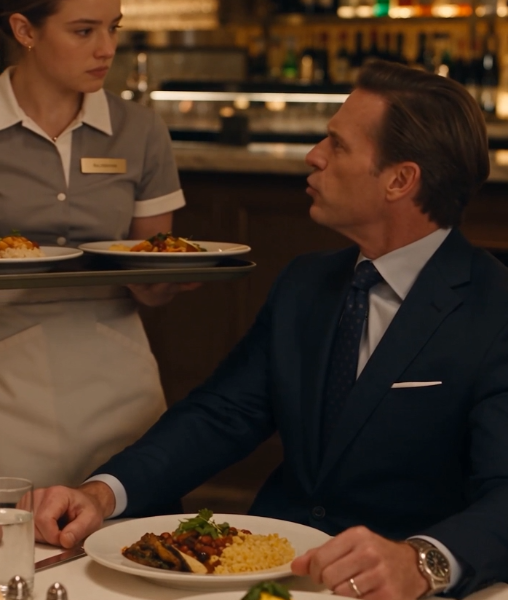
That was how she knew it would be a bad night. He sat in the corner banquette, in the pool of amber lamplight, with his back to the wall and his navy jacket hanging open and his left wrist flat on the tablecloth, where an enormous gold watch caught the glow. He was talking to the man on his right, a pink, plump, anxious individual in a grey suit, in a voice that carried across three tables. The man’s wife, a thin woman in beige, sat opposite, clutching a glass of water as though it might be taken from her.
“—and the beauty of it,” Whitaker was saying, “is that she has no choice. She can’t refinance. She can’t sell. There’s not a bank in the city that will touch her. And in thirteen days,” he consulted the gold watch, with a faint smile, “this very room belongs to me.”
“Gosh,” said the pink man.
“Forty-one residential units. Floor-to-ceiling glass. We’ll gut the whole ground floor. The kitchen, the bar, the—” He waved a large, tanned, manicured hand. “Everything. People will pay a fortune to look at a lobby where a restaurant used to be. It’s the sort of thing they love.”
“And the staff?” said the thin woman faintly.
“What staff?” said Whitaker, and laughed.
Nora stood three feet away with a menu in her hand and an expression of professional blankness that she had spent fourteen months perfecting. Her pulse was thudding in her ears. She had known. She had known, in the abstract, for months. But it was one thing to know it, and another to stand in a pool of warm golden light and hear a man discuss the demolition of her mother’s life over a basket of bread.
Rule one, she told herself. The guest is always welcome.
“Good evening, Mr. Whitaker,” she said. “I’m Nora. I’ll be looking after you tonight.”
He glanced up.
It was a flat, brief, appraising look, like a man checking the price on a piece of furniture. His eyes were pale blue, set a little too close, and bright with a kind of lazy, appetite-sharpened contempt. They travelled over her face, her hair, the crooked brass badge, the grey uniform that hung loosely on her narrow shoulders. Something in them registered, and dismissed.
“New,” he said.
“Yes, sir. I’ve been here fourteen months.”
“That’s not new, that’s a fixture. Where’s the other one? The Italian girl.”
“Chiara’s on her break, sir.”
“Pity.” He turned back to the pink man. “They always rotate the ugly ones in when I come. It’s a sort of reverse psychology. Do you see? They think I’ll go easy.”
The pink man tittered. The thin woman looked at the tablecloth.
Nora’s face did not move. She had learned that, too: how to make a mask out of the muscles of her cheeks, and wear it for six hours, and take it off in the bathroom afterwards and look at what was underneath. She said, evenly, “May I tell you about the menu?”
“No.”
“Of course, sir.”
“Bring the lamb for me. Medium-rare. The risotto for these two. And a bottle of the ’09 Margaux.” He snapped his fingers, once, quite softly, without looking at her. “Quickly.”
She brought the wine first. He did not taste it. He gestured at the glass, and she poured, and he drank half of it in one swallow, and made a face, and said nothing.
She brought the bread. He tore it into small pieces and left it.
She brought the first course, which was a delicate consommé of wild mushrooms with a tiny quenelle of truffle cream, and he looked at it with such quiet, deliberate distaste that she felt the kitchen’s whole effort wither on the plate. “Cold,” he said. It was not cold. She had touched the bowl. It was scalding. She took it back anyway, and carried it through the swing door into the roaring white glare of the kitchen, and the chef, a huge red-faced Breton named Yann, took one look at her face and said, without a word, give it here, and reheated it and sent it out again, and Whitaker said, better, and ate three spoonfuls and pushed it away.
She was sweating by the time the main course came up.
The pass was a long steel counter under a blaze of heat lamps, and on it, in a row, stood the plates: two golden risottos, creamy and perfumed with saffron, and a single loin of lamb, pink at the centre, glossed with a dark wine reduction and laid on a bed of buttered spinach. It was beautiful. It was perfect. She stood and looked at it for a moment, with a feeling in her chest that she could not name. Yann had been up since five. He had been cooking since he was fourteen years old. He put his whole heart on every plate, and this man was about to push it round with a fork.
“Quinn,” said Dev, at her elbow, in a low voice. “Let me take the third one. You’ve got the tray.”
“I’m fine.”
“It’s a big tray.”
“Rule two,” said Nora, with a thin smile. “Nobody carries more than they can balance.”
“Right. So—”
“I can balance it.”
She lifted it.
It was a round black service tray, heavy, with a non-slip rim, and she carried it on her right palm, shoulder-high, the way she had been taught. The two risottos sat on the left. The lamb sat on the right. She walked out through the swing door into the dining room, with her back straight and her chin up and her eyes fixed on the far corner, and the noise of the evening rose round her like a tide.
The room was very full. There were a hundred and twenty diners, and every one of them seemed to be laughing. A birthday party at table four sang something. A man at the bar was telling a story with his hands. And through it all, in a long straight line, between the tables and the potted palms and the gleaming brass lamps, she walked, one foot after another, without a single wobble, to the corner banquette.
Whitaker was gesturing.
He had one hand raised, and he was pointing at the pink man’s wife with his index finger, in the manner of a man making a point, and as she approached he swung round, with his eyes still on the thin woman, and said, without looking at Nora at all: “I said medium-rare.”
“I beg your pardon, sir?”
“Does that look medium-rare to you?”
She had not yet put the plate down. It was still on the tray, a foot from his elbow, steaming gently. She looked at it. It was a textbook lamb loin, rosy at the heart, with a thin line of pink running through the meat like a vein through marble. Yann would have fought a man for it.
“It’s exactly as you ordered, sir,” she said. “Perhaps if you—”
“Are you arguing with me?”
“No, sir. I only—”
“Take it away.”
She reached for it.
She would go over that moment, afterwards, a hundred times. She would lie awake with it in the dark. She would take it apart frame by frame, as her mother would later do on a screen, and she would never find the point at which she could have done anything differently. She had put her left hand on the rim of the plate. She had begun to lift. And Grant Whitaker, still turned half away from her, still pointing, with a look of faint impatient irritation on his handsome face, swung his arm backwards in a wide, slow, careless arc.
It struck the tray.
It was not a violent blow. That was the thing she kept returning to. It was almost gentle, almost absent-minded, like a man brushing a fly from his sleeve. But it caught the edge of the rim, exactly at the point where her wrist was bent, and the whole round black surface of the tray tipped, in one lazy smooth motion, like a ship going over.
The lamb slid first.
It skated off the edge in a long glistening ribbon of wine sauce and spinach, and hung for a heartbeat in the golden light, and fell. The risottos followed. She lunged. She caught the rim of one plate with her fingertips, and it spun out of her grasp and struck the corner of the table with a ringing crack, and the whole room, all hundred and twenty diners, stopped talking at once.
The plates hit the floor.
It was the loudest sound she had ever heard. It was a high, bright, shattering report, like a shot in a church, and it rang on and on, in the sudden stillness, as the china broke into a hundred pieces and the food scattered across the dark polished boards in a long wet spray of gold and green and brown.
The tray rang down after it, spinning, and rocked to a stop against a chair leg.
And then there was nothing at all.
“Look what you’ve done!” cried Grant Whitaker.
He had leapt to his feet. He stood over her, one hand clutching the lapel of his navy jacket, a long dark splash of wine sauce running down his trouser leg, with his handsome face contorted into an expression of purest, outraged, wounded dignity.
“Look what you’ve done! This suit cost four thousand pounds! Do you have any idea— Are you blind? Are you stupid? Do you have any idea who I am?”
“I’m so sorry, sir, I—”
She did not know what she said. She was already on her knees. It was an instinct, the oldest rule in the book: if you drop it, you pick it up. She was kneeling on the cold wooden floor in a spreading puddle of Margaux and wine reduction, with her black work trousers soaking and her hands full of broken china, scooping up shards of white porcelain and fragments of lamb, and the whole silent room stared down at her like a jury.
She thought: I did not drop it.
She thought: He moved his arm.
She thought, with a hot rush of shame that rose from her stomach to the roots of her hair: and nobody saw.
A sob tried to climb out of her chest. She bit down on it. She picked up a piece of plate with a jagged edge and felt it slice into her palm, a thin, bright, stinging line, and she did not drop it. She laid it carefully on the tray. She reached for the next.
“Sir,” she whispered. She looked up.
He was a very tall man, from down there. A great dark column of navy cloth, with a heavy gold watch and a blotched red face. Behind him, above him, the brass lamps glowed like small suns. She could see, at the edge of her vision, the staff gathered at the bar: Dev with his hand over his mouth, the sommelier gone white, and Paolo at the host stand, a small black figure, perfectly still, with an expression on his face that she could not read.
“Sir, please,” said Nora. Her voice came out cracked and small, and she hated it. “I didn’t— You moved your arm. You— I didn’t drop it, sir. You—”
“Are you calling me a liar?”
“No. No, sir. I’m only—”
“In front of my guests?” His voice rose to a roar. He looked round the silent restaurant, with his hands spread wide, as though appealing to a court. “Do you see this? Do you see what I’m dealing with? A fourteen-month waitress who can’t carry a plate! Get me your manager,” said Grant Whitaker, quite softly, with a thin, cold, delighted little smile. “Now.”









