The Medallion on the Marble
The Third RuleToby Hartley had three rules for staying alive, and he had broken the first two before he got through the kitchen door.
The first rule was never go inside. Inside was where people were, and people had eyes, and eyes had mouths, and mouths said things like where’s your mother? and who do you belong to? Outside was safe. Outside you could be a shape in a doorway, a heap of cardboard, a small grey ghost that nobody wanted to look at. He had been a ghost for two winters, and he was good at it.
The second rule was never steal. That one was his mum’s. She had said it in the last week, in the narrow hospital bed with the tubes in her arm, with her hand gripping his so hard that her knuckles went the colour of candle wax. You can be hungry, Toby. You can be cold. You can be sad till you think you’ll break. But you never take what isn’t yours. Promise me.
He had promised.
He had kept the promise for nineteen months, through the long wet autumn and the longer white winter, through nights in the bus shelter on Camden Road and mornings picking through the bins behind the bakery on Parkway. He had kept it the day he found half a sandwich in a litter bin and ate it in four seconds, standing up, and cried afterwards because it tasted of ham. He had kept it the week he was so hungry that the lights in the street went wavy and the pavement seemed to tilt. He was eight years old. He was a person of principle.
And then, at twenty past nine on a Saturday evening in November, he had slipped through the back door of Claridon House with a delivery boy’s crate of lemons, and walked into the most beautiful room he had ever seen, and broken both rules at once.
The third rule was the one that mattered. It was the only one he had made up himself.
If you’re going to be caught, be caught holding something.
He was on his hands and knees on the floor of the ballroom, and the floor was a miracle.
It was marble, pale gold and cream, polished to such a glassy shine that he could see his own face in it: a small, smudged, hollow-cheeked face with a scab on the left cheekbone and eyes much too big for it. Beneath him, the stone was warm. He could not get over that. It was warm, in November, in a building with ceilings as high as a church. Somewhere underneath, there must be pipes full of hot water, running through the floor like veins, just so that people could stand in their good shoes without their feet getting cold.
He had not been warm in nineteen months.
Above him, a long way up, hung chandeliers. He had counted six. They were enormous, glittering things like frozen waterfalls, each crystal throwing a thousand tiny rainbows across the gilded walls. Between them hung swags of white roses and cream silk, and at the far end of the room, on a dais, a string orchestra in white tie sawed away at something slow and sweet and sad that made the back of his throat ache.
He did not look at the orchestra. He looked at the tray.
It lay on its side near the foot of a gilt chair, half hidden by a trailing curtain of a woman’s skirt, where some waiter had dropped it and forgotten. It was a big oval silver tray, dented, with a rim of fancy twisted wire, and it was covered with bread.
Small round rolls, golden brown, with seeds on them. Triangles of white toast with the crusts cut off, buttered, with a smear of something pink and shiny on top. Half a baguette. A heap of crumbs. It smelled so good that his stomach did a long slow roll, like an animal turning over in its sleep, and a thin thread of spit ran down his chin.
Rule two, he told himself. You promised.
But the tray was on the floor. It had been thrown away. A thing on the floor was not taken, it was only found. He turned this over in his head with the careful moral rigour of a very small lawyer. Mum had said never take what isn’t yours. Nobody had said anything about what was thrown away. It was, when you thought about it, almost a kind of recycling.
He crawled.
He went along the floor on his hands and knees, in the shadow of a hundred pairs of gleaming shoes. Black patent leather. Gold sandals. A pair of red satin heels with a diamond buckle that sparkled like a tiny chandelier. He kept low. He kept quiet. He was good at it, he had a whole system: elbows tucked, breath shallow, never look up, never look anyone in the face. There was a smell of perfume and champagne and warm candle wax, and above it, from a long buffet table across the room, the rich, buttery, impossible smell of roasting meat.
His stomach cramped. He bit his lip until it bled.
Then his hand closed round a roll.
It was warm.
It was still warm. It had been sitting on that silver tray, under the warm gold lights, for perhaps ten minutes, and the soft crumb of it gave under his dirty fingers like the cheek of a baby. He did not wait. He did not think. He tore a piece off with his teeth and he ate it, and he nearly wept.
Bread. It was only bread. Salt, and butter, and yeast. It was the most beautiful thing that had ever happened to him.
He wolfed it. He crammed it into his mouth with both fists, tearing and swallowing, barely chewing, with crumbs showering down his chin and onto his torn brown tunic and the little gold medallion on its frayed leather cord that swung and clinked against the marble as he moved. He grabbed another roll. He grabbed a triangle of toast. He was shaking all over. He could not stop. He had the strange, dazed, drunken feeling of a person who has been very cold for a very long time and has just walked into a warm room.
Mum, he thought. Mum, there’s bread.
The memory came up through the food like a hand through water.
Her voice, in the dark of the hospital ward. The soft, scratchy, whispering voice of someone who had been very beautiful once, and was now mostly eyes. Toby. Listen to me. I need you to remember three things.
He had been six. He had nodded, and nodded, and nodded.
One. You are brave.
Two. You are loved.
Three. And here she had lifted a hand, thin as a bird’s claw, and touched the little gold disc on its cord at his throat, the one that she had put there on the day he was born, with her own fingers, in a different bed, in a different life. Three. If anyone ever asks you who you are, you show them this. You show them, and you say my name. You say Isabelle.
Who would ask?
Someone who will look very sad, his mother had whispered, with the ghost of a smile. She’s quite old now. She lives in a big house with lions on the gate. She’ll pretend she’s not sad. She’s very good at pretending.
Who is she, Mum?
But his mother had closed her eyes, and her hand had slid from his wrist onto the blanket, and that had been the last full sentence she had ever said.
He had not told anyone about the medallion. He had not shown it to a soul. For nineteen months he had worn it under his shirt, next to his skin, where the metal warmed to the heat of his body. When the big boys on the Parkway tried to take his shoes, he held it in his fist. When he was cold, he pressed it against his chest. He did not know what the lions meant, or the crown, or the little curly writing round the edge that he could not read. But he knew that a woman had said show them, and that a promise was a promise.
He had found the posters by accident, three days ago, pasted on a hoarding on Euston Road, beside a cinema advert and a missing cat.
THE WEXMOOR FOUNDATION ANNUAL GALA. IN AID OF HOMELESS CHILDREN. Saturday, 14 November. Claridon House, Mayfair. Hosted by the Dowager Countess of Wexmoor.
And in the corner, in gold, very small, a crest.
He had stood in front of that hoarding for a full half hour, in the rain, with his heart going like a hammer. Two lions. A crown. A shield. The same two lions, the same crown, the same shield, as the thing around his neck.
A big house with lions on the gate.
He had known then. He had known as surely as he knew his own name.
He had spent two days working out how to get inside.
The second roll was gone, and the toast, and most of the baguette. He had slowed down. The terrible empty ache in his stomach had begun to ease into something fuller and heavier and warmer, and he sat back on his heels with a half-eaten crust in his fist and for the first time looked up.
The room had gone quiet.
It was not completely quiet. The orchestra was still playing, soft and sweet, somewhere far away. But the buzz, the roar of four hundred people talking, had thinned and dropped and faded, as a tide goes out, until all that was left was a low shocked hush. He saw faces. They were turned to him from every side. A circle of them, in the glitter and the gold, like the petals of a huge strange flower.
A woman in a silver sequinned dress, with a glass of champagne halfway to her lips, was staring at him with an expression of absolute revulsion. A tall man in a bow tie, with pale eyes and a pink face, had put one hand over his mouth as though he were about to be sick. A girl in lilac whispered something to a friend, and the friend laughed.
Is that a child? someone said, quite clearly.
Good God.
How did it get in?
Toby’s stomach turned over.
He understood. He understood everything, in a clear flat flash, as you understand the colour of the sky. He was not a person here. He was a thing. A smell. A stain on the tablecloth. In the shining, golden, perfumed room of the rich, he was a rat that had run across the floor.
He had been looked at like that before, a hundred times. On the street. In shops. At the bus stop. But he had never been looked at like that by four hundred people at once, in a room so beautiful that it hurt, and he felt something inside him crumple, small and quiet, like a paper bag.
Get up, said the voice of his mother. Get up, Toby. You are brave.
He got halfway to his feet.
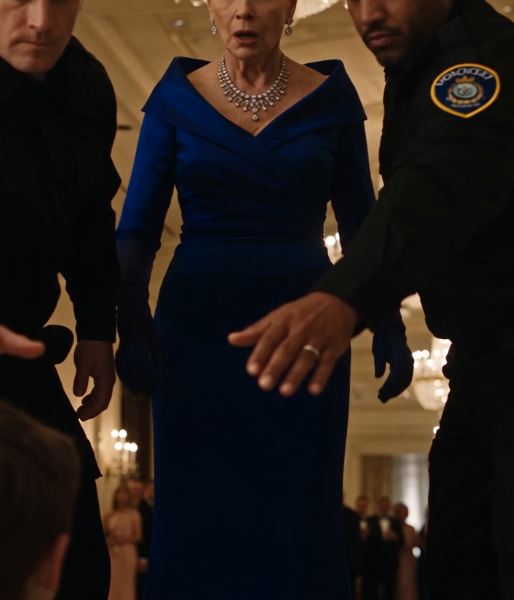
He saw, on the far side of the circle, a tall figure in black. A big man with a square pale face and a wire coiled behind one ear, pushing through the crowd. Another behind him. They moved quickly. They did not look like waiters.
Rule three, thought Toby. His heart had begun to hammer. If you’re going to be caught—
He grabbed the last roll.
He held it against his chest like a baby. His eyes darted round the ring of stony, glittering, hostile faces, looking for a gap, for a doorway, for anything, and found instead, at the far end of the room, in the wide gilded archway beneath the biggest of the chandeliers, a woman.
She was walking towards him.
She was very tall. She wore a long, dark blue silk gown that fell from her shoulders to the floor in a single unbroken line, the colour of deep water, and a collar of diamonds that blazed at her throat. Her hair was swept back from a stern, noble, handsome, ageing face. She moved without hurry, with her chin lifted and her gloved hands loose at her sides, and the crowd parted before her, without a word, as the sea parts for a ship.
She was looking directly at him.
And something about the way that she walked, the straight back, the slow proud tread, the long dark shadow cast by the chandelier, went through Toby Hartley like a cold wire. He did not know why. He only knew that every hair on his arms stood up, and that the bread fell out of his hand, and that he could not, for the life of him, look away.









