The Medallion on the Marble
The HostessAugusta, Dowager Countess of Wexmoor, had spent the best part of her life learning how not to look at things.
It was a skill. Like all skills, it had been taught early. As a girl of seven in the great cold nursery at Wexmoor Hall, she had learned not to look at the housemaid who wept on the back stairs. At twelve, she had learned not to look at her father when he came home late. At twenty, on her wedding day, standing in the vestry of a cold stone church with a diamond tiara pinned into her scalp, she had learned not to look at her husband’s face. And at fifty-four, in a hospital corridor in Bristol, when a nurse in a pink tunic had said gently, Lady Wexmoor, I’m so sorry, I think you may want to sit down, she had learned the hardest lesson of all.
She had learned not to look at the door.
For eleven years she had not looked at the door. Not at the telephone. Not at the post. Not at the long shadowed hall of the house in Hertfordshire, where on certain winter evenings, if the light fell a certain way, a slim fair girl in a white frock seemed to be standing at the foot of the stairs. She had not looked at the empty chair at dinner. She had not looked at the photograph that she kept face-down in the bottom drawer of her dressing table, under a pair of gloves and a lavender sachet.
She had looked at her work. She had looked at the Foundation, which she had built from nothing in six years into the largest children’s charity in the south of England. She had looked at her accounts, her committees, her speeches, her magnificent, immaculate, empty life.
And tonight she was looking at a ballroom.
“Four hundred and twelve,” said Rupert, at her elbow. “I counted the cards. A record, Augusta. You’ll have raised two million by midnight.”
“Three,” said Augusta.
“Three! Good heavens. You are a force of nature.”
She did not smile. She had stopped smiling at Rupert Wexmoor some thirty years ago, round about the time she had realised that he was her husband’s nephew, and her husband’s heir, and a man of such pleasant, plump, unctuous, unfailing helpfulness that every instinct she possessed told her to count the spoons. He stood beside her now under the chandeliers, in his immaculate white tie, with his pink face and his thinning sandy hair and a glass of champagne in his small plump hand, beaming at the room as though he had arranged it himself.
He had been beaming for eleven years.
“A splendid turnout,” he said. “Splendid. Look, there’s the Prime Minister’s wife. And the Pembertons. Sylvia’s in a dress that I believe is made entirely of foil. You must go and say something kind.”
“I shall go and say something true.”
“Oh, Augusta.”
“If you’ll excuse me, Rupert.”
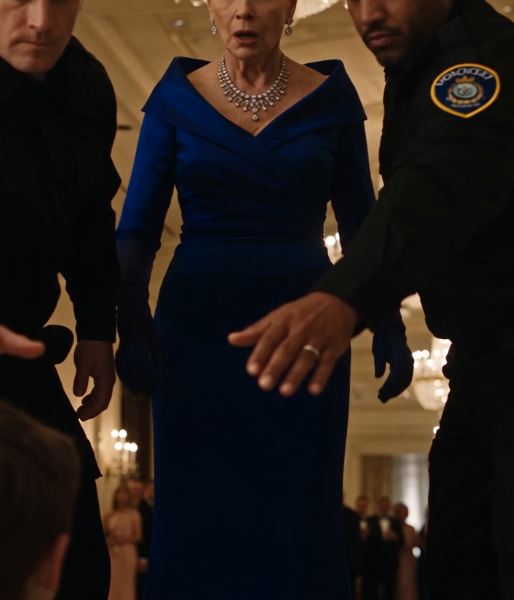
She left him. She walked down the long length of the room, between the clustered groups of guests, with her head high and her gloved hands folded. They parted for her as they always did. Heads turned. Smiles blossomed. A duchess caught her sleeve and gushed about the swan, the glorious ice swan, whose neck was already beginning to droop in the heat, so that it looked, thought Augusta, rather like a very expensive chicken. A banker bowed. A baroness wept about orphans.
She thanked them. She smiled at them. She said how very kind and we are so grateful and every penny counts, in the clear cool well-bred voice that she had cultivated for forty years, and all the while, behind her ribs, something very small and very old and very hard was beating like a clock.
It had begun at about eight o’clock.
She had been standing at the top of the staircase, receiving the guests, when it had come over her: a feeling, wordless and strange, like the faint pressure in the air before a thunderstorm. It was not a thought. It was lower than a thought. It was a kind of awareness, as though somewhere in the great glittering building, someone had just turned and looked at her. She had glanced round. She had seen nothing. She had put it down to nerves, or the champagne, or the long, long day.
But it had not gone away. It had grown. By nine, it had become a hum.
“Augusta, darling.”
It was Sylvia Pemberton, in the foil.
She was a thin, glittering, brittle creature of fifty, with a face like a polished pebble and a gown that clung to her like a coat of silver paint. Her husband hovered at her shoulder, a pink, pompous man named Giles who sat on six boards and had never in his life been seen to listen to anyone. Sylvia clutched a flute of champagne in her bony hand and gazed at Augusta with the avid, delighted, scandalised look of a woman who has just spotted a spillage.
“Have you seen?” breathed Sylvia.
“Seen what?”
“Over by the buffet. Oh, it’s too awful. There’s a— I don’t know what to call it. A child. A little street child, crawling about on the floor like a cat. I thought it was a joke. For the cause, you know, a sort of tableau. But it’s eating the bread, Augusta. From the floor.”
Augusta turned.
She turned slowly, as one turns in a dream. She looked across the glittering room, over the heads of the guests and the long white table with its ice sculpture and its pyramid of champagne glasses, to the far wall, where a circle of onlookers had gathered, in the gold light, round something small.
It was a boy.
He was kneeling on the marble, with his back half turned to her, a thin, ragged, hunched little figure in a torn brown tunic, with his hair standing up in dirty tufts and one grimy hand clutching a bread roll. He was eating as an animal eats, with both hands, in great gulping, tearing, desperate bites. She saw the sharp wing of a shoulder blade through the cloth. She saw the bare, filthy ankle, thin as a stick. She saw, as he turned his head, a small pale smudged profile, with a scab on the cheekbone and a long wet streak running down from the corner of one eye.
Something turned over in her chest.
It was a violent, wordless, wrenching movement, as of a great stone shifting in deep water, and for an instant the room reeled. She put out a hand and found nothing. She did not know why. She had seen street children before, a hundred of them, in her own shelters, with her own eyes, and she had always felt what a good woman feels: a pang, a pity, a firm resolve. This was not that. This was not pity. This was a thing so enormous and so unexpected that she could not find a name for it.
It’s nothing, she thought. You are overtired.
“Isn’t it ghastly?” said Sylvia. “Do get someone to take it away. People are looking.”
“Quite,” said Giles Pemberton. “Disgraceful. Where’s your security? They’re meant to keep out the, ah. The element.”
“It’s a child, Giles,” said Augusta.
It came out quiet, and cold, and clear. Giles blinked.
“Yes, but—”
“It is a child. It is, I believe, hungry. We are, I believe, at a party in aid of hungry children.” She heard her own voice rise a little. “I should think that the least we might do is not to stare.”
Sylvia gaped. A faint flush crept up Giles’s pink neck. Around them, a few of the nearer guests, who had been listening with the attentiveness of cattle at a gate, discovered something fascinating in their glasses.
She did not wait for an answer.
She began to walk.
She did not decide to. She was simply moving, through the thinning crowd, towards the small kneeling figure by the wall, with the long dark blue skirts of her gown whispering over the marble and her heart going like a drum. She did not look at the guards who were already shouldering through the guests from either side. She did not look at Rupert, who had put down his glass and was calling her name in a thin, sharp, strangely urgent voice. She looked at one thing only: a bare thin neck, and on it, glinting in the gold light, a loop of frayed brown cord.
There was something hanging from it.
It swung as the boy moved, bright and small, in and out of the shadow of his tunic. She could not see it clearly. It was a flash, a wink, a glint of yellow, no bigger than a coin.
And Augusta Wexmoor, who had learned, over sixty-six years, not to look at anything, found that she could not stop looking at that.









