The Medallion on the Marble
Show ThemThe lady smelled of rain and roses.
That was the first thing Toby noticed, in the first wild second, with her gloved hands clamped on his shoulders and her great dark face a foot from his own. She smelled of something cold and green and expensive, like a florist’s shop in winter. She smelled, strangely, of Mum. Not of the hospital, or the last grey months, but of the old Mum, the Mum from before, who used to sit on the edge of his bed in Bristol with a hairbrush in her hand and sing about a white horse. It was so unexpected, and so enormous, that his whole mind went white.
“Child,” the lady said again. Her voice was ragged. “Where did you get that?”
He could not speak.
His mouth had gone dry. He was standing with his back against a gilt chair, in a ring of staring faces, with a crust of bread still wedged in his cheek, and he was shaking so hard that his teeth chattered. He could feel everything: the cold of the marble through his torn plimsolls, the warmth of the lady’s hands through his thin tunic, the dreadful, glittering, listening weight of four hundred pairs of eyes. He wanted to run. He wanted, more than he had ever wanted anything, to be small, and silent, and invisible, a ghost in a doorway.
But she had the medallion in her hand.
She was holding it out to him, between two black-gloved fingers, with the broken cord trailing, and he saw that her hand was trembling too. It shook like a leaf. It shook so badly that the little gold lions caught the chandelier light and flickered like candle flames, and a strange, enormous, unlikely thought rose through the dizziness in his head.
She’s frightened.
She’s more frightened than I am.
“My mum gave it to me,” said Toby.
It came out in a croak. He swallowed, and tried again, louder, and his voice cracked in the middle and kept on going. He heard it ring across the hush of the ballroom, high and thin and absurdly clear, like a boy soprano in a cathedral.
“My mum gave it to me. She put it on me when I was born. She said that if anyone ever asked me who I am, I should show them.”
A ripple went round the crowd.
The lady did not move.
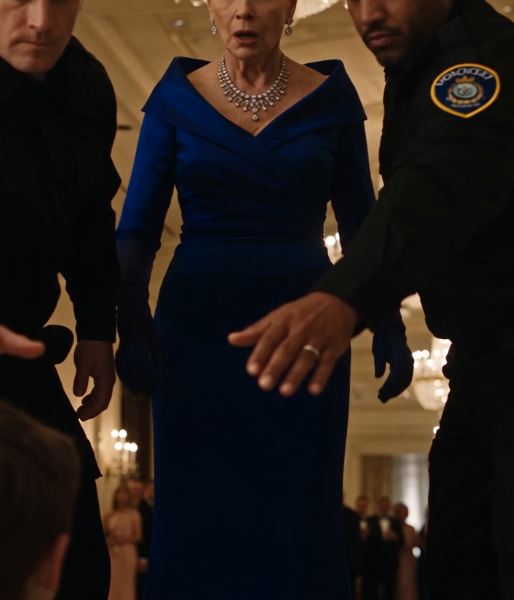
She stayed exactly where she was, kneeling on the marble in her great dark gown, with her face turned up to him, and for a long second Toby thought that she had not heard. Her eyes were fixed on his. They were a pale hard blue, the colour of ice on a puddle, ringed with fine dark lashes, and they were not cold at all. They were wet. There was something moving at the back of them, deep down, like a fish in a pool.
“And what,” said the lady very softly, “was your mother’s name?”
He had promised.
He had promised, in a narrow hospital bed, with a thin hand gripping his wrist. You show them. You show them, and you say my name. He had practised it, over and over, all the nineteen months. In bus shelters. In the dark. In his head, under the blankets of cardboard. He had thought of a hundred ways to say it: brave, and loud, and proud, and polite. He had imagined the lady’s face.
He had never imagined it would be so hard.
“Isabelle,” said Toby.
It was like watching a building fall down.
There was no sound. There was no movement. The lady knelt there, quite still, with the medallion held out in her trembling hand and her eyes on his face, and he saw it happen. He saw something go out of her. It was a small, quiet, slow collapse, like a great old tree sinking into a river: the proud straight back, the lifted chin, the grim set of the mouth, all of it giving way, softly, helplessly, from the inside. Her lips parted. A long fine shudder went through her from head to foot. And a single tear, a big slow heavy tear, brimmed over her lashes and rolled down the carved white cheek and fell on the dark blue silk with no sound at all.
“Isabelle,” said the lady.
She said it as one says a word in a foreign language that one has not spoken for a long time. As if she were tasting it. As if she were afraid that, if she spoke it too loudly, it would break.
“Yes,” said Toby. “Isabelle Wexmoor. Only she changed it. Isabelle Hartley. After Dad.”
“After—”
“After Sam. He made the cot. He died when I was three. A scaffold fell on him.” He said it flatly, as he had said it to a hundred indifferent social workers, in a hundred beige rooms. “Mum said you’d be sad.”
“Did she?”
“She said you’d look sad. She said you’d pretend you weren’t, because you were very good at pretending.” He hesitated. His chin shook. “She said you lived in a big house with lions on the gate.”
The lady made a small, odd sound.
It was somewhere between a laugh and a sob. It came out of her like a hiccup, a short wet gasp, and she put one gloved hand over her mouth and shut her eyes, and for a moment she rocked a little, to and fro, on her knees, as a person rocks who has been struck.
“Oh, she knew me,” she whispered through her fingers. “She always knew me.”
“Are you the lady?” said Toby. He was crying now himself. He could not help it. The tears came hot and fast and ran down his dirty face and mingled with the crumbs. “Are you her? The lady with the lions? Are you my—”
He could not say it. It was too big. It stuck in his throat like a stone.
“I should like to be,” said the lady, opening her eyes.
She was smiling.
It was the strangest smile he had ever seen. It was crooked, and trembling, and enormously, helplessly tender, and it transformed her whole face. All the cold had gone out of it. It was suddenly a young face, a girl’s face, wide-eyed and shining and wet. It was exactly the face in the photograph, the one that his mother had kept tucked in the back of a library book, of a pretty fair-haired girl in a white frock, laughing on a lawn.
He knew it at once.
“You’ve got her mouth,” said Toby, wonderingly.
The lady laughed. It was a cracked, strangled, astonished little laugh, and it broke in the middle, and she pressed the heel of her hand against her lips, while the tears ran down in two bright streams and dripped off her chin onto the great diamond collar at her throat.
“I think,” she said unsteadily, “that she got it from me.”
Someone was shouting.
It was a thin, high, furious voice, and it came from the edge of the circle, and it did not belong to the moment at all. It was the voice of a man who had lost his footing and was clutching at the air.
“This is absurd! Augusta, for God’s sake! This is a performance! The boy is a plant! He’s a, a paid— He’s been coached! Can’t you see? Somebody has primed him! Some wretched journalist, some opportunist, they’ve found out about Isabelle and they’ve—”
“Rupert,” said the lady.
She did not turn her head.
“A trick! A shameful trick! On an evening of all evenings! And in front of the Prime Minister’s wife! You are being manipulated, my dear, can’t you see it? A child in rags, a medallion that could have been stolen from anywhere—”
“It is not,” said the lady, “a copy.”
She said it very quietly. But the whole ballroom heard.
“It is not a copy. It is the second of the Wexmoor medallions, cast in 1789 from the same mould as the one that I am wearing, and given to my daughter on the morning of her eighteenth birthday. She wore it for six years. She wore it on the day she left this house, and she never took it off. And I will tell you what else.” She paused. She raised her head, and turned, slowly, still kneeling, and fixed on the plump pink man in the white tie a gaze like a drawn blade. “I saw your face, Rupert. When I held it up. I have known you for thirty years, and I have never seen you look like that. You looked as though you had seen a ghost.”
“My dear, I was only—”
“You looked as though you had seen the one thing you could not afford to see.”
The room was utterly silent.
Rupert Wexmoor opened his mouth. He closed it. A thin sheen of sweat had broken out across his forehead, and he put up a plump hand and dabbed at it with a silk handkerchief, and Toby, watching him from the circle of the lady’s arm, felt a slow cold dawning in his stomach.
He knows, he thought. He knows who I am.
He did not know how he knew. It was just there, like the knowledge of rain. The man was afraid of him.
He slid his hand into his sock.
There was something folded flat against his ankle, beneath the grey wool, where he had kept it for nineteen months: a small, creased, grubby square of lined paper, as soft as cloth from handling. He had never shown it to anyone. He had not read it, even, more than once or twice, because the words hurt too much. But his mother had put it into his hand on the last day, and said, this is for her, and he had kept it like a prayer.
He drew it out. He held it up.
“I’ve got a letter,” said Toby.









