The Medallion on the Marble
Semper RedeoShe knew the handwriting at once.
It was a round, dashing, impatient hand, with long loops and a habit of crossing the t with a stroke that ran off the end of the word like a skid mark. She had seen it on a thousand school reports and birthday cards and notes left under her door. She had seen it, for twelve years, in her dreams.
She did not take the paper from the boy’s fingers. She did not dare. She knelt in front of him on the marble, in her ruined gown, with four hundred people watching, and read it where it lay in his hand. It was a short note. The pencil had been pressed so hard in places that it had dented the page. It had been written, she saw, by someone who was in great pain and had very little time.
Mother,
I’m so sorry for the way I left. I know that you are proud and I know that you were frightened. I’ve written to you every Christmas for ten years and you have never answered, and I’ve decided that this means you are as stubborn as I am, and I love you for it.
I am very ill. I won’t be here much longer. I’m not afraid, but I am afraid for Toby.
His name is Tobias Henry Hartley. He is seven. He is brave, and kind, and he has Daddy’s eyes and Sam’s hands and your chin, God help him. I have nothing to leave him except his name and the medallion. I am sending him to you with it. If you will have him, he is yours. If you won’t, I’ll understand. But I think you will.
I always said I’d return.
Your Isabelle.
She read it once.
She read it twice. She read it a third time, in the cold flat shining silence of the ballroom, with the sound of her own breathing in her ears and the blood pounding in her temples, and when she had finished, she lifted her eyes and looked at the child.
Ten years.
I’ve written to you every Christmas for ten years.
There was no sound. There was no light, but the glittering unbearable brilliance of the chandeliers. She had not known that a person could be struck so hard, and so quietly, and go on standing. She was kneeling. She was perfectly still. She could not feel her hands. And somewhere in the depths of her, under the shock and the grief and the dizzying, enormous, impossible joy, a cold black thing was beginning to uncoil, slow and heavy, like a snake in a well.
Ten letters.
Ten Christmases.
I have never received one.
“Rupert,” said Augusta Wexmoor.
She said it without turning her head. It was the voice of a woman reading out a sentence in a court of law.
“Who has collected my post for the past eleven years?”
There was no answer.
“Gerald.”
“My lady.” The big man had come up at her shoulder, and he stood there, square and grave and attentive, with his hands folded in front of him and a curious light in his eyes. “I’m here.”
“I should be grateful if you would escort Mr. Wexmoor to the cloakroom.”
“With pleasure, my lady.”
“Augusta,” said Rupert.
It was a croak. He had gone the colour of tallow. His round pink face glistened with sweat in the chandelier light, and his small pale eyes darted wildly from one face to the next, looking for an ally, an exit, a single sympathetic glance. He found none. They stared back at him in absolute silence: the Pembertons, the bankers, the duchess, the waiters in the archway with their silver trays.
“My dear,” he said. His voice shook. “My dear, it’s a dreadful misunderstanding. I was only trying to— to spare you. Think of your health. Think of the shock. A woman who had abandoned her family, a woman who had broken your husband’s heart—”
“Do not,” said Augusta, “say another word.”
He stopped.
“You will wait in the cloakroom. Mr. Voss will sit with you. At midnight, Mr. Whitlock will be here with the post books, the estate ledgers and the register of correspondence for the last eleven years, and you and I will go through them together, line by line, page by page, until I have found every letter that my daughter wrote to me and every letter that I wrote to her. And then we shall discuss,” she said, “what is to be done.”
The big man took Rupert Wexmoor by the elbow.
He did it gently. He did not need to do it any other way. The plump figure in the white tie went with him like a sleepwalker, with his mouth open and his handkerchief crushed in his fist, across the marble, between the staring ranks of guests, who parted before him in total silence as before a funeral. Nobody spoke. Nobody laughed. A woman in a lilac gown put out a hand as he passed and then snatched it back as though from a flame.
The cloakroom door closed behind him with a soft, heavy sound.
Augusta did not watch him go.
She was looking at the boy.
He was very small.
She had known that from the first. She had known it from the moment that she had seen the thin neck, the shoulder blades like wings, the bare dirty ankles. But it was only now, kneeling in front of him in the huge glittering room, with his mother’s letter in his hand and his mother’s mouth trembling in his face, that she understood how small he was. He was a handful. He was an armful. He could have been picked up in a single embrace and tucked inside her coat. He had survived, she thought, two winters of the streets of London on his own, without a coat, without a parent, without so much as a name that anyone would call him by, and he stood there before her with his chin up and his fists clenched, small and pale and fierce and absolutely, heartbreakingly upright.
“Tobias,” she said.
“Toby,” said Toby.
“Toby.” She tried it. It was a good name. It was a name that suited him. “Toby, I have something to say to you, and I want you to listen very carefully, because I’m not sure that I shall be able to say it twice.”
He nodded.
“I was wrong.”
It came out of her in a whisper.
“I was wrong, and I was proud, and I was a fool. I sent your mother away because I could not bear what I had lost, and I told myself that it was her fault, because that was easier. I never wrote. I never telephoned. I let eleven years go by, and I told myself every single morning that she would come home when she was ready. And she did.” Her voice cracked. “She came home, my darling. She sent you. It’s just that it took a little longer than either of us expected.”
He was crying again.
He did not make a sound. The tears simply ran down his face, one after another, tracing clean white tracks through the dirt, and dripped from the point of his chin onto the front of his tunic. He stood quite straight, with the letter held against his chest, and his lower lip caught between his teeth, and a look in his wide grey-green eyes of such unutterable, incredulous, aching hope that she thought her heart would stop.
“Does that mean,” said Toby, in a very small voice, “that I can stay?”
“Oh, my darling.”
She opened her arms.
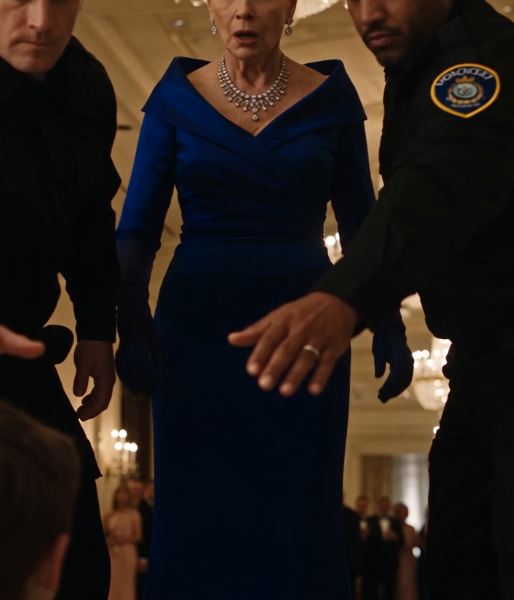
She did not decide to. It was simply the only thing left. She spread them wide, her long dark-gloved arms, with the great blue silk fanning out around her on the floor like the petals of an enormous flower, and she said, in a voice that she did not recognise as her own, the voice of a girl of eighteen in a sunny morning room:
“Come here.”
He came.
He came with a small, choked, wordless cry, and flung himself at her like a thrown stone, and she caught him. He weighed nothing. He smelled of smoke and bread and rain. His thin arms went round her neck and clung there with a fierce, desperate, hopeless strength, and his face was pressed into the glittering diamonds at her throat, and he was sobbing now, in great shuddering gulps, the long-held sobs of a child who has been brave for far too long.
“I’ve got you,” said Augusta. She was rocking him. She had her cheek against his dirty hair. “I’ve got you. I’ve got you. I’m here.”
“I did it,” he sobbed. “I did it, I did it. I showed them. I said her name.”
“You did. You did, my darling. You did it beautifully.”
“She said you’d look sad.”
“I do. I do, I’m afraid. I look dreadfully sad. But I think—” She drew back a little, and put her gloved hands on either side of his small wet face, and looked into his eyes, and laughed, through her tears. “I think that I’m going to stop.”
And she kissed him on the forehead.
It was the first kiss she had given anyone in twelve years. It landed on a bruised, dirty, salt-streaked brow, under a tangle of dark hair, and she felt the whole small body relax against her at last, and go soft and heavy, like a wet cat after a storm. She gathered him up. She got slowly to her feet, with the great damp skirts of her gown dragging round her ankles and the child in her arms, with his legs hanging down and his head tucked into her shoulder, and she stood there, in the very middle of the polished golden floor, under the biggest of the chandeliers.
The room was silent.
It was a different silence now. It was not the thin, cold, cruel hush of earlier. It was soft, and full, and warm, and tremulous. Four hundred of the richest and most fashionable people in England stood in their silks and their diamonds, quite still, with their glasses in their hands, and nobody said a word. Sylvia Pemberton had her hand pressed to her mouth. Her husband was looking at the floor. A woman in lilac was crying openly. And at the back of the room, in the great gilded archway, one of the young waiters had begun, very gently, to clap.
It was only one pair of hands, at first.
Then another. Then the whole room.
They did not cheer. It was not a cheering sort of sound. It rose slowly, softly, from table to table, like rain beginning on a roof, until the whole vast golden room was filled with it, four hundred pairs of hands, clapping for a woman and a child in the middle of a ballroom floor. The orchestra, quite spontaneously, without any signal, lifted their bows and began to play, very quietly, something slow and sweet and old.
Augusta did not hear it.
She stood with her chin on the boy’s hair, and her eyes closed, and the light of the chandeliers falling over the two of them like a benediction, and she thought, in the quiet that came after: Henry. I found her. I found her boy.
In her arms, very faintly, a small voice said:
“Gran?”
She opened her eyes.
“Yes, darling?”
“Are there any more rolls?”
EPILOGUE — The Door Stays Open
It snowed on Christmas Eve, the first snow of the year, great soft slow flakes drifting out of a low white sky onto the park and the lawns and the long grey roof of Wexmoor Hall.
Toby stood at the window of his bedroom with his forehead against the cold glass and watched them fall.
It was a very large bedroom. It had a four-poster bed with green velvet curtains, and a fireplace the size of a cupboard, and a rocking horse in the corner with a real horsehair mane. There was a bookcase full of books that had belonged to his mother. There was a rug in front of the fire that was softer than any bed he had ever slept in. There was a tray on the table with a pot of cocoa and a plate of buttered toast cut into triangles with the crusts left on, because, as the housekeeper had said, with a wink, they tell me that’s how you like it.
He had been there for six weeks.
He still woke in the night, sometimes, in the dark, with his heart pounding, and lay for a moment with his eyes wide open, quite sure that he was in a bus shelter on Camden Road. Then he would feel the warmth of the blankets. He would hear the quiet tick of the clock. And he would turn his head and see, across the room, through the half-open door, a thin wedge of yellow light from the landing.
She always left it open.
She never said why. She simply did it, every night, at ten o’clock, when she came in to say goodnight: a tall, straight, grey-haired woman in a plain dark dressing gown, with her hair in a plait over one shoulder, who sat on the edge of his bed for exactly ten minutes and told him a story about someone who had lived in this room before him. She left the door ajar when she went. She left the landing light burning.
He had asked her about it once.
“Is that so the monsters can’t get in?” he had said.
“No, darling.” She had stroked his hair back from his forehead. “It’s so that nobody ever has to knock.”
Outside, the snow came down. In the garden below, beside the old chapel, with its new roof of grey slate gleaming in the dusk, a small stone lay half-buried under the drifts. It was a plain flat grey stone, with a name on it, and under the name a line of Latin. They had put it there in November, the two of them, with the vicar in his scarf and the whole household standing at a respectful distance in the cold.
Isabelle Wexmoor Hartley, 1991–2024. Beloved daughter, wife, mother.
Semper redeo.
And next to it, on a very much smaller stone, which Toby had insisted on choosing himself, a name that had been carved by a stonemason in the village, in letters of a fine clean sans-serif that he said looked like something a carpenter might have chosen:
Samuel Hartley. He mended the roof.
He had seen it on the first day. They had walked down to the chapel, hand in hand, in the thin grey light, and his grandmother had pushed open the great oak door and led him in under the high vaulted ceiling. She had pointed upwards, without a word. And there, on the oldest rafter, in the dusty gloom, cut with a pocket knife into the ancient black wood, in small careful capital letters that had weathered in thirteen years to the colour of honey, he had read:
S.H. + I.W. 2011.
“He did it on the last day,” she had said. Her voice had been quite steady. “Mr. Whitlock found it. He was repairing the leadwork. Your mother must have held the ladder.”
He had stood there for a very long time.
Now, in the quiet of Christmas Eve, he put his hand into the pocket of his pyjamas and drew out a small gold disc on a new leather cord. The old one had been mended by a jeweller in Bond Street, who had done it for nothing. The medallion lay warm and heavy in his palm. Two lions. A crown. A shield. And round the rim, in tiny worn letters that he could now read, three words.
I always return.
He did not know, quite, what it meant. He thought it might mean that people came back. He thought it might mean that doors, if you left them open, would be walked through. He thought it might mean that a boy who had slept in the cold, and been hungry, and been looked at as a thing, could one day be a person again, with a bed, and a name, and a grandmother who left the light on.
There was a soft knock at the door.
It was open already, but she knocked anyway, with one knuckle, on the frame, as she always did, and put her head round it.
“Are you awake, darling?”
“Yes, Gran.”
“I thought you might be.” She came in. She was carrying something in her arms, wrapped in brown paper and tied with string. “I wasn’t going to give you this until the morning. But I find that I have never been very good at waiting. Will you forgive an old woman?”
He took it.
It was heavy. It was square and flat, and the paper was soft with age, and as he turned it over in his hands, he saw that the string had been tied in a particular way, in a tight neat double knot, with the ends tucked under, and he knew, with a small cold flicker of recognition, that he had seen it before.
“Did Mum tie this?”
“I found it in the attic. She wrapped it in the winter that she left. She meant to take it with her, I think, and forgot.”
He undid the knot.
It was a photograph, in a plain silver frame. A man and a woman and a very small baby on a lawn, in front of a long grey house, in the summer sun. The man was tall and brown and broad-shouldered, with sawdust in his hair, and he was laughing. The woman was fair and slim and laughing too. And between them, held up in both their hands like a prize, with a gold medallion on a cord round its tiny neck, and a fat fist raised in triumph, was a baby, with large grey-green eyes.
He stared at it.
“That’s you,” said his grandmother. “That’s you, on the day you were born. Your father took the picture himself, with a timer. She had written on the back.”
He turned it over.
Tobias Henry Hartley. Born at home. Perfect. Semper redeo.
“She sent it to me,” said Augusta. “On your first birthday. It came in a plain brown envelope. It never reached me.” She paused. “Mr. Whitlock found it in a drawer in Rupert’s study in the spring, with the rest. Twenty-two letters, in all. One for every Christmas and every birthday. He had kept them all, tied up in a bundle with a bit of red ribbon.” She drew a long breath. “I don’t think I shall ever be able to forgive him. But I find that I am rather too busy to hate him.”
Toby did not answer. He was looking at the picture. At the baby, with its fat fists. At the man, who had made a cot. At the woman, who had sung about a white horse.
He put the frame carefully on the bedside table, next to the plate of toast, where he could see it from the pillow. He climbed into bed. And his grandmother drew up the great green velvet coverlet, and tucked it round his chin, and sat on the edge of the mattress, and began, as she did every night, to tell him a story.
It was about a girl in a white frock, who ran down a great stone staircase on a bright spring morning, and laughed.
He was asleep before the end.
She sat there for a long time afterwards, in the soft light from the landing, with the snow whispering against the glass and the old house settling and creaking round them like a ship at anchor. She did not move. She watched him breathe. Then she got quietly to her feet, and crossed the room, and stopped for a moment in the doorway, with her hand on the frame.
She looked at the door.
It was a heavy old door, of dark oak, with a brass latch. It had been shut for eleven years. It had been shut by her own hand, in a cold grey library, on a girl in a white frock. She had stood behind it every night of her life, with her ear to the wood, listening for a footstep that did not come.
She opened it wide.
She let it swing back until it touched the wall. She left it there, wide open, with the landing light falling gold across the floor, and she went out into the long warm quiet of the corridor, past the portraits of her ancestors and the tall frosted windows and the wintry gleam of the park beyond, and she did not look back.
She did not need to.
The door would stay open.
THE END 🕊️









